



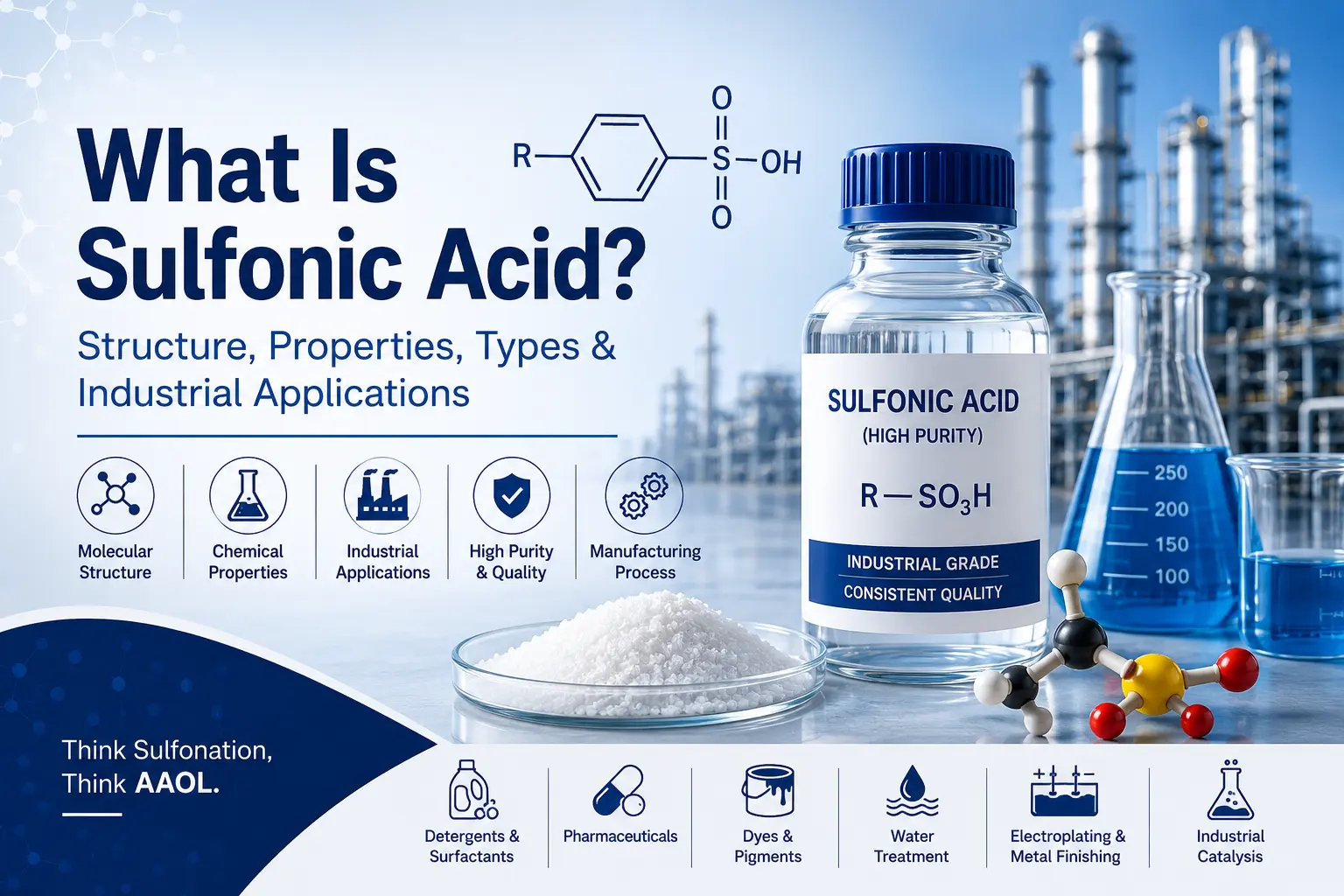
Sulfonic acids are a class of strong organic acids widely used across multiple industrial sectors, including detergents, pharmaceuticals, dyes, catalysts, electrochemistry, and specialty chemical manufacturing. Due to their high acidity, chemical stability, and excellent solubility, sulfonic acids are essential intermediates and performance-enhancing agents in modern chemical formulations.
This article explains what sulfonic acid is, how it works chemically, its key types, and why it is critical in industrial applications, with insights aligned to real-world manufacturing and supply requirementss.
What Is Sulfonic Acid?
Sulfonic acids are organic compounds characterized by the sulfonic acid functional group (–SO₃H), where a sulfonyl group is bonded to an organic moiety such as an alkyl or aryl group. They are structurally related to sulfuric acid but differ in that one hydroxyl group is replaced by an organic substituent.
General Formula:
R–SO₃H, where R represents an organic group.
Sulfonic acids are known for their exceptional proton-donating ability, making them among the strongest organic acids used in industry.
Chemical Structure & Acidity
1. Molecular Structure
The sulfonic acid group consists of:
- One sulfur atom
- Three oxygen atoms
- One hydroxyl (–OH) group
- One organic substituent (R)
This configuration allows for strong electron delocalisation.
2. Acidity Explained
Sulfonic acids are highly acidic because their conjugate base, the sulfonate ion (RSO₃⁻), is resonance-stabilized. The negative charge is distributed across three oxygen atoms, significantly increasing stability and acidity.
✔ This resonance stabilization explains why sulfonic acids:
- Fully dissociate in aqueous solutions
- Function efficiently even at low concentrations
- Remain stable under industrial processing conditions
Key Chemical Properties of Sulfonic Acids
| Property | Description |
|---|---|
| Acid Strength | Strong organic acids |
| Water Solubility | Very high |
| Thermal Stability | Excellent |
| Oxidizing Nature | Non-oxidizing (for most types) |
| Reactivity | Highly effective catalysts |
Major Types of Sulfonic Acids Used in Industry
1. Benzene Sulfonic Acid
Benzene sulfonic acid consists of a benzene ring bonded to a sulfonic acid group. It is widely used as an intermediate in organic synthesis, including phenol production and specialty chemical manufacturing.
2. Linear Alkyl Benzene Sulfonic Acid (LABSA)
LABSA is one of the most important surfactants in the detergent industry. It offers:
- High detergency power
- Excellent emulsification
- Cost-effective large-scale use
3. Methanesulfonic Acid (MSA)
Methanesulfonic acid is valued for its:
- Non-volatile nature
- High purity potential
- Low corrosiveness compared to mineral acids
It is commonly used as a strong acid catalyst and in electrochemical applications.
Industrial Applications of Sulfonic Acids
Detergents & Cleaning Formulations
Sulfonic acids such as LABSA and dodecyl benzene sulfonic acid are core ingredients in:
- Laundry detergents
- Dishwashing liquids
- Industrial cleaning agents
Pharmaceutical & Dye Manufacturing
Sulfonic acid derivatives like sulphanilic acid are essential in:
- Azo dye synthesis
- Pharmaceutical intermediates
- Pigment manufacturing
Catalysts in Chemical Synthesis
Methanesulfonic acid is widely used as a non-oxidizing acid catalyst in:
- Esterification
- Alkylation
- Polymer processing
Electroplating & Battery Applications
High-purity sulfonic acids are utilized in:
- Electroplating baths
- Battery electrolyte formulations
- Surface finishing processes
Their stability improves reaction efficiency and process consistency.
Safety, Handling & Environmental Considerations
Sulfonic acids are corrosive substances and must be handled with appropriate safety measures:
- Use of protective equipment
- Controlled storage conditions
- Compliance with industrial safety standards
Certain sulfonic acids, particularly methanesulfonic acid, are considered environmentally favorable alternatives to traditional mineral acids due to their low volatility and biodegradability in controlled applications.
Quality Standards & Manufacturing Reliability
Industrial buyers evaluate sulfonic acids based on:
- Purity consistency
- Batch-to-batch reliability
- Regulatory compliance
- Application-specific performance
At AAOL India, sulfonic acids are manufactured and supplied to meet stringent quality requirements, ensuring consistent performance across diverse industrial applications.
Why AAOL India is the Best Choice for Sulfonic Acids?
At AAOL India, it is our passion to be the leading innovator of sulfonic acid and its derivatives. We are a major supplier of benzene sulphonic acid, methane sulphonic acid, linear alkyl benzene sulphonic acid, and many more industrial chemicals.
- Unmatched Purity: We pride ourselves on producing sulfonic acids of the highest purity to ensure that they work as designed in all their applications.
- Customized Solutions: Whether you require specialized products or large-scale quantities for your industry, we can offer tailored solutions to meet your specific needs.
- Sustainable Manufacturing: Our production processes are designed to use eco-friendly solutions in order to reduce the adverse impact on the environment without compromising the quality of the products.
Final Note
Sulfonic acids are indispensable in modern industrial chemistry due to their strength, stability, and versatility. Selecting a reliable supplier ensures consistent quality, performance, and regulatory compliance.
Partner with AAOL India in producing high-quality sulfonic acids and derivatives that have maintained consistency, stability, and better outcomes in industrial practices.
Call us now and talk about your particular demands and discover customised chemical solutions designed to be of the best quality.
FAQs
Is sulfonic acid stronger than sulfuric acid?
Sulfonic acids are strong organic acids but are not universally stronger than sulfuric acid.
Why are sulfonic acids widely used in detergents?
Their high solubility, strong surfactant properties, and stability make them ideal for cleaning formulations.
Are sulfonic acids safe for industrial use?
Yes, when handled according to safety guidelines and regulatory standards.


Comments are closed