



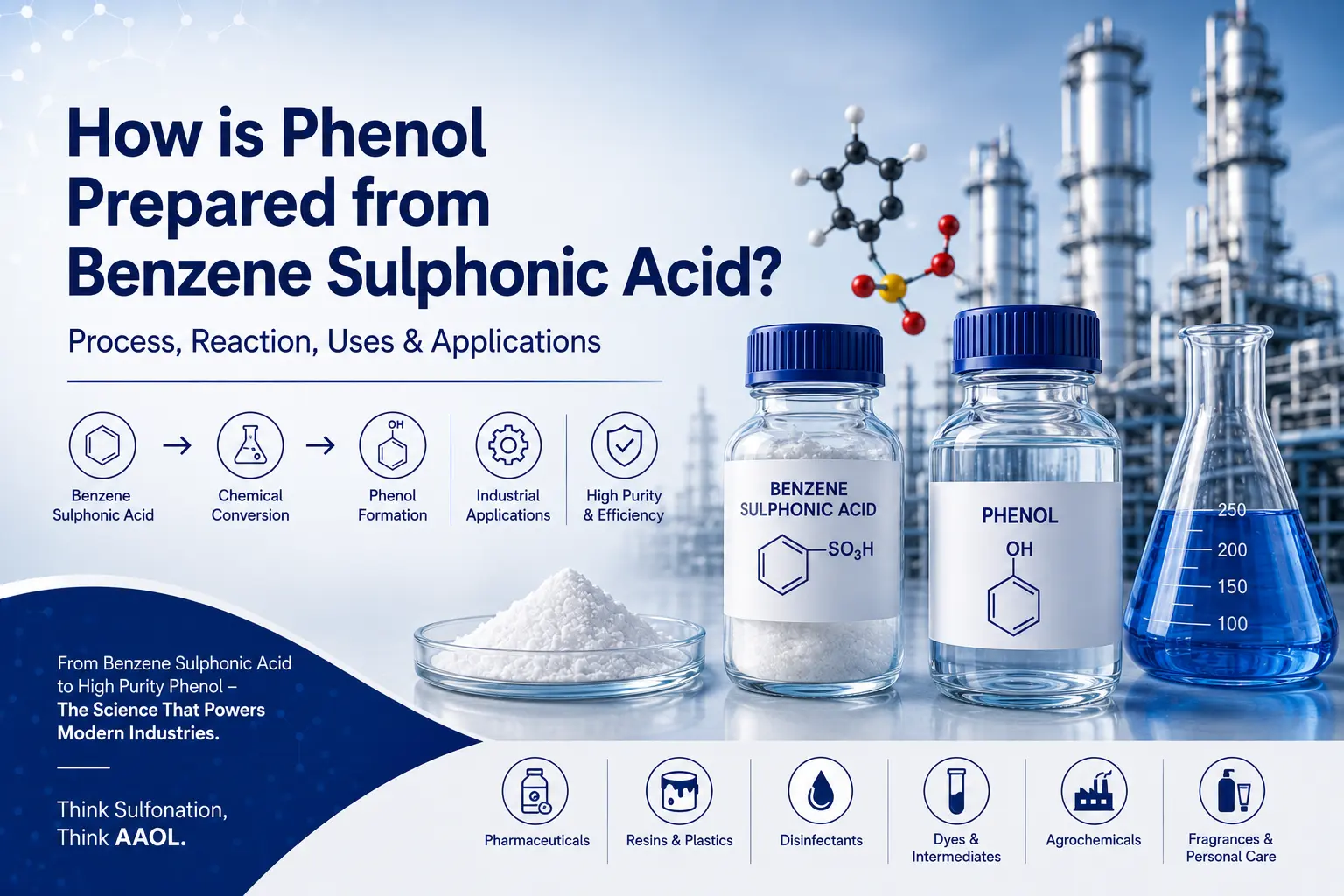
Phenol can be prepared from benzene sulphonic acid by converting the sulphonic acid into its sodium salt, heating the sodium benzene sulphonate with molten sodium hydroxide, and then acidifying the sodium phenoxide formed in the reaction.
The complete conversion can be represented as:
Benzene sulphonic acid → Sodium benzene sulphonate → Sodium phenoxide → Phenol
The key reaction involves alkaline fusion with sodium hydroxide at about 573 K (300°C) followed by acidification. Educational chemistry references also describe the benzene sulphonic acid route using NaOH followed by dilute HCl under high-temperature conditions.
What Is Benzene Sulphonic Acid?
Benzene sulphonic acid is an aromatic sulphonic acid with the molecular formula:
C6H6O3S
It consists of a benzene ring bearing a sulphonic acid group (–SO3H).
In the phenol-preparation reaction, the sulphonic acid is first converted to its sodium salt before alkaline fusion.
AAOL India works extensively with sulphonation chemistry and sulphonic-acid derivatives, making this reaction relevant to the broader chemistry of aromatic sulphonation.
For readers interested in the underlying chemistry, this section should internally link to AAOL India’s dedicated content on the sulphonation process and sulphonic acids.
Preparation of Phenol from Benzene Sulphonic Acid: Reaction
The preparation takes place in three logical stages.
Step 1: Formation of Sodium Benzene Sulphonate
Benzene sulphonic acid is first neutralized with sodium hydroxide to form sodium benzene sulphonate.
C6H5SO3H + NaOH → C6H5SO3Na + H2O
Here:
C6H5SO3H= benzene sulphonic acidC6H5SO3Na= sodium benzene sulphonate
This sodium salt is the intermediate used in the alkaline-fusion step.
Step 2: Alkaline Fusion with Sodium Hydroxide
Sodium benzene sulphonate is heated with molten sodium hydroxide at approximately 573 K or 300°C.
During this reaction, the sulphonate group is replaced and sodium phenoxide is formed.
C6H5SO3Na + 2Na2OH (573K)→ C6H5ONa + Na2SO3 + H2O
This is the most important step in the conversion of benzene sulphonic acid to phenol.
Other chemistry resources similarly describe molten NaOH as the reagent required for the conversion and identify sodium phenoxide as the intermediate product.
Step 3: Acidification of Sodium Phenoxide
The sodium phenoxide formed in the previous step is then acidified, commonly using dilute hydrochloric acid.
C6H5ONa + HCl → C6H5OH + NaCl
The final product is phenol, also historically known as carbolic acid.
Therefore:
Phenol is prepared from benzene sulphonic acid by alkaline fusion of sodium benzene sulphonate with molten NaOH followed by acidification of sodium phenoxide.
Complete Conversion of Benzene Sulphonic Acid to Phenol
The full sequence can be written as:
C6H5SO3H → C6H5SO3Na → C6H5O3Na → C6H5OH
Or in words:
Benzene sulphonic acid
↓ NaOH
Sodium benzene sulphonate
↓ molten NaOH, about 573 K
Sodium phenoxide
↓ dilute acid
Phenol
This is the clearest reaction pathway to remember when studying the preparation of phenol from benzene sulphonic acid.
Reaction Conditions at a Glance
| Stage | Starting Material | Reagent / Condition | Product |
|---|---|---|---|
| 1 | Benzene sulphonic acid | NaOH | Sodium benzene sulphonate |
| 2 | Sodium benzene sulphonate | Molten NaOH, about 573 K | Sodium phenoxide |
| 3 | Sodium phenoxide | Dilute HCl / acidification | Phenol |
The high-temperature alkaline-fusion step is essential to the conversion.
Why Does Benzene Sulphonic Acid Form Phenol with Molten NaOH?
The sulphonic acid group on the aromatic ring can ultimately be replaced by a hydroxyl group under strongly alkaline, high-temperature conditions.
When sodium benzene sulphonate is heated with molten sodium hydroxide, the reaction produces sodium phenoxide.
Sodium phenoxide is then protonated during acidification to form phenol.
The transformation is therefore a useful example of how one functional group attached to an aromatic ring can be converted into another through appropriate reaction conditions.
This is why the route is frequently taught in organic chemistry and in the Alcohols, Phenols and Ethers section of senior-secondary chemistry curricula.
Exam-Ready Answer: How Is Phenol Prepared from Benzene Sulphonic Acid?
For a short examination answer:
Benzene sulphonic acid is converted into sodium benzene sulphonate, which is fused with molten NaOH at about 573 K to form sodium phenoxide. On acidification with dilute HCl, sodium phenoxide gives phenol.
Reaction:
C6H5SO3Na + 2NaOH (573 K)→ C6H5ONa + Na2SO3 + H2O
followed by:
C6H5ONa + HCl → C6H5OH + NaCl
That is the answer I would place high on the page because the competing SERP is strongly exam-driven. Current ranking pages also emphasize the reagents, 573 K condition and acidification step.
How to Prepare Phenol from Benzene
Some users search more broadly for how to convert benzene into phenol.
If the starting material is benzene rather than benzene sulphonic acid, benzene must first be converted into benzene sulphonic acid through sulphonation.
The overall pathway becomes:
Benzene → Benzene sulphonic acid → Sodium benzene sulphonate → Sodium phenoxide → Phenol
This distinction is important because the standard benzene sulphonic acid route does not convert benzene directly into phenol in one step.
Is the Benzene Sulphonic Acid Route Used for Industrial Phenol Production?
The conversion of benzene sulphonic acid to phenol is an important historical and educational route in organic chemistry.
However, it should not be confused with the dominant modern large-scale method for producing phenol.
Modern industrial phenol production is commonly associated with the cumene process, where cumene is oxidized to cumene hydroperoxide and subsequently cleaved to produce phenol and acetone. Maharashtra Board chemistry material also identifies the cumene process as the commercial method of phenol preparation.
The benzene sulphonic acid route remains important because it demonstrates:
- • aromatic functional-group conversion
- • alkaline fusion chemistry
- • formation of sodium phenoxide
- • conversion of an aromatic sulphonate into phenol
This distinction should be made clearly so the article is chemically accurate rather than implying that this is the principal modern industrial process.
Benzene Sulphonic Acid Route vs Other Methods of Preparing Phenol
Phenol can be prepared through several different reactions.
| Starting Material | Main Conversion | General Method |
|---|---|---|
| Benzene sulphonic acid | Sodium phenoxide → phenol | Alkaline fusion |
| Chlorobenzene | Sodium phenoxide → phenol | High-temperature NaOH treatment |
| Benzene diazonium chloride | Phenol | Hydrolysis |
| Cumene | Phenol + acetone | Cumene process |
The current article should not explain all of these in depth.
Their purpose here is only to show that the benzene sulphonic acid route is one of several established methods.
Conclusion
The preparation of phenol from benzene sulphonic acid involves converting benzene sulphonic acid to sodium benzene sulphonate, heating it with molten sodium hydroxide at approximately 573 K to form sodium phenoxide, and finally acidifying sodium phenoxide to obtain phenol.
The essential pathway is:
Benzene sulphonic acid → Sodium benzene sulphonate → Sodium phenoxide → Phenol
This reaction is an important example of aromatic functional-group transformation and remains widely taught in organic chemistry, even though modern bulk phenol production commonly uses other industrial processes.
FAQs
How is phenol prepared from benzene sulphonic acid?
Phenol is prepared by converting benzene sulphonic acid into sodium benzene sulphonate, fusing it with molten sodium hydroxide at about 573 K to form sodium phenoxide, and then acidifying the sodium phenoxide to produce phenol.
What reagent is used to convert benzene sulphonic acid to phenol?
The main reagent used in the alkaline-fusion step is sodium hydroxide (NaOH). Acidification, commonly using dilute HCl, is then used to convert sodium phenoxide into phenol.
What intermediate is formed during preparation of phenol from benzene sulphonic acid?
The important intermediate formed immediately before phenol is sodium phenoxide (C6H5ONa).
Sodium benzene sulphonate is also formed earlier in the reaction sequence.
At what temperature is sodium benzene sulphonate heated with NaOH?
The alkaline-fusion reaction is commonly represented at approximately 573 K, or about 300°C. Educational references for this conversion also give 573 K as the required condition.
How is sodium phenoxide converted into phenol?
Sodium phenoxide is acidified using a dilute acid such as hydrochloric acid.
C6H5ONa + HCl → C6H5OH + NaCl
This produces phenol.
What is the mechanism of preparation of phenol from benzene sulphonic acid?
The important transformation occurs during alkaline fusion, when the sulphonate functionality is replaced under strongly basic, high-temperature conditions and sodium phenoxide is produced.
Acidification of sodium phenoxide then gives phenol.
For this page, I would describe the reaction principle rather than attempt an overcomplicated school-level arrow-pushing mechanism unless AAOL wants to create a dedicated advanced chemistry section.
Can phenol be prepared directly from benzene?
Benzene is not converted to phenol in the standard benzene sulphonic acid route in one step.
Benzene is first sulphonated to form benzene sulphonic acid, after which the sulphonic acid is converted through sodium benzene sulphonate and sodium phenoxide to phenol.


Comments are closed