



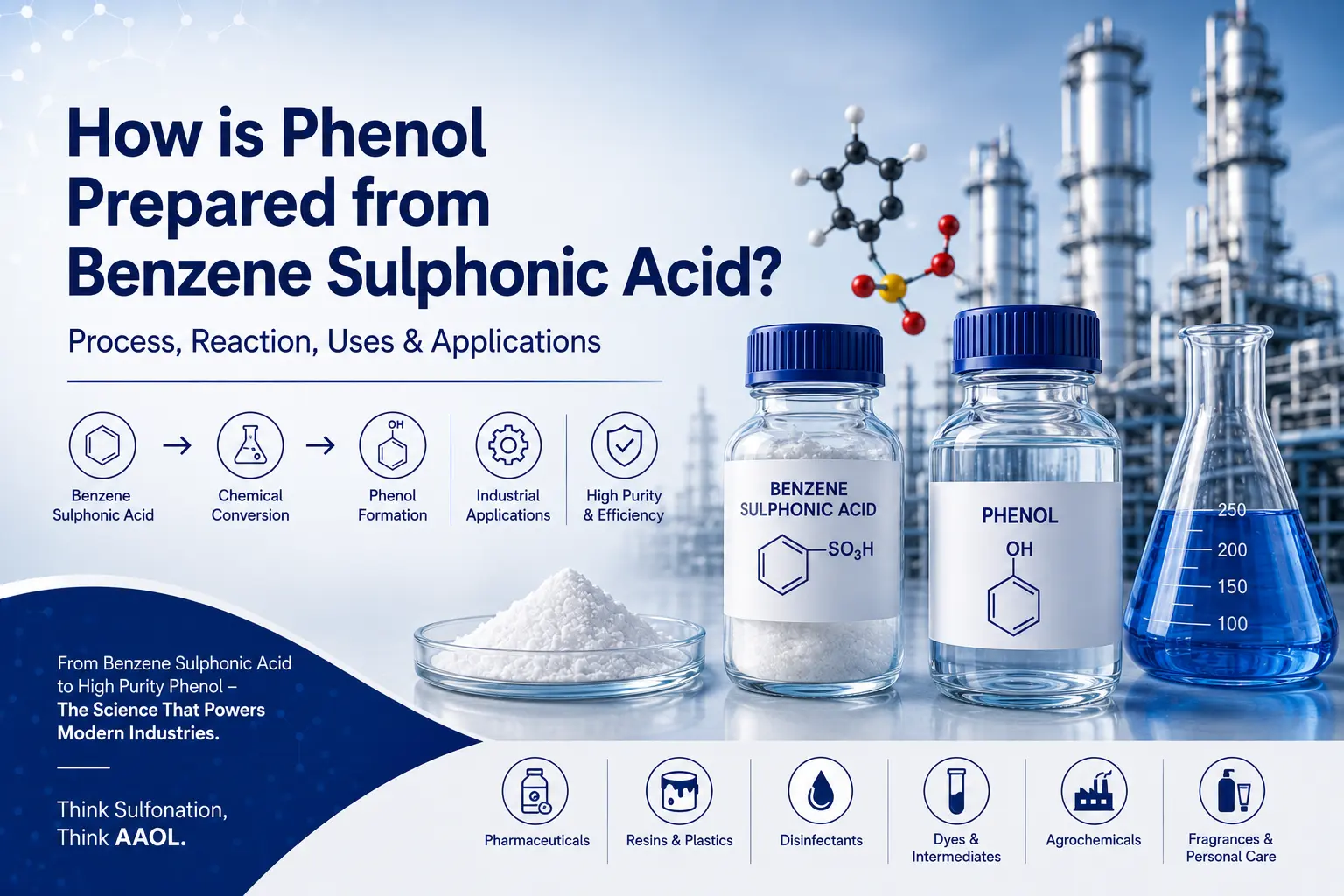
Phenol is a key aromatic compound widely used in the production of plastics, pharmaceuticals, dyes, and resins. Using a two-step process, it can be effectively synthesized from benzene sulphonic acid.
The process plays a significant role in organic chemistry, as it provides a viable pathway for the preparation of phenol using readily accessible raw materials. It starts with the sulfonation of benzene to produce benzene sulphonic acid, which is fused with molten sodium hydroxide at about 300–350 °C to form sodium phenoxide.
Acidification of sodium phenoxide results in the eventual production of phenol. As well as being industrially relevant, this preparation also demonstrates some of the most important concepts underlying aromatic substitution and functional group transformation and can be considered an important reaction in synthetic organic chemistry.
How is Phenol Prepared from Cumene?
One of the most commonly used processes to prepare phenol industrially is the cumene process, by which cumene is converted into phenol, with acetone as a by-product.
The cumene (isopropylbenzene) is initially oxidized to cumene hydroperoxide by air in this process. This unstable intermediate is then subjected to acid-catalyzed cleavage to produce phenol and acetone together. Economically, the process is significant because both products are valuable in chemical industries, phenol in resins, plastics, and pharmaceuticals, and acetone in solvents and in manufacturing polymers.
Read What Is Sulfonic Acid? Structure, Properties, Types & Industrial Applications, if you are still not properly familiar with sulphonic acid and want to take a deeper dive.
How is Phenol Prepared from Aniline?
Phenol can be prepared from aniline through the diazotization reaction followed by hydrolysis. The aniline is first subjected to low temperature (0 -5 o C) treatment with sodium nitrite and hydrochloric acid to produce benzene diazonium chloride. This intermediate is unstable but serves as a key precursor.
When warming the diazonium salt with water, it undergoes hydrolysis to yield phenol along with the liberation of nitrogen gas. This process reveals how diazonium salts are useful in transforming aromatic amines into valuable aromatic alcohols.
What are Ethers? How is Phenol Prepared from Benzene Sulphonic Acid?
Ethers are organic compounds in which an oxygen atom is attached to two alkyl or aryl groups, depicted as R–O–R. They are relatively inert, less reactive, and used as solvents and intermediates in organic synthesis.
Phenol from benzene sulphonic acid is synthesised in two stages. In the first step, benzene is sulfonated using concentrated sulfuric acid to form benzene sulphonic acid. This is then fused with a high-temperature sodium hydroxide mixture to yield sodium phenoxide. Lastly, the sodium phenoxide is acidified using a mineral acid, e.g., HCl, to obtain pure phenol.
Define phenol, and how is phenol prepared from benzene sulphonic acid
Phenol is a significant aromatic compound; its formula is C6H5OH, that is, a hydroxyl group (-OH) is directly attached to a benzene ring. It looks like a crystalline solid with a distinct odor and is commonly utilized in industries in the manufacturing of plastics, resins, dyes, drugs, as well as even disinfectants. Phenol is a unique organic compound because of its structure, making it a unique compound in organic chemistry.
In the process “how is phenol prepared from benzene sulphonic acid”, Benzene sulphonic acid is one of the traditional ways of making phenol. Benzene is initially subjected to the sulfuric acid solution, where it is sulfonated to produce benzene sulfonic acid. This compound is fused with high-temperature solid sodium hydroxide to produce sodium phenoxide. Finally, acidification with dilute hydrochloric acid gives pure phenol.
Preparation of Phenol from Diazonium Salt
Benzene diazonium salts serve as convenient precursors for the preparation of phenol, and are significant intermediates in aromatic chemistry. This process begins with the diazotization of aniline. Aniline is treated with sodium nitrite (NaNO₂) and hydrochloric acid (HCl) at low temperatures (0–5 °C), forming benzene diazonium chloride.
This salt is volatile and very reactive, and therefore useful in various transformations.
When benzene diazonium is warmed with water yields phenol, and the nitrogen gas is released as a by-product. This reaction highlights the versatility of diazonium salts in the transformation of aromatic amines to phenolic compounds and is widely taught as a reliable laboratory method of preparing phenol.
AAOL India Offers Premium-Grade Benzene Sulphonic Acid
The Benzene sulphonic acid offered by AAOL India is of a high grade, and it can feed into many applications, including the dye range, plastic, resins, and even industrial applications. Our solutions are effective and reliable since quality and safety are our priority.
Contact us today for more information.
Wrap Up
Phenol is a very valuable aromatic compound whose use is widespread in plastics, dyes, resins, drugs, and disinfectants. It is produced in a variety of ways, including combining benzene sulphonic acid by fusion and acidification, from the cumene process, by diazotizing and hydrolyzing aniline, and by hydrolyzing diazonium salts.
FAQs
How is phenol prepared from BDC?
To convert benzene diazonium chloride to phenol, perform a hydrolysis reaction by heating the benzene diazonium chloride solution with water or a dilute acid like dilute sulfuric acid.
How do you prepare benzene from sulphonic acid?
Benzene is prepared from benzene sulphonic acid by desulfonation, carried out by heating with dilute sulfuric acid or steam.
What is carbolic acid, and how is it prepared from benzene sulphonic acid?
Carbolic acid (phenol) is prepared from benzene sulphonic acid by fusing its sodium salt with molten sodium hydroxide at about 300–350 °C to form sodium phenoxide, which on acidification yields phenol.
How do you prepare phenol from salicylic acid?
Phenol is prepared from salicylic acid by heating it with soda lime (NaOH + CaO), which removes the –COOH group. This decarboxylation reaction produces phenol along with the release of CO₂.
How is BDC prepared?
Benzenediazonium chloride is prepared by diazotization of aniline using sodium nitrite and hydrochloric acid at 0–5 °C.
How is phenol prepared from aniline?
Phenol is prepared from aniline by first converting it into benzene diazonium chloride using NaNO₂ and HCl at 0–5 °C. On hydrolysis with warm water, the diazonium salt decomposes to give phenol with nitrogen gas evolution.
How is phenol prepared from benzene sulphonic acid?
This benzene sulphonic acid can be treated with molten sodium hydroxide at high temperatures to encourage the formation of sodium phenoxide. Finally, sodium phenoxide on acidification gives phenol.
How is phenol prepared from sodium benzene sulphonate?
Phenol is prepared from sodium benzene sulphonate by fusing it with solid sodium hydroxide at high temperature (around 300–350 °C) to form sodium phenoxide. On acidification of sodium phenoxide with dilute HCl, phenol is obtained
How is phenol prepared from chlorobenzene?
Phenol is prepared from chlorobenzene through Dow’s process. Chlorobenzene is fused with aqueous sodium hydroxide at about 623 K under high pressure (300 atm) to form sodium phenoxide.


Comments are closed