


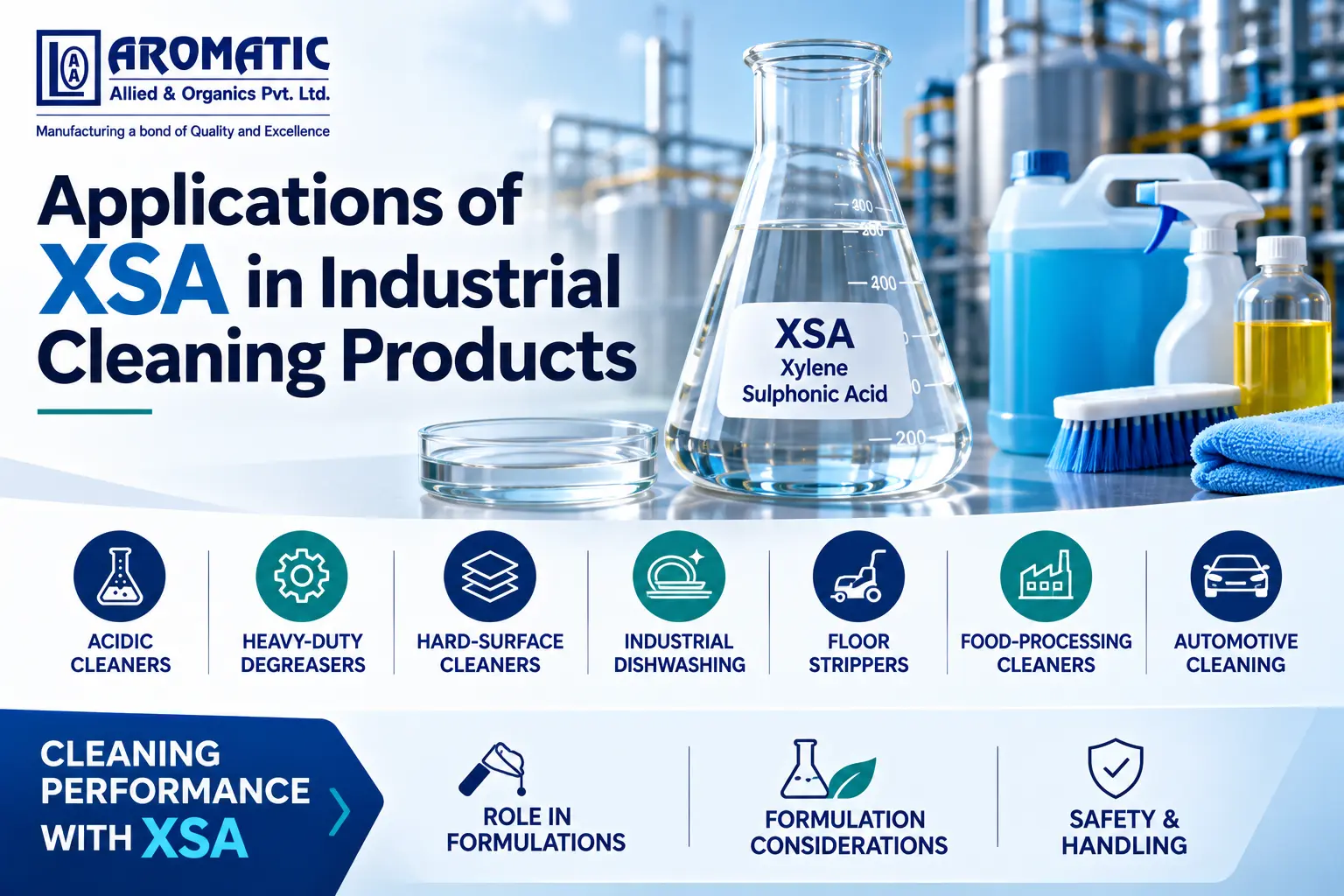
Industrial cleaning formulations need more than strong detergency. They must also remain stable, compatible with water and surfactants, easy to process, and suitable for the surfaces they are designed to clean.
Within this chemistry, Xylene Sulphonic Acid (XSA) can play a useful role in selected industrial cleaning systems, especially where acidity, sulfonate chemistry, or conversion to xylene sulfonate salts is relevant.
However, one distinction is essential from the beginning:
XSA is not the same as Sodium Xylene Sulfonate (SXS).
XSA is the acidic form, while SXS is the sodium salt commonly used as a hydrotrope to improve solubility, clarity, and formulation stability in water-based cleaning products. Because the two chemicals are closely related, they are sometimes discussed together, but their formulation roles are not identical.
This article explains where XSA fits into industrial cleaning chemistry, how it differs from SXS, and what formulators should consider before using it.
What Is Xylene Sulphonic Acid (XSA)?
Xylene Sulphonic Acid is an aromatic sulfonic acid derived from sulfonated xylene chemistry.
AAOL’s commercial XSA product is supplied as a liquid solution. Its current product page specifies:
● yellow to dark brown solution,
● XSA purity of at least 70% by titration,
● free sulfuric acid not more than 2%,
● acid value of at least 220 mg KOH/g,
● and easy solubility in water, alcohol, and ether.
For buyers evaluating the commercial material, see the full Xylene Sulphonic Acid product specifications.
From a chemistry perspective, XSA belongs to the broader family of aromatic sulphonic acids. The sulfonic acid group gives it strong acidity and high compatibility with polar media, which helps explain its relevance in several industrial processes.
AAOL also manufactures related materials across its sulphonic acids portfolio and hydrotrope range.
Why XSA Is Relevant to Industrial Cleaning Chemistry
Industrial cleaning products often combine several classes of ingredients, such as:
● surfactants,
● builders,
● solvents,
● chelating agents,
● acids or alkalis,
● hydrotropes,
● corrosion-control additives,
● and specialty performance ingredients.
XSA can be relevant where the formulation or manufacturing process requires strong organic acidity, sulfonate chemistry, or an intermediate for producing xylene sulfonate salts.
Its role should not automatically be described as “the main cleaning surfactant.”
In many liquid cleaning formulations, the better-known functional ingredient is actually Sodium Xylene Sulfonate, which is widely used as a hydrotrope rather than as the primary detergent surfactant. AAOL’s hydrotropes page similarly describes SXS as a material used to enhance the solubility of other compounds in water-based systems.
Understanding this difference prevents formulators from assigning the wrong function to the wrong chemical.
XSA vs SXS: What Is the Difference?
XSA and SXS are chemically related but function differently.
| Property | XSA | SXS |
|---|---|---|
| Full name | Xylene Sulphonic Acid | Sodium Xylene Sulfonate |
| Chemical form | Acid | Sodium salt |
| Main chemical character | Strong organic acid | Hydrotropic sulfonate salt |
| Typical formulation role | Acidic process chemical, intermediate, specialty ingredient | Hydrotrope, solubilizer, formulation aid |
| Cleaning relevance | Selected acidic systems and precursor chemistry | Liquid detergents, degreasers, hard-surface cleaners, concentrated formulations |
| Water compatibility | High | High |
PubChem identifies sodium xylene sulfonate as the sodium salt of xylene sulfonic acid, confirming the direct parent-compound relationship between the two materials.
Competitor product documentation also positions SXS specifically as a hydrotrope that improves solubility and stability in liquid detergents and industrial cleaners.
That is why hydrotropic performance should generally be attributed to SXS or other xylene sulfonate salts rather than automatically to free XSA.
Main Applications of XSA in Industrial Cleaning Products
The relevance of XSA varies depending on whether the formulation uses the acid directly or converts it into a neutralized sulfonate form.
Acidic Industrial Cleaners
Some industrial cleaning formulations are designed to operate under acidic conditions.
Acidic cleaners may be used where the cleaning target involves:
● mineral residues,
● inorganic deposits,
● scale,
● oxide-related soils,
● or processing residues that respond better to acidic chemistry.
In these systems, XSA may be evaluated as part of the acid system because it provides strong organic acidity and is compatible with aqueous media.
However, its suitability depends on:
● target soil,
● surface material,
● corrosion risk,
● total acid strength,
● concentration,
● temperature,
● and other formulation ingredients.
XSA should therefore not be treated as a universal descaling ingredient.
Heavy-Duty Degreasing Formulations
Heavy-duty industrial cleaners often contain mixtures of surfactants, solvents, builders, and coupling agents.
Xylene sulfonate chemistry can support these systems where formulators need to keep different ingredients compatible within an aqueous formulation.
This is particularly relevant when hydrophobic ingredients, surfactants, or solvents would otherwise create:
● haze,
● precipitation,
● phase separation,
● or unstable viscosity.
In most cases, the hydrotropic function is associated more directly with SXS than with free XSA.
For formulators working specifically with hydrotropes, AAOL’s hydrotropes for detergent and cleaning formulations provide the more relevant product family. AAOL describes SXS as a hydrotrope used to improve solubility in water-based systems.
Hard-Surface Cleaners
Industrial hard-surface cleaners may need to combine:
● detergent surfactants,
● solvents,
● fragrance components,
● alkaline or acidic ingredients,
● and water.
Maintaining a uniform formulation can become difficult when the ingredients have very different solubility characteristics.
Xylene sulfonate salts are commonly used to improve compatibility in these systems.
Their hydrotropic role can help:
● maintain clarity,
● improve solubilization of less water-soluble components,
● reduce phase separation,
● and support more concentrated formulations.
XSA itself may be relevant upstream as part of the chemistry used to produce these xylene sulfonate salts or in specific acidic formulations.
Industrial Dishwashing Formulations
Industrial and institutional dishwashing products often contain concentrated surfactant and builder systems.
In such formulations, the challenge is not only removing food residues and grease. The product must also remain:
● stable,
● pumpable,
● uniform,
● and compatible with other ingredients.
SXS is more commonly associated with the hydrotropic role in these formulations because it can help keep surfactant systems and other components dissolved in water.
Therefore, when discussing xylene sulfonate chemistry in dishwashing products, the technically accurate distinction is:
XSA is the acid form, while neutralized xylene sulfonates such as SXS are typically the more direct hydrotropic formulation ingredients.
Floor Strippers and Maintenance Cleaners
Professional floor-maintenance products can contain strong detergent systems, solvents, and alkalinity or acidity depending on the specific task.
Xylene sulfonate hydrotropes may be used where formulation stability and solubilization of hydrophobic ingredients are important.
This is especially relevant in concentrated products where high active levels can increase the risk of:
● cloudiness,
● crystallization,
● phase separation,
● and viscosity instability.
Again, SXS is normally the more direct hydrotropic ingredient, while XSA remains relevant as the corresponding acid and process intermediate.
Food-Processing and Recirculation Cleaners
Industrial food and beverage facilities often use circulation-based cleaning systems for equipment, tanks, pipelines, and processing surfaces.
Cleaning products in these environments may contain acidic, alkaline, or enzymatic systems depending on the soil and equipment.
Xylene sulfonate chemistry may be relevant in selected formulations where solubilization and ingredient compatibility are required.
However, formulation suitability must also consider:
● applicable regulatory requirements,
● residue limits,
● food-contact rules,
● cleaning validation,
● and the grade of every raw material used.
The presence of XSA or SXS chemistry in cleaning formulations should not be interpreted to mean that any particular industrial grade is automatically suitable for food-contact use.
Automotive and Equipment Cleaning
Automotive cleaners, workshop degreasers, and industrial equipment cleaners often need to handle:
● oils,
● grease,
● traffic film,
● particulate soils,
● lubricants,
● and processing residues.
These products may contain concentrated surfactant systems and solvents that can be difficult to keep homogeneous in water.
SXS and related hydrotropes can help improve the compatibility of these formulation components.
Where XSA is used, its role should be defined according to the formulation chemistry rather than assumed to be equivalent to the function of SXS.
What Does XSA Actually Do in a Cleaning Formulation?
The most useful way to understand XSA is by separating its possible roles.
It Can Provide Acidity
XSA is a strong organic sulfonic acid.
In suitably designed acidic cleaning systems, this acidity may contribute to the formulation’s overall acid profile.
The actual cleaning performance still depends on the complete acid system and the nature of the deposit being removed.
It Can Serve as an Intermediate for Xylene Sulfonate Salts
One of the most important relationships in cleaning chemistry is the conversion of xylene sulfonic acid into salts such as SXS.
This is significant because the salt has a different functional role from the acid.
It Is Related to Hydrotropic Chemistry
Xylene sulfonate salts are established hydrotropes.
They improve the ability of water-based systems to accommodate ingredients that have limited water solubility.
Typical benefits can include:
● better formulation clarity,
● improved solubilization,
● reduced precipitation,
● improved compatibility,
● and more stable concentrated formulations.
These benefits should not automatically be assigned to free XSA itself.
It May Support Specialty Formulation Requirements
XSA may also be evaluated where a formulator needs a water-soluble strong organic acid with sulfonate functionality.
Whether it is appropriate depends on:
● pH target,
● substrate,
● material compatibility,
● concentration,
● neutralization strategy,
and final product requirements.
Why SXS Is Often Used Instead of Free XSA in Detergents
For many conventional liquid detergents and industrial cleaners, formulators are not seeking additional acidity.
They are seeking solubilization and formulation stability.
That is where SXS becomes more relevant.
AAOL’s hydrotrope portfolio describes SXS as a hydrotrope that helps improve the solubility of other compounds in water-based solutions.
Competitor SXS documentation similarly emphasizes:
● surfactant solubilization,
● formulation clarity,
● prevention of precipitation,
● compatibility with mixed surfactant systems,
● and stability in concentrated cleaners.
For a broader explanation of detergent chemistry, AAOL’s guide to sulphonic acids used in detergent formulations explains how sulfonated chemistry supports modern cleaning systems.
XSA vs LABSA in Industrial Cleaning
XSA and LABSA may both appear in discussions about detergent and cleaning chemistry, but their roles are different.
| Factor | XSA / Xylene Sulfonate Chemistry | LABSA |
|---|---|---|
| Main role | Acid, intermediate, hydrotrope-related chemistry | Primary anionic surfactant precursor |
| Main cleaning contribution | Formulation support or acidic chemistry | Detergency and emulsification |
| Hydrotropic role | Mainly associated with neutralized xylene sulfonates such as SXS | Not its primary function |
| Typical use | Specialty cleaners, formulation intermediates, hydrotrope chemistry | Laundry, dishwashing, surface cleaning, general detergents |
LABSA is commonly used because neutralized linear alkylbenzene sulfonates provide strong detergency and oily-soil removal.
Xylene sulfonate chemistry is more often used to help the formulation itself remain workable and stable, especially in concentrated aqueous systems.
This is an important difference.
A hydrotrope does not necessarily replace a detergent surfactant, and a detergent surfactant does not necessarily replace a hydrotrope.
Factors Formulators Should Evaluate Before Using XSA
Choosing XSA should be based on the full formulation rather than on a single product property.
Acid Concentration
AAOL’s commercial XSA page lists a minimum XSA purity of 70% in solution.
The active concentration affects:
● dosing,
● final pH,
● neutralization demand,
● and formulation balance.
Free Sulfuric Acid
The same product specification lists free sulfuric acid at not more than 2%.
This matters because residual mineral acid can influence:
● corrosion,
● pH,
● compatibility,
● and final product specifications.
Formulation pH
If XSA is added directly, its acidity will affect the formulation pH.
This is very different from adding pre-neutralized SXS.
Surfactant Compatibility
The formulator should determine whether XSA, or the neutralized xylene sulfonate derived from it, is compatible with:
● anionic surfactants,
● nonionic surfactants,
● amphoteric surfactants,
● solvents,
● builders,
● and other formulation additives.
Surface Compatibility
Strong acidic cleaners can attack some:
● metals,
● coatings,
● stone surfaces,
● seals,
● and other materials.
Compatibility should be verified against the intended substrate.
Corrosion Risk
AAOL’s XSA page identifies the material as corrosive and recommends appropriate protective equipment and ventilation.
Corrosion control therefore needs to be considered in both manufacturing equipment and the final end-use formulation.
Neutralization Requirements
Where the desired function is hydrotropy rather than acidity, neutralization to a xylene sulfonate salt may be part of the process.
The type of salt and final pH can significantly change formulation behavior.
Applications of XSA in Industrial Cleaning Products in India
Applications of XSA in industrial cleaning products in India are best understood through the needs of the specific cleaning sector rather than as a single broad use case.
Potential areas include:
● industrial and institutional cleaners,
● manufacturing-plant cleaners,
● automotive and workshop degreasers,
● hard-surface cleaners,
● floor-maintenance products,
● specialized acidic cleaners,
● and detergent manufacturing.
India has a large and diverse chemical and manufacturing base, so cleaning formulations vary substantially by industry.
For that reason, buyers should evaluate:
● required acid profile,
● target soil,
● surface compatibility,
● whether a hydrotrope or acid is actually needed,
● raw-material consistency,
● technical documentation,
● and supply format.
AAOL’s broader sulfonation capabilities include the manufacture of sulphonic acids and hydrotropes for industrial applications. Its site also documents over 25 years of experience in sulphonic-acid chemistry and multiple reaction capabilities.
XSA Safety and Handling
XSA is a corrosive acidic material and should be handled according to the current SDS and plant-specific procedures.
AAOL advises:
● keeping the material in its original tightly closed container,
● storing it at room temperature,
● providing adequate ventilation,
● avoiding eye contact,
● and wearing appropriate personal protective equipment.
Industrial users should also evaluate:
● materials of construction,
● transfer systems,
● spill containment,
● compatibility with other raw materials,
● neutralization procedures,
● and emergency response requirements.
Conclusion
Xylene Sulphonic Acid has a relevant but specific place in industrial cleaning chemistry.
Its strongest value is not that it acts as a universal detergent ingredient. Instead, it is useful because it provides strong organic acidity and forms the chemical basis for xylene sulfonate salts used in water-based formulations.
The most important distinction for formulators is therefore:
XSA is the acid. SXS is the sodium salt and is typically the more direct hydrotrope used for solubilization, clarity, and formulation stability.
Understanding that difference helps manufacturers select the correct material for:
● acidic cleaning systems,
● detergent processing,
● concentrated cleaners,
● degreasers,
● hard-surface cleaners,
● and other industrial formulations.
For technical and procurement evaluation, review AAOL’s Xylene Sulphonic Acid product specifications, the company’s hydrotropes for detergent and cleaning formulations, and its broader guide to sulphonic acids used in detergent formulations.
FAQs
What is XSA used for in industrial cleaning products?
XSA may be used in selected acidic cleaning systems, specialty chemical formulations, and as an intermediate for producing xylene sulfonate salts. In many liquid detergent systems, its sodium salt SXS is more directly used as a hydrotrope.
Is XSA a surfactant or an acid?
XSA is primarily a strong organic sulfonic acid. It is related to sulfonate chemistry used in surfactants and hydrotropes, but its role should not automatically be equated with that of a primary detergent surfactant.
What is the difference between XSA and SXS?
XSA is Xylene Sulphonic Acid. SXS is Sodium Xylene Sulfonate, the neutralized sodium salt. SXS is commonly used as a hydrotrope to improve solubility, clarity, and stability in water-based cleaning formulations.
Is XSA used in detergent formulations?
XSA chemistry is relevant to detergent manufacturing, but in many finished liquid detergent formulations the xylene sulfonate salt, particularly SXS, is the more direct functional ingredient.
Can XSA be used in degreasers?
It may be relevant in selected acidic or specialty degreasing formulations, but suitability depends on formulation pH, surfactant system, substrate compatibility, corrosion risk, and the type of soil being removed.
What is the role of xylene sulfonates in hard-surface cleaners?
Xylene sulfonate salts such as SXS are commonly used as hydrotropes. They help improve solubilization of surfactants and other ingredients and can support clearer, more stable formulations.
What are the applications of XSA in industrial cleaning products in India?
Potential applications include industrial cleaners, specialized acidic cleaners, equipment cleaners, degreasers, hard-surface cleaners, and detergent manufacturing. The appropriate form—XSA or a neutralized xylene sulfonate such as SXS—depends on the required function.
Is XSA the same as LABSA?
No. LABSA is primarily associated with anionic surfactant and detergent chemistry, while XSA is an aromatic sulfonic acid more closely associated with acidity, specialty chemistry, and the production of xylene sulfonate hydrotropes.


Comments are closed