



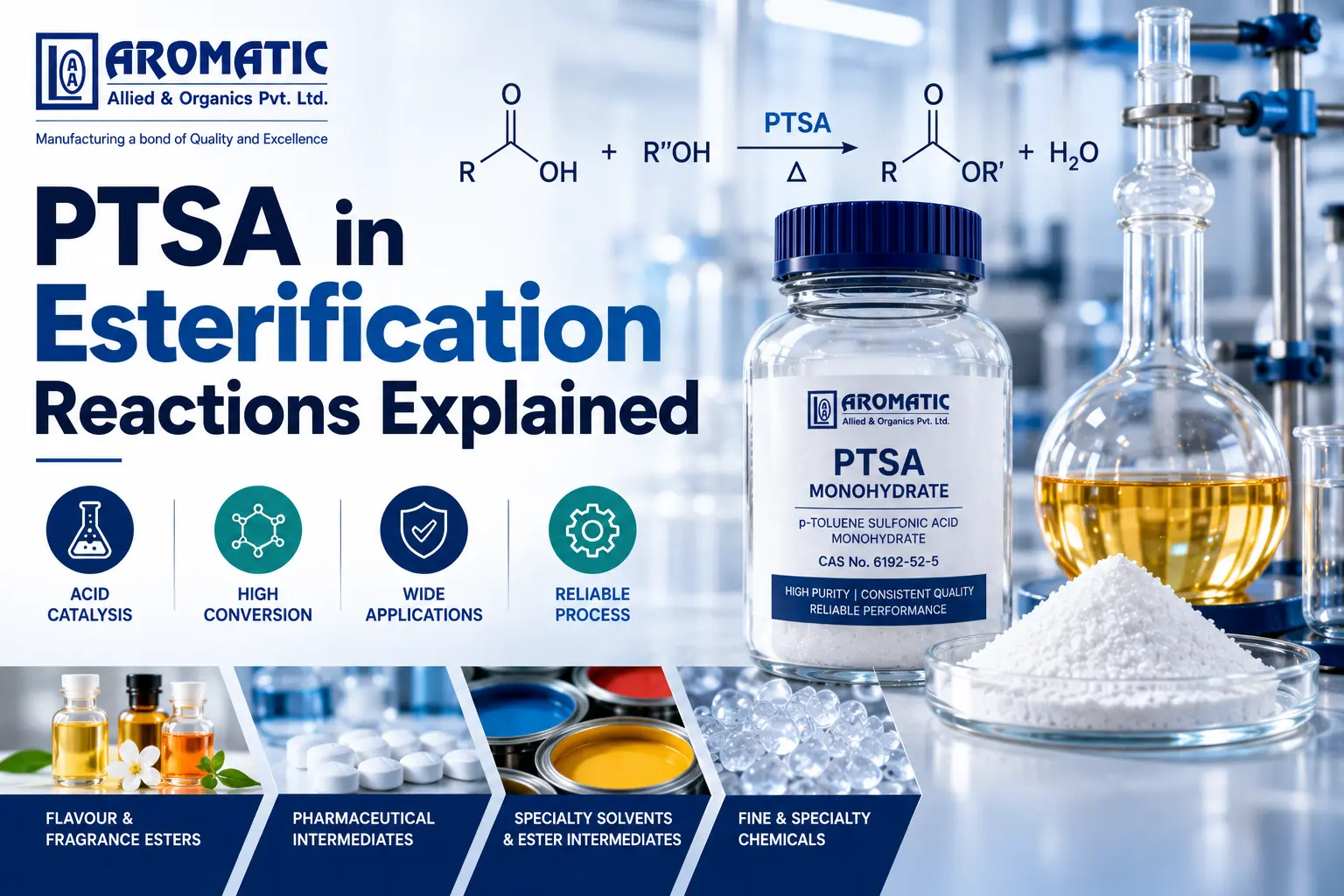
P-Toluenesulfonic Acid (PTSA) is a strong organic acid widely used as a catalyst in esterification and other acid-catalyzed organic reactions. In esterification, PTSA helps activate the carboxylic acid carbonyl group, making it more reactive toward an alcohol and supporting the sequence of proton-transfer steps that leads to ester formation.
AAOL’s current TDS specifically identifies pTSA Monohydrate as an organic catalyst used in pharmaceuticals, agrochemicals and esterification industries.
However, PTSA does not determine ester yield by itself. Reaction temperature, reactant ratio, water content, catalyst loading, substrate structure and downstream processing all influence the final result.
This article explains how PTSA works in esterification, the reaction mechanism, the key variables that affect performance and the practical considerations involved in industrial use.
What Is Esterification?
Esterification is a reaction in which an ester is formed, commonly through the reaction of a carboxylic acid with an alcohol.
A typical Fischer esterification can be represented as:
Carboxylic Acid + Alcohol ⇌ Ester + Water
Or more generally:
\[ RCOOH + R’OH \rightleftharpoons RCOOR’ + H_2O \]
The reaction is reversible. This means the final conversion depends not only on reaction speed but also on the equilibrium between the starting materials and products.
An acid catalyst such as PTSA accelerates the reaction pathway, but it does not automatically force the reaction to complete conversion.
Why Are Esters Important?
Esters are widely used in chemical manufacturing and organic synthesis.
Depending on their structure, they may be used in:
- ● Fine chemicals
- ● Flavour and fragrance compounds
- ● Solvents
- ● Plasticizer chemistry
- ● Pharmaceutical intermediates
- ● Specialty chemical synthesis
- ● Polymer and resin-related processes
The catalyst and reaction conditions should therefore be selected according to the specific ester being produced and the quality requirements of the process.
What Is the Role of PTSA in Esterification?
PTSA acts as a Brønsted acid catalyst, meaning it donates protons during the reaction.
Its main role is to increase the reactivity of the carboxylic acid carbonyl group.
The carbonyl carbon in a carboxylic acid is electrophilic, but protonation of the carbonyl oxygen makes that carbon even more susceptible to attack by the alcohol.
PTSA therefore helps create a lower-energy catalytic pathway through which the reactants can form the ester more efficiently.
The catalyst is regenerated at the end of the cycle and is not consumed as a stoichiometric building block of the ester.
Main Functions of PTSA in Esterification
PTSA supports the reaction by:
- ● Protonating the carbonyl oxygen
- ● Increasing carbonyl electrophilicity
- ● Facilitating nucleophilic attack by the alcohol
- ● Supporting proton transfers within reaction intermediates
- ● Helping convert a hydroxyl group into a better leaving group
- ● Facilitating water elimination
- ● Regenerating the acid catalyst after ester formation
The practical effectiveness of PTSA still depends on the entire reaction system.
How PTSA-Catalyzed Esterification Works
The mechanism can be understood in five main stages.
Step 1: Protonation of the Carbonyl Oxygen
PTSA provides a proton to the carbonyl oxygen of the carboxylic acid.
This makes the carbonyl carbon more electrophilic and therefore more reactive toward the alcohol.
Step 2: Nucleophilic Attack by the Alcohol
The oxygen atom of the alcohol attacks the activated carbonyl carbon.
This produces a tetrahedral intermediate.
At this stage, the original carbonyl structure has temporarily changed while new bonds and proton transfers are established.
Step 3: Proton Transfer
Protons are transferred within the intermediate.
This rearrangement helps convert one of the hydroxyl groups into a better leaving group.
The goal is to prepare the intermediate for elimination of water.
Step 4: Elimination of Water
Water leaves from the intermediate.
This step produces a protonated form of the ester.
Because water is also a product of the overall reaction, its concentration can influence reaction equilibrium.
Step 5: Ester Formation and Catalyst Regeneration
The protonated ester loses a proton.
This produces the final ester and regenerates the PTSA catalyst.
The overall reaction remains:
\[ RCOOH + R’OH \rightleftharpoons RCOOR’ + H_2O \]
The important distinction is:
PTSA accelerates the reaction pathway; it does not change the fundamental equilibrium relationship by itself.
Why PTSA Is Used as an Esterification Catalyst
PTSA is widely used because it provides strong organic acid catalysis and can be compatible with many organic reaction systems.
Its practical suitability may include:
- ● Strong Brønsted acidity
- ● Compatibility with many organic substrates
- ● Established use in acid-catalyzed synthesis
- ● Availability in solid monohydrate form
- ● Suitability for selected industrial esterification processes
AAOL’s TDS identifies its PTSA Monohydrate grade specifically as an organic catalyst and includes esterification industries among its stated applications.
However, the fact that PTSA works well in one esterification process does not prove that it will be optimal in every esterification.
Factors Affecting PTSA-Catalyzed Esterification
1. Catalyst Loading
Catalyst loading influences how much acid is available to promote the reaction.
Too little catalyst may result in a slower reaction.
Excessive catalyst loading may:
- ● Increase acid-related side reactions
- ● Complicate downstream neutralization
- ● Increase purification requirements
- ● Affect acid-sensitive substrates
The appropriate catalyst level should therefore be established experimentally or through a validated process.
There is no universal PTSA loading that is ideal for every esterification.
2. Reaction Temperature
Higher temperatures generally increase reaction rates, but they can also affect:
- ● Side-product formation
- ● Substrate stability
- ● Solvent loss
- ● Product stability
- ● Reaction selectivity
The optimal temperature depends on the specific carboxylic acid, alcohol, catalyst loading and solvent system.
Temperature should therefore be optimized for the process rather than chosen solely because PTSA is being used.
3. Reactant Ratio
Because Fischer esterification is reversible, the relative amounts of carboxylic acid and alcohol can influence equilibrium.
In some systems, an excess of one reactant is used to favour ester formation.
The appropriate ratio depends on:
- ● Raw-material cost
- ● Ease of reactant recovery
- ● Downstream separation
- ● Desired conversion
- ● Process economics
4. Water Content
Water is one of the most important considerations in esterification because it is a product of the reaction.
As water accumulates, the reverse reaction can become increasingly relevant.
Depending on the process, water may be managed by:
- ● Physical removal
- ● Solvent selection
- ● Reactant excess
- ● Controlled starting moisture
- ● Appropriate catalyst form
However, the importance of water varies between systems.
It would be inaccurate to say that any amount of water automatically prevents PTSA-catalyzed esterification.
5. Substrate Structure
Not all carboxylic acids and alcohols react at the same rate.
Factors such as:
- ● Steric hindrance
- ● Electronic effects
- ● Functional-group sensitivity
- ● Solubility
- ● Molecular size
can influence esterification behaviour.
A PTSA-catalyzed process that works well for a simple alcohol and carboxylic acid may require different conditions for a more complex substrate.
6. Solvent Selection
The solvent can influence:
- ● Catalyst solubility
- ● Reactant solubility
- ● Reaction temperature
- ● Water removal
- ● Product isolation
Some esterification processes are carried out without an added solvent, while others use a solvent selected for reaction or separation purposes.
The suitability of PTSA should therefore be assessed in the actual reaction medium.
7. Reaction Time
Longer reaction time does not necessarily mean better performance.
Once equilibrium has been approached, additional heating may provide little benefit and can increase:
- ● Side reactions
- ● Product degradation
- ● Energy consumption
- ● Process cost
Reaction monitoring is therefore preferable to relying on time alone.
PTSA Monohydrate in Esterification Reactions
PTSA is commonly available as PTSA Monohydrate, where the acid is associated with one molecule of water in its hydrated form.
AAOL’s current TDS identifies its commercial product as Para Toluene Sulfonic Acid-Monohydrate, CAS 6192-52-5.
The TDS specifies:
- ● White to light pink crystalline powder
- ● Minimum 98% assay as PTSA Monohydrate
- ● Maximum 0.5% free sulfuric acid
- ● Melting point of 102–105°C
- ● Maximum 50 ppm iron
For esterification, the important consideration is not simply that the catalyst is a monohydrate. It is whether the reaction system can accommodate the water associated with that product form.
In many processes, PTSA Monohydrate can be used effectively.
In more moisture-sensitive systems, the contribution of water should be evaluated as part of process development.
PTSA Monohydrate vs Anhydrous PTSA in Esterification
PTSA Monohydrate and anhydrous PTSA provide the same underlying acid functionality, but they differ in water content and molecular weight.
This affects how the catalyst should be dosed and evaluated.
Factor | PTSA Monohydrate | Anhydrous PTSA |
| Chemical form | Hydrated | Water-free form |
| Water of crystallization | Present | Absent |
| Molar loading at equal weight | Lower | Higher |
| Water contribution | Includes hydrate water | Lower inherent water contribution |
| Main process consideration | Whether added water is acceptable | Whether a low-water catalyst form is needed |
AAOL does not commercially supply anhydrous PTSA. It is included here only for technical comparison.
Therefore, any process considering anhydrous PTSA should evaluate it as a separate commercial material rather than assume equivalence with AAOL’s Monohydrate grade.
Does PTSA Monohydrate Reduce Esterification Yield?
Not necessarily.
The presence of hydrate water may matter in some equilibrium-sensitive reactions, but it does not automatically mean that PTSA Monohydrate produces lower yield.
The outcome depends on:
- ● Starting water content
- ● Reactant ratio
- ● Reaction temperature
- ● Water-removal method
- ● Catalyst loading
- ● Substrate structure
- ● Solvent system
The correct approach is to evaluate the complete reaction rather than judge performance from catalyst hydration alone.
Applications of PTSA-Catalyzed Esterification
Fine and Specialty Chemicals
PTSA can be used in selected esterification routes for fine and specialty chemical manufacturing.
Its suitability depends on reaction chemistry, impurity requirements and downstream purification.
Flavour and Fragrance Esters
Certain esters are used in flavour and fragrance chemistry.
PTSA may be used in selected esterification routes where the catalyst is compatible with the raw materials and product-quality requirements.
Not every flavour or fragrance ester is manufactured using PTSA, so this should remain application-specific.
Specialty Solvents and Ester Intermediates
Selected ester products are used as solvents or chemical intermediates.
PTSA may support their synthesis where acid-catalyzed esterification is appropriate.
Pharmaceutical and Agrochemical Intermediates
AAOL’s TDS lists PTSA Monohydrate applications in pharmaceutical and agrochemical industries in addition to esterification.
In such applications, catalyst selection should also consider:
- ● Impurity profile
- ● Residual catalyst
- ● Product specifications
- ● Downstream purification
- ● Applicable regulatory or customer requirements
A catalyst being used in pharmaceutical-related chemistry does not automatically make it pharmaceutical grade.
PTSA vs Sulfuric Acid in Esterification
PTSA and sulfuric acid are both strong acid catalysts that can be used in esterification, but the best choice depends on the process.
Factor | PTSA | Sulfuric Acid |
| Acid type | Organic sulfonic acid | Mineral acid |
| Typical form | Often solid as PTSA Monohydrate | Usually liquid |
| Compatibility with organic systems | Often suitable in many systems | Process-dependent |
| Water contribution | Depends on PTSA form | Depends on sulfuric acid concentration |
| Handling | Solid dosing may be useful in some processes | Liquid handling may be useful in others |
| Corrosion | Requires material compatibility review | Requires material compatibility review |
| Work-up | Reaction-specific | Reaction-specific |
| Cost | Process-specific | Process-specific |
AAOL’s TDS describes PTSA Monohydrate as an organic catalyst with strength comparable to mineral acids such as sulfuric acid.
That does not mean PTSA is universally better than sulfuric acid.
The correct catalyst depends on:
- ● Reaction performance
- ● Raw-material compatibility
- ● Water balance
- ● Equipment
- ● Work-up
- ● Economics
- ● Product specifications
Process Considerations for Industrial Esterification
Moving from laboratory esterification to commercial production introduces additional requirements.
Catalyst Specification
The catalyst should meet a defined specification for:
- ● Assay
- ● Appearance
- ● Impurities
- ● Relevant moisture parameters
- ● Batch consistency
AAOL’s current TDS specifies a minimum 98% assay for pTSA Monohydrate.
Packaging and Supply
AAOL’s standard TDS packaging is:
25 kg HDPE bags with LDPE liner.
Bulk packaging can also be customized according to commercial requirements.
Storage
The TDS instructs users to store the material in its original tightly closed container at room temperature.
The SDS additionally advises keeping the product dry, away from sunlight and away from oxidising agents. MSDS_pTSA Monohydrate
Safety
PTSA Monohydrate is a corrosive material.
The AAOL SDS classifies it for skin corrosion, serious eye damage and corrosivity to metals. MSDS_pTSA Monohydrate
Industrial handling should therefore follow:
- ● Current SDS instructions
- ● Appropriate PPE requirements
- ● Ventilation controls
- ● Equipment-compatibility procedures
- ● Site-specific safety protocols
Work-Up and Catalyst Removal
The effectiveness of a catalyst should not be judged only by reaction speed.
After esterification, the process may need to manage:
- ● Residual acid
- ● Unreacted alcohol
- ● Unreacted carboxylic acid
- ● Water
- ● Neutralization salts
- ● Product purification
The best catalyst is the one that performs effectively within the complete manufacturing process.
Conclusion
PTSA is an effective organic acid catalyst for esterification because it activates the carboxylic acid carbonyl group and facilitates the proton-transfer steps required for ester formation.
Its performance depends on the complete reaction environment.
Important variables include:
- ● Catalyst loading
- ● Temperature
- ● Reactant ratio
- ● Water content
- ● Substrate structure
- ● Solvent
- ● Reaction time
- ● Downstream processing
PTSA Monohydrate can be suitable for many esterification systems where its hydrated form is compatible with the process. The impact of water should be evaluated rather than assumed.
AAOL’s pTSA Monohydrate is specified as an organic catalyst and is expressly listed for use in esterification industries.
For industrial applications, catalyst selection should be based on verified specifications, process validation and the requirements of the final product.
Looking for PTSA Monohydrate for esterification applications?
AAOL supplies pTSA Monohydrate for industrial applications, with standard 25 kg HDPE/LDPE packaging and customizable bulk supply options.
Review the PTSA Monohydrate product specifications and request the current TDS, SDS or COA to evaluate suitability for your process.
FAQs
What is the role of PTSA in esterification?
PTSA acts as a Brønsted acid catalyst. It activates the carboxylic acid carbonyl group and facilitates the proton-transfer steps that allow the alcohol and carboxylic acid to form an ester.
Is PTSA used in Fischer esterification?
Yes. PTSA can catalyze Fischer esterification in suitable reaction systems.
Does PTSA increase esterification yield?
PTSA can accelerate the reaction, but it does not automatically increase the equilibrium yield. Yield depends on reactant ratio, water content, temperature, catalyst loading and other reaction conditions.
Can PTSA Monohydrate be used in esterification?
Yes. AAOL’s current TDS explicitly lists esterification industries among the applications of its PTSA Monohydrate product.
Does the water in PTSA Monohydrate matter?
It can matter in reactions that are highly sensitive to water or equilibrium conditions. Its practical effect should be evaluated for the specific esterification process.
Is anhydrous PTSA better for esterification?
Not universally. Anhydrous PTSA may reduce the amount of water introduced with the catalyst, but that does not guarantee better yield, selectivity or conversion.
Is PTSA better than sulfuric acid for esterification?
Neither catalyst is universally better. The correct choice depends on reaction chemistry, catalyst handling, equipment compatibility, product purity, work-up and economics.


Comments are closed