



A purchase order may be approved in minutes, but the consequences of ordering the wrong chemical or accepting a shipment without verifying its documentation, can affect production schedules, product quality, regulatory compliance, and customer confidence for weeks.
Experienced procurement professionals know that buying a chemical isn’t just about comparing specifications or negotiating prices. Before any material enters a manufacturing facility, there is one critical checkpoint that often determines whether the shipment is accepted or rejected: documentation.
This is where Understanding COA, TDS, and MSDS becomes essential.
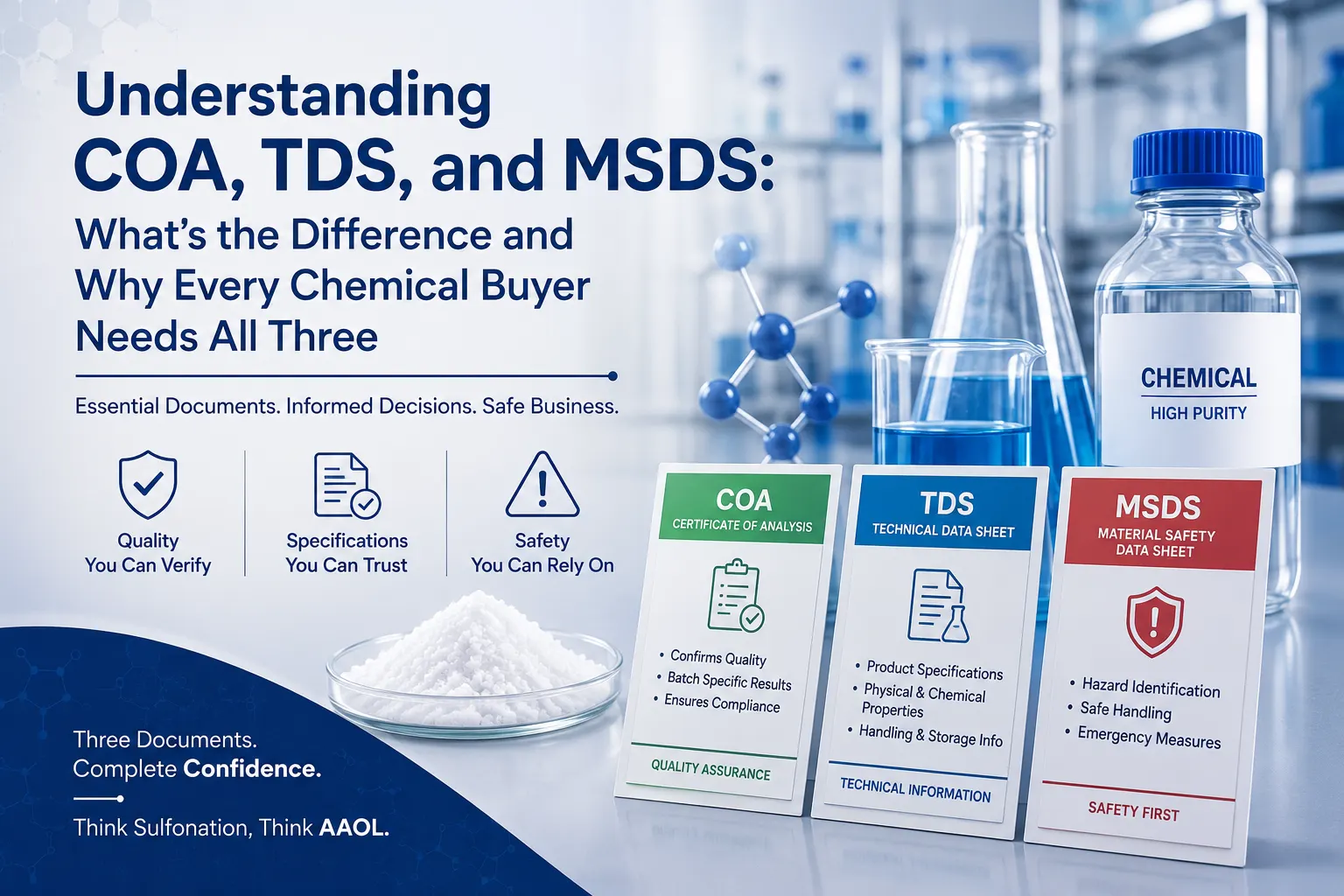
Although these three documents are frequently requested together, they answer entirely different questions. A Certificate of Analysis confirms whether the supplied batch meets the agreed specifications. A Technical Data Sheet explains what the product is designed to do and its typical technical characteristics. An MSDS, or more accurately today, a Safety Data Sheet (SDS), provides guidance on handling, storage, transportation, and emergency response.
Confusing these documents is surprisingly common, especially among first-time buyers and organizations sourcing specialty chemicals for new projects. A Technical Data Sheet cannot verify the quality of a delivered batch, just as a Certificate of Analysis cannot replace the safety information required for workplace handling. Each document supports a different stage of procurement, quality assurance, and regulatory compliance.
For manufacturers operating in pharmaceuticals, specialty chemicals, agrochemicals, detergents, or industrial processing, understanding these differences isn’t simply good practice, it is an essential part of supplier qualification and risk management.
In this guide, we’ll explore what each document contains, when it should be requested, how quality teams use it, and the common mistakes buyers should avoid before approving a chemical purchase.
Why Every Chemical Buyer Should Understand COA, TDS, and MSDS
Every chemical travels with a story.
It begins with manufacturing, continues through laboratory testing, passes quality control, and eventually reaches the customer’s warehouse. Throughout this journey, documentation becomes the bridge between the manufacturer and the buyer.
Without proper documentation, even a high-quality product may fail to meet procurement or quality assurance requirements.
Whether you’re sourcing p-Toluenesulfonic Acid (PTSA), Phenol Sulphonic Acid, Xylene Sulfonic Acid, or other specialty chemicals, understanding coa and tds documents, along with safety documentation, helps reduce uncertainty during procurement.
Each document serves a different stakeholder within an organization:
● Procurement teams verify that the supplier has provided the required commercial and technical documentation before approving an order.
● Quality Assurance (QA) teams compare analytical results against internal acceptance criteria.
● Production teams review technical characteristics to confirm the material is suitable for the intended application.
● EHS (Environment, Health, and Safety) professionals rely on safety documentation to establish safe handling, storage, and emergency procedures.
When these departments work with the correct information, the entire procurement process becomes more efficient and significantly less prone to costly errors.
This is one reason why experienced chemical manufacturers routinely provide multiple technical documents rather than relying on a single specification sheet.
Also Read: What Is Quality Control in the Pharmaceutical Industry?
What Is a COA (Certificate of Analysis)?
Among all technical documents supplied with industrial chemicals, the COA Certificate of Analysis is arguably the most important for quality assurance.
A Certificate of Analysis is a batch-specific quality document issued by the manufacturer after laboratory testing. It confirms that the material supplied has been tested against predefined specifications and records the analytical results for that particular production batch.
Unlike general product literature, every COA relates to a specific batch or lot number. This makes it one of the most important tools for product traceability and quality verification.
A typical Certificate of Analysis may include:
● Product name
● Batch or lot number
● Manufacturing date
● Retest or expiry date (where applicable)
● Tested quality parameters
● Test methods
● Specification limits
● Actual analytical results
● Approval or quality control authorization
For regulated industries such as pharmaceuticals, food ingredients, and specialty chemicals, the COA provides evidence that the supplied material conforms to agreed quality requirements before it enters production.
Must Read: PTSA Quality Parameters Buyers Should Know
Why Buyers Should Never Skip the COA
Imagine two shipments of the same chemical arriving from the same supplier.
Both containers carry identical labels, packaging, and product names.
However, only one shipment includes analytical results confirming that its purity, moisture content, acidity, or other critical parameters meet specification.
Without those analytical results, the receiving company has no objective evidence that the delivered material satisfies its quality requirements.
This illustrates why quality teams frequently insist on reviewing the COA before approving incoming raw materials.
For organizations purchasing specialty chemicals from suppliers such as AAOL India, the Certificate of Analysis supports not only quality verification but also batch traceability and internal documentation requirements.
What Is a TDS (Technical Data Sheet)?
One of the most common misconceptions among first-time buyers is assuming that a Technical Data Sheet can replace a Certificate of Analysis.
It cannot.
Understanding the tds coa meaning begins with recognizing that these documents serve entirely different purposes.
A Technical Data Sheet (TDS) is a reference document that describes a product’s typical technical characteristics, recommended applications, physical and chemical properties, and performance information. Rather than reporting analytical results for a specific batch, it provides general technical guidance intended to help customers determine whether a product is suitable for their application.
A TDS commonly includes information such as:
● Product description
● Typical physical properties
● Chemical characteristics
● Recommended applications
● Storage recommendations
● Packaging options
● Handling guidance
● Performance information
Because these values represent the product’s general characteristics, a Technical Data Sheet usually remains unchanged across multiple production batches unless the formulation or specification is updated.
How Procurement Teams Use a TDS
Before requesting quotations or approving a product for evaluation, procurement and technical teams often review the Technical Data Sheet to answer questions such as:
● Does the product meet our application requirements?
● Is the chemical compatible with our process?
● Are the physical properties suitable for our manufacturing conditions?
● Does the supplier offer the required product grade?
Only after confirming technical suitability does the quality team normally move on to reviewing the batch-specific Certificate of Analysis.
This distinction becomes especially important when comparing tds vs coa documentation during supplier qualification.
A Technical Data Sheet helps determine whether a product is technically suitable.
A Certificate of Analysis confirms whether the specific batch delivered actually meets those specifications.
What Is an MSDS (or SDS)?
While the COA and TDS help buyers evaluate product quality and technical suitability, they do not explain how a chemical should be handled safely. That responsibility belongs to the Material Safety Data Sheet (MSDS), now more commonly referred to as the Safety Data Sheet (SDS) under the Globally Harmonized System (GHS).
An MSDS is designed to communicate health, safety, environmental, and emergency information associated with a chemical product. Unlike a COA, it is not a quality document, nor is it intended to verify whether a specific batch meets product specifications.
Instead, it serves as a safety reference for everyone who may handle, transport, store, or respond to an incident involving the chemical.
A typical SDS contains information such as:
● Product identification
● Hazard classification
● Composition or ingredient information
● First-aid measures
● Fire-fighting measures
● Accidental release procedures
● Handling and storage recommendations
● Exposure controls and personal protective equipment (PPE)
● Physical and chemical properties
● Stability and reactivity
● Toxicological and ecological information
● Transport and regulatory information
For manufacturing facilities, laboratories, warehouses, and logistics providers, this document is an essential part of workplace safety and regulatory compliance.
Why Every Manufacturing Facility Requires an SDS
Imagine a drum of chemical material leaking during unloading.
The receiving team doesn’t need to know the product’s purity or viscosity first, they need to know:
● Is the chemical corrosive?
● Which PPE should be used?
● How should the spill be contained?
● What is the recommended first-aid procedure?
● Are there incompatible materials that must be kept away?
These answers are found in the SDS, not in the TDS or COA.
This is why safety professionals, warehouse managers, and emergency response teams often consider the SDS one of the first documents they review before handling any chemical.
TDS vs COA: Which Document Should Buyers Trust?
One of the most common questions procurement professionals ask is:
“If I already have a Technical Data Sheet, do I still need a Certificate of Analysis?”
The answer is yes.
Although these documents may appear similar at first glance, they serve fundamentally different purposes.
A Technical Data Sheet tells you what a product is designed to deliver under normal conditions.
A Certificate of Analysis tells you whether the actual batch you received meets those specifications.
Think of it this way.
If you’re purchasing a new vehicle, the manufacturer’s brochure describes the engine capacity, fuel efficiency, dimensions, and standard features. That brochure is similar to a TDS, it explains the product’s intended characteristics.
Now imagine receiving an inspection report confirming that your specific vehicle passed all quality checks before delivery. That inspection report is comparable to a COA.
Both documents are valuable, but they answer different questions.
Practical Comparison: TDS vs COA
|
Technical Data Sheet (TDS) |
Certificate of Analysis (COA) |
|
General product information |
Batch-specific analytical results |
|
Normally remains unchanged |
Generated for each production batch |
|
Supports product evaluation |
Supports batch verification |
|
Used before purchasing |
Used before accepting a shipment |
|
Typical values |
Actual laboratory test results |
Understanding tds vs coa helps procurement teams avoid one of the most common purchasing mistakes, assuming that a product specification sheet is sufficient evidence of product quality.
Difference Between COA and MSDS
Another area of confusion involves the difference between coa and msds.
These documents are sometimes requested together, but they exist for entirely different reasons.
A Certificate of Analysis focuses on quality.
An SDS focuses on safety.
For example:
If a pharmaceutical manufacturer receives PTSA for production, the quality team reviews the COA to verify purity, moisture content, and other analytical parameters before releasing the material for manufacturing.
Meanwhile, warehouse personnel consult the SDS to understand storage conditions, handling precautions, recommended protective equipment, and emergency procedures.
Neither document can replace the other because they answer different operational questions.
COA Answers Questions Like:
● Does this batch meet specification?
● What analytical results were obtained?
● Has the material passed quality testing?
SDS Answers Questions Like:
● Is this chemical hazardous?
● How should it be stored?
● What PPE is recommended?
● What should happen if accidental exposure occurs?
For organizations operating under ISO quality systems or Good Manufacturing Practices (GMP), maintaining access to both documents is considered an important part of supplier qualification and quality management.
Which Chemical Document Should Buyers Request Before Purchasing and When?
One of the biggest mistakes in chemical procurement is requesting documentation only after the material arrives. A common misconception among first-time buyers is that requesting a single technical document is enough to evaluate a chemical supplier. In reality, each document answers a different question, and the stage of procurement determines which one should be requested.
Experienced procurement teams follow a much more structured approach.
Stage 1: Product Evaluation
At this stage, buyers review the Technical Data Sheet. Start by requesting the Technical Data Sheet (TDS). This document helps determine whether the product is technically suitable for your intended application. It provides general information about physical and chemical properties, recommended uses, and typical product characteristics, making it an important reference during the supplier evaluation stage.
The objective is to determine whether the product’s typical characteristics align with the intended manufacturing process.
Questions commonly asked include:
● Is this the correct product grade?
● Does it meet our application requirements?
● Are the physical and chemical properties suitable?
Stage 2: Supplier Qualification
The Safety Data Sheet (SDS/MSDS) should also be reviewed to understand the product’s hazard classification, storage requirements, transport considerations, and safe handling procedures. This allows warehouse teams, production personnel, and EHS departments to assess whether the material can be safely introduced into the facility. Before approving a supplier, buyers often request:
● Technical Data Sheet
● Safety Data Sheet
● Quality certifications
● Regulatory documentation
This helps establish confidence in both the product and the supplier’s quality systems.
Stage 3: Pre-Dispatch or Shipment Approval
Before production materials are released for use, quality teams typically review the Certificate of Analysis.
Once the shipment arrives, the Certificate of Analysis (COA) becomes the most important document. It verifies that the specific batch supplied has been tested and complies with the agreed product specifications.
Experienced procurement teams rarely rely on a single document. Instead, they review all three at different stages of the purchasing process to minimize technical, quality, and regulatory risks.
This confirms that the specific batch supplied complies with the agreed specifications.
For regulated industries, batch approval frequently depends on this document.
Stage 4: Storage and Production
Once the material reaches the manufacturing facility, the SDS becomes an important operational reference.
Production teams, warehouse personnel, maintenance staff, and EHS professionals rely on it throughout the product’s lifecycle.
Viewed together, these documents support different stages of procurement, quality assurance, and operational safety.
Which Document Is Generated for Every Batch?
One of the easiest ways to distinguish between these documents is to ask a simple question:
“Which one changes every time a new batch is manufactured?”
The answer is the Certificate of Analysis (COA).
Every production batch undergoes quality testing before release. The analytical results generated from those tests are recorded in a batch-specific COA, making it unique to that particular lot of material.
In contrast:
● A Technical Data Sheet (TDS) is generally a product-level document. It only changes when the product specification, formulation, or technical information is updated.
● A Safety Data Sheet (SDS/MSDS) is also product-specific rather than batch-specific. It is revised only when regulatory requirements, hazard classifications, or safety information change.
This distinction is particularly important for pharmaceutical manufacturers and specialty chemical companies, where batch traceability is a critical part of quality assurance.
A buyer should therefore never accept a TDS or SDS as evidence that a delivered batch meets specification. Only the COA provides analytical confirmation for that specific batch.
Common Mistakes Buyers Make While Reviewing Chemical Documentation
Even experienced procurement teams occasionally overlook critical details.
Some of the most common mistakes include:
Accepting a TDS Instead of a COA
This is perhaps the most frequent error.
A TDS provides typical product information, it does not verify the quality of the delivered batch.
Ignoring Batch Numbers
Every COA should correspond to the batch number printed on the product label.
Failing to cross-check batch identification can create traceability issues later.
Overlooking Revision Dates
Technical documents are periodically updated.
Using outdated documentation may lead to incorrect assumptions regarding product specifications or safety information.
Treating the SDS as a Quality Certificate
An SDS helps employees handle chemicals safely.
It does not certify purity, assay, moisture content, or compliance with product specifications.
Failing to Review Test Parameters
Receiving a COA is only the first step.
Quality teams should confirm that the reported analytical parameters align with their own acceptance criteria rather than assuming every specification automatically meets internal requirements.
Organizations that establish standardized documentation review procedures are generally better positioned to reduce procurement risks and maintain consistent manufacturing quality.
How Pharmaceutical and Specialty Chemical Manufacturers Use COA, TDS, and MSDS Together
In a well-managed manufacturing environment, COA, TDS, and SDS are not standalone documents, they form a documentation system that supports the entire lifecycle of a chemical product, from supplier evaluation to production and regulatory compliance.
Consider a pharmaceutical manufacturer sourcing p-Toluenesulfonic Acid (PTSA) for use in organic synthesis.
Before the purchasing team approves the supplier, they review the Technical Data Sheet to determine whether the product’s physical and chemical properties align with the intended application. The TDS helps answer questions such as product grade, recommended applications, appearance, solubility, and typical specifications.
Once the supplier has been technically approved, the focus shifts to quality verification. Before the raw material is released for production, the Quality Assurance team reviews the Certificate of Analysis to verify that the supplied batch complies with the agreed specifications. Depending on the application, they may examine parameters such as assay, moisture content, free acidity, appearance, or other product-specific quality characteristics.
At the same time, the Environment, Health, and Safety (EHS) team reviews the Safety Data Sheet to establish appropriate storage conditions, handling procedures, personal protective equipment (PPE), spill response measures, and emergency protocols.
Each department is reviewing a different document because each document answers a different operational question.
When used together, these documents help organizations reduce procurement risks, maintain product quality, improve workplace safety, and strengthen regulatory compliance.
Read This: What Is an Active Pharmaceutical Ingredient (API)?
A Simple Workflow: How COA, TDS, and MSDS Fit into the Procurement Process
One of the easiest ways to understand these documents is to view them as part of a structured procurement workflow.
Step 1 – Product Evaluation
The buyer reviews the Technical Data Sheet (TDS) to determine whether the product is suitable for the intended application.
↓
Step 2 – Supplier Qualification
The procurement and quality teams review technical documentation, certifications, and regulatory information before approving the supplier.
↓
Step 3 – Batch Verification
Once the material is ready for dispatch, the manufacturer issues the Certificate of Analysis (COA) for that specific production batch.
↓
Step 4 – Goods Receipt and Quality Approval
The receiving quality team compares the batch number and analytical results with its internal acceptance criteria before releasing the material for production.
↓
Step 5 – Storage and Safe Handling
The warehouse and production teams rely on the Safety Data Sheet (SDS/MSDS) to ensure the chemical is stored, handled, and transported safely throughout its lifecycle.
This workflow demonstrates why no single document can replace the others. Each one contributes to a different stage of chemical procurement and quality management.
A Practical Checklist for Chemical Buyers Before Approving Any Shipment
One of the biggest opportunities to improve procurement efficiency lies in following a consistent documentation review process.
Before approving a shipment, experienced buyers typically confirm:
Technical Suitability
● Does the Technical Data Sheet match our application requirements?
● Is the correct product grade being supplied?
● Are the published specifications suitable for our process?
Batch Compliance
● Does the Certificate of Analysis correspond to the batch number on the product packaging?
● Have all required quality parameters been tested?
● Do the analytical results comply with our acceptance criteria?
Safety Compliance
● Has the latest SDS been provided?
● Are storage recommendations suitable for our facility?
● Have handling precautions been communicated to production and warehouse teams?
Following this simple review process helps minimize delays during incoming quality inspection and reduces the likelihood of material rejection.
Why Documentation Quality Reflects Supplier Reliability
Experienced procurement professionals often evaluate suppliers based on more than product pricing.
The quality of the documentation itself can reveal a great deal about the supplier’s manufacturing practices and quality management systems.
Reliable suppliers generally provide:
● Clear and professionally prepared technical documents.
● Batch-specific Certificates of Analysis.
● Updated Safety Data Sheets aligned with applicable regulations.
● Consistent product specifications across production batches.
● Responsive technical support when clarification is required.
Conversely, incomplete or outdated documentation can create unnecessary uncertainty during supplier qualification and incoming quality inspections.
For industries such as pharmaceuticals, specialty chemicals, food ingredients, and industrial manufacturing, documentation quality often becomes an important indicator of supplier credibility.
How AAOL India Supports Customers with Complete Technical Documentation
At AAOL India, we understand that today’s chemical buyers expect much more than a product delivered on time.
Whether the requirement involves p-Toluenesulfonic Acid (PTSA), and other Sulphonic Acids like Phenol Sulphonic Acid, Xylene Sulfonic Acid, or other specialty chemicals, procurement decisions increasingly depend on the availability of accurate technical documentation alongside dependable product quality.
To support customers across pharmaceutical manufacturing, specialty chemicals, agrochemicals, industrial processing, and research applications, AAOL India places strong emphasis on documentation that helps simplify procurement, quality verification, and regulatory review.
By providing customers with essential technical documents such as Certificates of Analysis, Technical Data Sheets, and Safety Data Sheets, we aim to make supplier qualification more transparent while helping customers maintain efficient quality assurance processes.
For organizations operating in regulated industries, this level of documentation can help streamline incoming material inspection and strengthen confidence throughout the supply chain.
Conclusion
Understanding COA, TDS, and MSDS is about much more than learning three technical acronyms. These documents form the foundation of quality assurance, product evaluation, workplace safety, and supplier qualification throughout the chemical supply chain.
A Technical Data Sheet helps buyers determine whether a product is technically suitable for their application. A Certificate of Analysis verifies that the supplied batch meets agreed quality specifications through laboratory testing. A Safety Data Sheet provides the information needed to store, transport, handle, and respond to the product safely.
Together, these documents enable manufacturers to make informed purchasing decisions while reducing operational risks and supporting regulatory compliance.
Whether you’re sourcing raw materials for pharmaceutical manufacturing, specialty chemicals, agrochemicals, or industrial applications, reviewing the right documentation before approving a shipment can save significant time, cost, and quality-related challenges later in the production process.
If you’re looking for specialty chemicals backed by comprehensive technical documentation, AAOL India provides customers with the information needed to support supplier qualification, quality assurance, and procurement confidence.
Request a Quote to discuss your chemical sourcing requirements with our technical team.
Is a COA mandatory for every chemical purchase?
Not necessarily. Requirements vary depending on the industry, customer specifications, and intended application. However, pharmaceutical, food, and specialty chemical manufacturers commonly require a batch-specific COA before accepting raw materials.
Can a TDS replace a COA?
No. A Technical Data Sheet describes the typical characteristics of a product, whereas a Certificate of Analysis reports the actual test results for a specific production batch.
Is MSDS the same as SDS?
In most cases, yes. The term Safety Data Sheet (SDS) is now widely used under the Globally Harmonized System (GHS), although many industries continue to use the term MSDS.
Which document should be reviewed first?
During supplier evaluation, buyers typically begin with the Technical Data Sheet to determine product suitability. Once the supplier is approved and a batch is produced, the Certificate of Analysis becomes the primary document for quality verification.
Why is batch number verification important?
The batch number printed on the Certificate of Analysis should match the batch number on the product packaging. This ensures traceability and confirms that the analytical results apply to the material received.


Comments are closed