



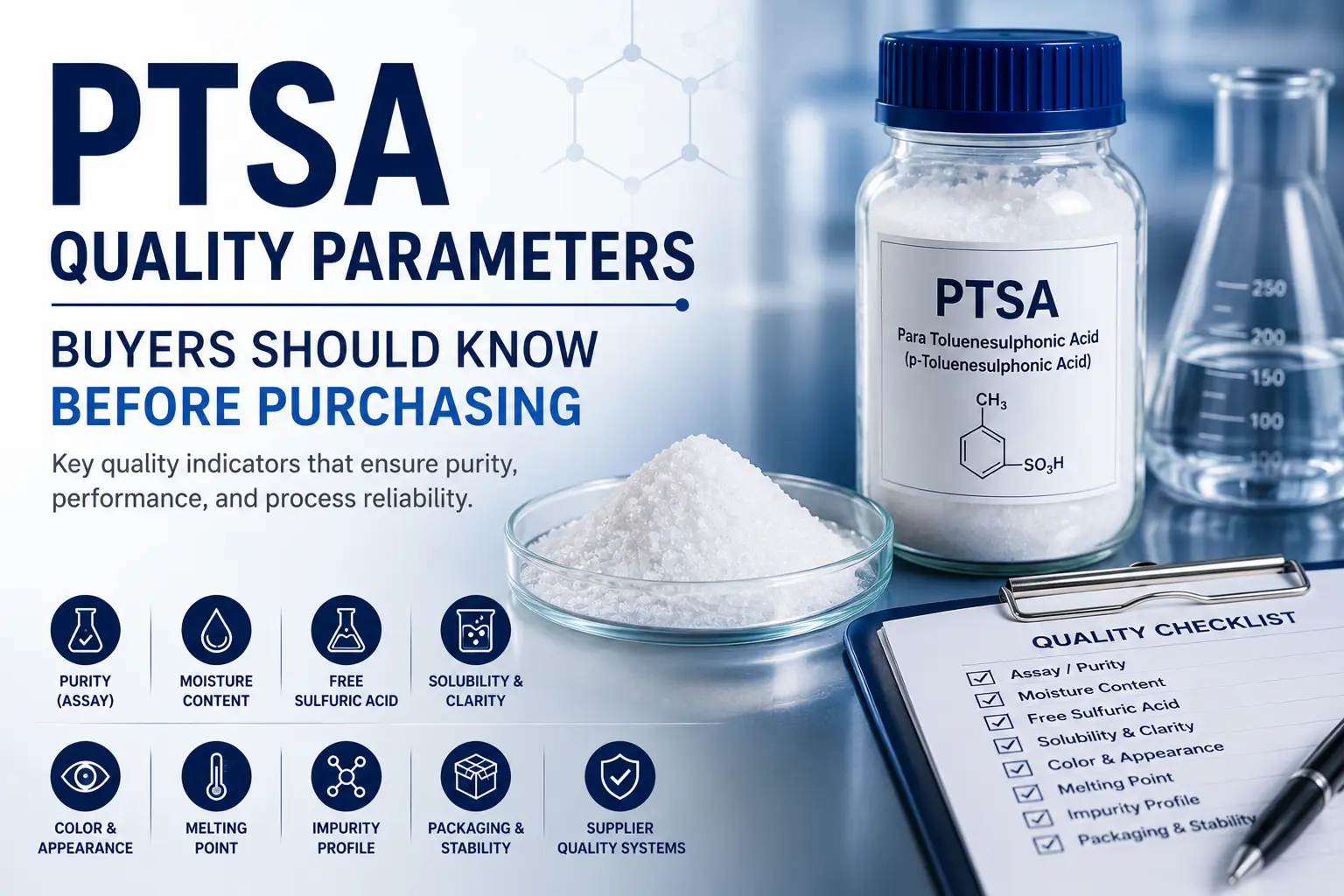
When purchasing p-Toluenesulfonic Acid (PTSA), many buyers naturally focus on price, availability, and delivery timelines. However, experienced procurement teams and process chemists know that PTSA quality can have a direct impact on reaction efficiency, product consistency, catalyst performance, and manufacturing outcomes.
A PTSA product that appears similar on paper may perform differently in production if critical quality parameters are not carefully evaluated. This is particularly important for pharmaceutical manufacturers, specialty chemical producers, resin manufacturers, and contract synthesis organizations where process reliability often depends on raw material consistency.
Understanding the most important PTSA quality parameters helps buyers make informed sourcing decisions while minimizing operational risks.
Why PTSA Quality Matters More Than Many Buyers Realize
PTSA is widely used as a strong organic acid catalyst in organic synthesis, esterification, transesterification, acetalization, polymer chemistry, and pharmaceutical manufacturing. Because it frequently functions as a catalyst, even small variations in quality can influence process performance.
For manufacturers operating large-scale production facilities, inconsistent raw materials can lead to:
• Reduced reaction efficiency
• Variability in product quality
• Process optimization challenges
• Additional quality-control requirements
• Increased manufacturing costs
This is why experienced buyers typically evaluate PTSA specifications beyond basic product descriptions.
Assay or Purity: The First Parameter Every Buyer Should Check
Purity is often the first specification procurement teams review.
The assay value indicates the amount of active p-Toluenesulfonic Acid present in the material. Industrial PTSA specifications commonly include minimum assay requirements to ensure consistent catalytic performance. Published PTSA specifications frequently reference assay values measured through analytical methods such as HPLC or titration.
Why Purity Matters
Higher purity generally supports:
• Consistent catalytic activity
• Predictable reaction performance
• Reduced impurity-related risks
• Better process reproducibility
For pharmaceutical and specialty chemical applications, purity often becomes one of the most closely monitored specifications.
Moisture Content: A Frequently Overlooked Quality Indicator
One of the most important PTSA quality parameters is moisture content.
PTSA is known to be hygroscopic, meaning it readily absorbs moisture from the environment. Published PTSA specifications commonly include moisture limits because excess moisture can influence storage stability and process performance.
Why Buyers Monitor Moisture Levels
Excessive moisture may affect:
• Material handling
• Storage stability
• Accurate dosing
• Reaction conditions
• Batch consistency
For organizations operating moisture-sensitive processes, this parameter deserves particular attention during supplier evaluation.
Free Sulfuric Acid Content: An Important Indicator of Product Quality
Another critical specification is free sulfuric acid content.
During manufacturing, residual sulfuric acid may remain if production and purification processes are not adequately controlled. Many commercial PTSA specifications therefore establish maximum allowable limits for free sulfuric acid.
Why This Parameter Matters
Lower levels of residual sulfuric acid can help reduce concerns related to:
• Process variability
• Equipment compatibility
• Product quality consistency
• Downstream processing requirements
For high-value manufacturing operations, monitoring this specification can help avoid unnecessary process complications.
Solubility Performance and Clarity
PTSA is commonly selected because of its excellent solubility characteristics in water and many polar solvents.
Published product specifications frequently include solubility requirements and visual appearance standards to verify product quality. Some PTSA grades are specified as producing a clear solution when dissolved in water.
Why Solubility Matters
Poor solubility performance can affect:
• Reaction efficiency
• Mixing behavior
• Process consistency
• Catalyst distribution
As a result, many quality-control teams evaluate solubility alongside other key specifications.
Color and Visual Appearance
While color alone does not always determine chemical performance, it can provide useful information about material condition and storage history.
Commercial PTSA specifications often describe acceptable appearance ranges, typically from white to off-white material. Because PTSA is hygroscopic, exposure to heat, moisture, or storage conditions may influence appearance over time.
What Buyers Typically Look For
Quality teams often verify:
• Physical appearance
• Color consistency
• Absence of contamination
• Packaging condition
These checks provide an additional layer of quality assurance before production use.
Melting Point as a Quality Verification Tool
Melting point is another specification commonly included in PTSA quality documentation.
Published PTSA specifications may include minimum melting-point requirements as part of overall quality verification.
Why It Matters
Melting-point data can help confirm:
• Product identity
• Material consistency
• Manufacturing quality
• Batch conformity
Although it may not be the primary purchasing criterion, it remains a useful quality indicator.
Impurity Profile: Increasingly Important for Regulated Industries
For pharmaceutical manufacturers and highly regulated industries, evaluating impurity profiles has become increasingly important.
Analytical methods such as HPLC and ion chromatography are routinely used to detect and quantify PTSA-related impurities and residual contaminants. Scientific literature documents the use of these methods for quality control and pharmaceutical applications.
Industries That Pay Close Attention to Impurities
• Pharmaceutical manufacturing
• API production
• Contract development and manufacturing
• Specialty chemical production
• High-purity synthesis operations
In these sectors, understanding impurity levels can be just as important as understanding assay values.
Packaging and Storage Stability Considerations
Quality does not end when PTSA leaves the manufacturing facility.
Because PTSA is hygroscopic, packaging quality and storage practices play an important role in preserving material integrity. Published technical documentation highlights the importance of controlling exposure to moisture and environmental conditions.
Questions Buyers Should Ask Suppliers
Before placing large-volume orders, buyers should consider:
• How is the material packaged?
• What storage conditions are recommended?
• How is moisture exposure minimized?
• What shelf-life information is available?
• What quality-control procedures are followed?
The answers can provide valuable insight into supplier capabilities.
Supplier Quality Systems Matter as Much as Product Specifications
Two PTSA suppliers may provide similar specification sheets while delivering very different customer experiences.
Experienced buyers often evaluate:
Quality-Control Infrastructure
Robust testing procedures help support consistent product quality.
Batch-to-Batch Consistency
Consistency remains one of the most important indicators of supplier reliability.
Technical Documentation
Comprehensive documentation simplifies qualification and procurement processes.
Industry Experience
Suppliers with deep industry knowledge often provide stronger technical support and supply-chain reliability.
How AAOL India Supports PTSA Sourcing Requirements
For manufacturers sourcing PTSA, quality specifications represent only one part of the purchasing decision.
At AAOL India, we recognize that customers require more than a catalyst supplier. They need confidence in product consistency, documentation, technical support, and dependable supply. Organizations operating in pharmaceuticals, specialty chemicals, industrial processing, and custom synthesis environments often prioritize suppliers capable of supporting long-term manufacturing objectives alongside quality expectations.
This combination of product quality and supply reliability remains an important consideration in today’s increasingly competitive manufacturing environment.
Conclusion
Understanding PTSA quality parameters is essential for buyers seeking consistent manufacturing performance and long-term process reliability.
While purity remains a primary consideration, experienced procurement teams also evaluate moisture content, free sulfuric acid levels, solubility, appearance, melting point, impurity profiles, and supplier quality systems before making purchasing decisions.
For pharmaceutical manufacturers, specialty chemical producers, and industrial users, a thorough evaluation of these parameters can help reduce risk, improve process consistency, and support better production outcomes. By partnering with experienced suppliers such as AAOL India, buyers can strengthen both product quality assurance and supply-chain reliability.


Comments are closed