



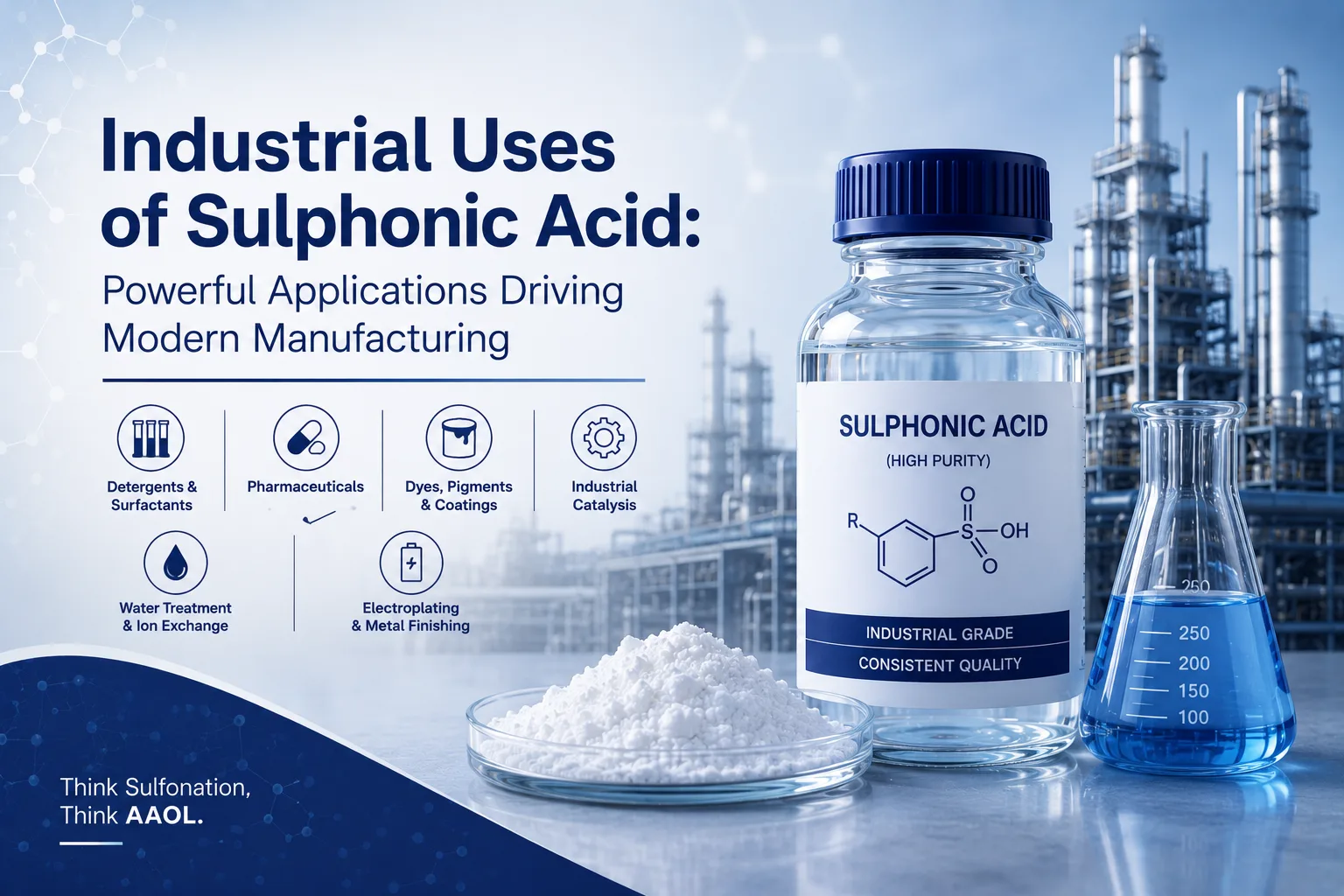
Sulphonic acid is one of the most versatile classes of industrial chemicals used across numerous sectors, from pharmaceuticals and petrochemicals to detergents and advanced material manufacturing. Due to its exceptional acidity, water solubility, catalytic efficiency, and chemical stability, sulphonic acid and its derivatives have become indispensable in modern industrial processes.
As industries increasingly seek efficient catalysts, high-performance intermediates, and sustainable chemical solutions, sulphonic acid compounds continue to play a crucial role in enhancing production efficiency, product quality, and process innovation.
At AAOL, we specialize in manufacturing high-purity Sulphonic Acids and advanced sulfonation products that serve diverse industrial applications globally. Our expertise in sulfonation chemistry has enabled us to develop specialty products that meet the evolving needs of pharmaceuticals, agrochemicals, dyes, polymers, and specialty chemical industries.
In this article, we explore the most significant industrial uses of sulphonic acid and why it remains a cornerstone of modern chemical manufacturing.
What is Sulphonic Acid?
Sulphonic acids are organosulfur compounds containing the functional group –SO₃H attached to a carbon atom. They are strong organic acids known for their excellent chemical stability, high solubility, and catalytic properties.
Common industrial sulphonic acid derivatives include:
• Para Toluene Sulphonic Acid (PTSA)
• Alkyl Benzene Sulphonic Acid (LABSA)
• Methane Sulphonic Acid (MSA)
• Naphthalene Sulphonic Acids
These compounds are extensively used as catalysts, surfactants, intermediates, and performance enhancers across various manufacturing sectors.
For industries seeking premium-grade products, AAOL offers a broad range of Sulphonic Acids designed for high-performance industrial applications.
Why Sulphonic Acid is Important in Industry
The widespread adoption of sulphonic acid can be attributed to several unique properties:
• Strong acidity comparable to mineral acids
• High thermal stability
• Excellent water solubility
• Superior catalytic efficiency
• Lower corrosion compared to some inorganic acids
• Compatibility with diverse organic reactions
• Environmental advantages in certain industrial processes
These characteristics make sulphonic acids suitable for both conventional and advanced industrial applications.
Major Industrial Uses of Sulphonic Acid
1. Pharmaceutical Manufacturing and API Synthesis
One of the most important industrial uses of sulphonic acid is in pharmaceutical manufacturing.
Sulphonic acid derivatives are widely employed in:
• Active Pharmaceutical Ingredient (API) synthesis
• Drug intermediates production
• Salt formation reactions
• Selective organic transformations
• Catalytic synthesis pathways
Particularly, Para Toluene Sulphonic Acid Monohydrate (PTSA) serves as an efficient catalyst in esterification, alkylation, and condensation reactions commonly used in pharmaceutical chemistry.
As pharmaceutical manufacturers increasingly focus on process efficiency and purity, sulphonic acid-based catalysts have become preferred alternatives in many synthetic routes.
2. Industrial Catalyst for Organic Synthesis
Sulphonic acids function as highly effective acid catalysts in numerous industrial reactions.
Applications include:
• Esterification
• Polymerization
• Acetalization
• Etherification
• Dehydration reactions
Unlike traditional mineral acids, sulphonic acids often provide better selectivity while minimising unwanted side reactions.
This catalytic efficiency improves:
• Product yield
• Process consistency
• Energy utilization
• Manufacturing economics
High-purity PTSA remains one of the most widely used catalysts in speciality chemical manufacturing worldwide.
3. Detergent and Surfactant Manufacturing
Perhaps the largest-volume application of sulphonic acid derivatives is in detergent production.
Linear Alkyl Benzene Sulphonic Acid (LABSA) is a key raw material used in:
• Household detergents
• Industrial cleaners
• Dishwashing liquids
• Laundry formulations
• Institutional cleaning products
LABSA contributes:
• Excellent cleaning performance
• Effective grease removal
• Strong foaming properties
• Cost-efficient formulation design
Its widespread use makes sulphonic acid chemistry a cornerstone of the global cleaning products industry.
4. Agrochemical and Crop Protection Formulations
Sulphonic acids play a vital role in agrochemical manufacturing.
They are used in:
• Herbicide intermediates
• Pesticide synthesis
• Fungicide production
• Agricultural formulation stabilisers
Sulphonation chemistry helps improve:
* Active ingredient solubility
* Formulation stability
* Dispersion characteristics
* Product performance in field applications
As modern agriculture demands increasingly sophisticated crop protection products, sulphonic acid derivatives continue to gain importance.
5. Dye and Pigment Manufacturing
The dye industry heavily depends on sulphonation processes.
Sulphonic acids are utilised in:
• Dye intermediates production
• Reactive dyes
• Acid dyes
• Textile colorants
• Pigment dispersants
Sulphonation enhances water solubility and dye affinity, allowing better interaction with textile fibers and substrates.
Many specialty dyes used in textiles, leather, paper, and inks rely on sulphonic acid chemistry for their performance characteristics.
6. Polymer and Resin Production
Sulphonic acids serve as catalysts and intermediates in polymer manufacturing.
Applications include:
• Phenolic resins
• Epoxy systems
• Specialty polymers
Engineering plastics
• Thermosetting resins
The use of sulphonic acid catalysts enables:
• Controlled polymerization
• Improved molecular structure
• Enhanced product consistency
• Reduced processing times
Advanced resin manufacturers often prefer PTSA-based catalytic systems due to their reliability and effectiveness.
7. Petroleum Refining and Fuel Additives
The petroleum sector utilizes sulphonic acid derivatives in several critical processes.
Applications include:
• Lubricant additives
• Fuel detergent additives
• Corrosion inhibitors
• Emulsifiers
• Refinery chemical processing
Petroleum sulphonates help improve fuel stability, equipment protection, and overall operational efficiency.
These specialty chemicals contribute significantly to extending equipment life and enhancing fuel performance.
8. Electroplating and Electronics Manufacturing
An advanced application of sulphonic acid is found in electrochemical industries.
Methane Sulphonic Acid (MSA) and related compounds are increasingly used in:
• Electroplating baths
• Semiconductor manufacturing
• Printed circuit board production
• Metal finishing operations
Benefits include:
• Enhanced metal deposition quality
• Reduced environmental impact
• Improved conductivity
• Superior process control
As electronics manufacturing continues to evolve, sulphonic acid-based chemistries are becoming increasingly valuable.
9. Speciality Chemical and Custom Synthesis Operations
Specialty chemical manufacturers frequently utilize sulphonic acids in custom synthesis projects.
Applications include:
Fine chemicals
• Performance chemicals
• High-value intermediates
• Research-driven formulations
• Contract manufacturing projects
Sulphonic acids often enable reaction pathways that are difficult to achieve using conventional catalysts.
This flexibility makes them essential for innovation-driven chemical manufacturing.
AAOL’s expertise in sulfonation chemistry supports the development of advanced speciality chemicals tailored to customer-specific requirements.
10. Green Chemistry and Sustainable Manufacturing
One of the fastest-growing industrial uses of sulphonic acid involves sustainable chemical processing.
Modern manufacturers are increasingly incorporating sulphonic acid catalysts to:
• Reduce waste generation
• Improve reaction selectivity
• Lower energy consumption
• Minimize hazardous by-products
• Enhance process sustainability
Solid-supported sulphonic acid catalysts and recyclable sulfonation systems are gaining attention as industries transition toward environmentally responsible manufacturing practices.
This trend is expected to accelerate significantly as global sustainability standards continue to evolve.
The Growing Demand for Para Toluene Sulphonic Acid (PTSA)
Among all sulphonic acid derivatives, Para Toluene Sulphonic Acid Monohydrate (PTSA) remains one of the most important industrial products.
Its popularity stems from:
• Strong catalytic activity
• High purity
• Excellent stability
• Broad industrial applicability
• Cost-effective process performance
PTSA is extensively used across pharmaceuticals, resins, polymers, fragrances, dyes, and specialty chemicals, making it a strategic raw material for numerous industries.
Choosing the Right Sulphonic Acid Manufacturer
Selecting a reliable sulphonic acid supplier directly impacts product quality and process performance.
Key factors to evaluate include:
• Manufacturing expertise
• Product purity standards
• Quality control systems
• R&D capabilities
• Regulatory compliance
• Production capacity
• Technical support
AAOL combines more than two decades of expertise in sulfonation chemistry with advanced manufacturing infrastructure, enabling consistent delivery of high-quality sulphonic acid products for global industries.
Conclusion
Sulphonic acid has evolved far beyond its traditional applications and now serves as a critical building block for modern industrial innovation. From pharmaceutical synthesis and agrochemical production to advanced electronics, polymers, petroleum processing, and sustainable manufacturing, sulphonic acid derivatives continue to drive technological progress across sectors.
As industrial processes become increasingly sophisticated, demand for high-purity sulphonic acids and specialized sulfonation products will continue to grow. Companies that leverage advanced sulphonic acid chemistry gain advantages in efficiency, product performance, and long-term sustainability.
With extensive expertise in sulfonation chemistry and a commitment to quality, AAOL remains a trusted partner for industries seeking reliable sulphonic acid solutions and specialty chemical manufacturing capabilities.


Comments are closed