



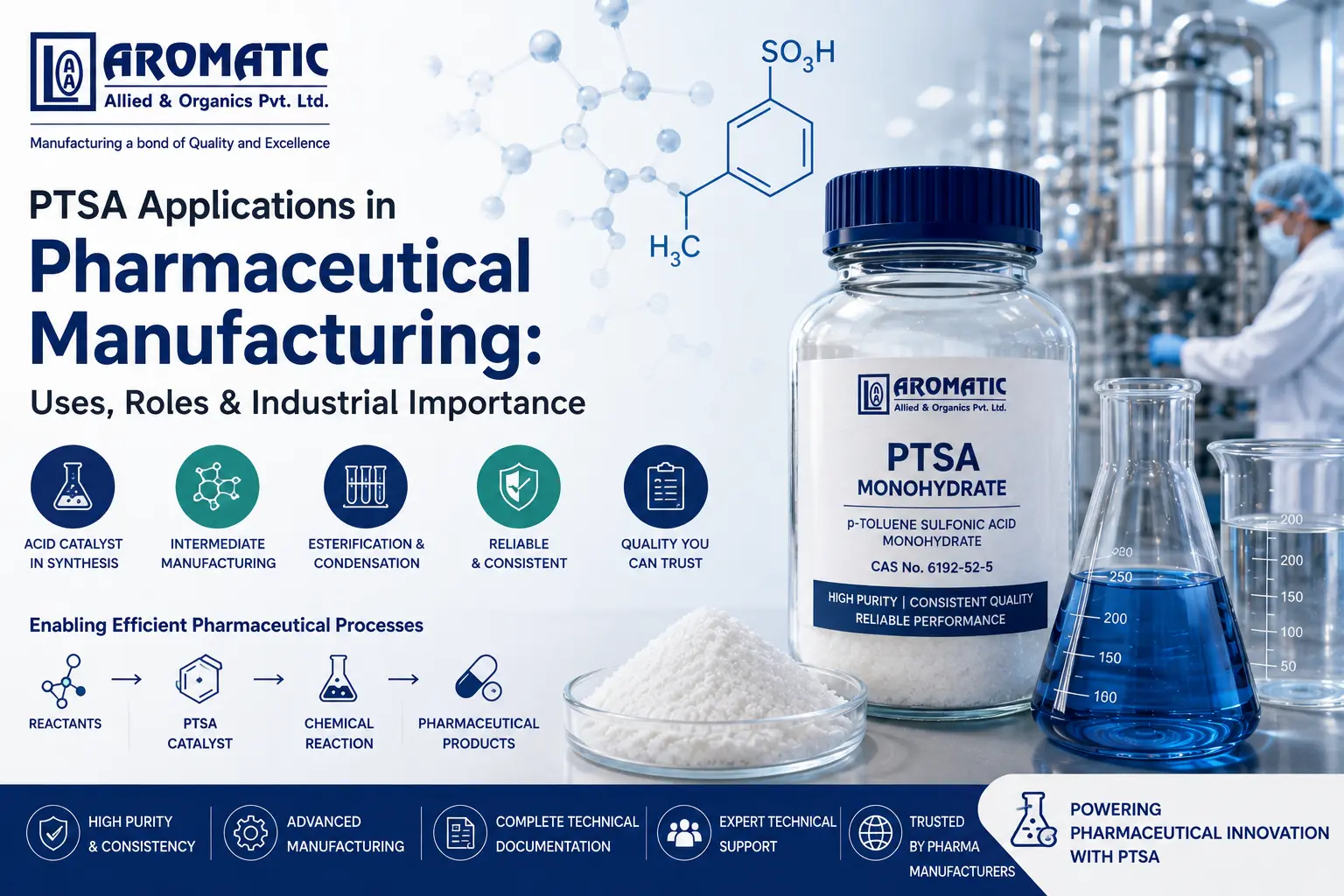
Pharmaceutical manufacturing depends on controlled chemical reactions, consistent raw materials, and processes that can be scaled without compromising product quality. Within this environment, PTSA applications in pharmaceutical manufacturing are particularly relevant because p-Toluenesulfonic Acid (PTSA) can function as a strong organic acid catalyst in a range of synthetic transformations.
PTSA is used in pharmaceutical chemistry to support acid-catalyzed reactions involved in the preparation of pharmaceutical intermediates and other organic compounds. Its relevance extends from laboratory and process-development work to manufacturing processes where controlled reaction conditions and consistent chemical inputs are important. Research literature also demonstrates the use of PTSA as a catalyst in synthetic routes toward compounds of pharmaceutical interest.
For pharmaceutical manufacturers, however, the question is not simply whether PTSA works as a catalyst. The more important considerations are where it fits into a process, how its quality can affect reaction performance, and what should be evaluated when sourcing it for repeated manufacturing requirements.
What Is PTSA?
PTSA, commonly known as p-Toluenesulfonic Acid or Para Toluene Sulfonic Acid, is an organic sulphonic acid widely used as an acid catalyst and chemical reagent. It is available in different forms, including anhydrous PTSA and PTSA Monohydrate.
AAOL’s PTSA Monohydrate product is identified by CAS No. 6192-52-5 and is specified with a minimum assay of 98%. The product is positioned for applications including pharmaceutical intermediates, organic synthesis, industrial catalysis, and research and development.
Its strong acidic character makes PTSA useful for promoting several acid-catalyzed organic transformations. Unlike a general-purpose mineral acid, PTSA is an organic acid that can be incorporated into a variety of reaction systems used in synthetic chemistry.
Why Is PTSA Used in Pharmaceutical Manufacturing?
The pharmaceutical industry involves numerous multistep chemical transformations. A reaction may require a catalyst to increase reaction rate, facilitate a particular transformation, or enable a process to proceed under practical manufacturing conditions.
PTSA can fulfil this catalytic role in suitable reactions.
Its importance comes from several practical characteristics: strong acidity, usefulness in organic reaction media, established application across synthetic chemistry, and availability in forms suitable for laboratory, pilot, and industrial applications. AAOL’s existing PTSA literature also highlights its use in esterification, condensation, acetalization, dehydration, and other acid-catalyzed transformations.
For pharmaceutical manufacturers, this means PTSA can be considered when developing or operating reaction pathways where controlled acid catalysis is required.
Key PTSA Applications in Pharmaceutical Manufacturing
PTSA as an Acid Catalyst in Pharmaceutical Synthesis
One of the most important PTSA pharmaceutical applications is its use as an acid catalyst in organic synthesis.
Acid catalysis can facilitate reactions by increasing the reactivity of suitable functional groups and helping establish conditions required for the desired transformation. PTSA has been investigated in a variety of synthetic reactions, including multicomponent and condensation chemistry relevant to the preparation of complex organic molecules. For example, research from pharmaceutical-industry-affiliated scientists has demonstrated PTSA-catalyzed synthesis of tetracyclic dihydroquinoline structures using a one-pot approach.
The specific suitability of PTSA depends on the reaction pathway, substrate, solvent system, temperature, catalyst loading, and downstream purification requirements. Therefore, its use should be determined through appropriate process development rather than assumed for every pharmaceutical reaction.
Read this: PTSA in Organic Synthesis: Why It Remains a Preferred Catalyst for Modern Chemical Manufacturing
PTSA in Pharmaceutical Intermediate Manufacturing
Pharmaceutical intermediates are compounds produced during the synthesis of an API or other pharmaceutical substance. Their manufacture frequently involves several controlled chemical transformations.
PTSA can serve as a catalyst or reagent in selected steps used to prepare such intermediates. Its role may include facilitating condensation, esterification, acetalization, or related acid-catalyzed transformations depending on the synthetic route.
This makes PTSA relevant to manufacturers developing or producing intermediates where an organic acid catalyst is technically appropriate.
For procurement teams, the quality of the PTSA used in these processes becomes important because catalyst characteristics can influence reaction behaviour, process consistency, and downstream purification.
PTSA in Esterification Reactions
Esterification is an important organic transformation used across chemical and pharmaceutical manufacturing. PTSA can catalyze reactions between carboxylic acids and alcohols, helping promote ester formation under appropriate conditions. AAOL’s PTSA product information identifies esterification among its key application areas.
In pharmaceutical synthesis, ester groups may form part of intermediates or final molecular structures, depending on the synthetic pathway. PTSA can therefore have a role in selected esterification steps where its catalytic properties align with the process requirements.
The actual catalyst concentration and operating conditions should always be established through validated process development rather than applying a generic dosage across different reactions.
PTSA in Condensation and Related Acid-Catalyzed Reactions
Condensation chemistry represents another area where PTSA can be useful.
A number of organic synthesis routes rely on acid catalysis to facilitate reactions between suitable starting materials. Published research has demonstrated PTSA-catalyzed condensation and multicomponent reactions under different conditions, illustrating the versatility of the compound as an organic acid catalyst.
For pharmaceutical process developers, this flexibility can make PTSA a useful candidate during catalyst screening and reaction optimization.
PTSA in Acetalization and Deprotection Chemistry
PTSA is also used in acid-catalyzed transformations involving acetals and related functional groups. Its catalytic activity can be useful in synthetic sequences where protection or deprotection of functional groups forms part of the overall route.
The relevance of this application is particularly apparent during pharmaceutical process development, where synthetic routes may require selective transformations while controlling side reactions and purification requirements.
A published ACS study, for example, documents the use of p-toluenesulfonic acid monohydrate as a catalyst for alkylation chemistry under comparatively mild conditions, highlighting its established role in selective organic synthesis.
PTSA in Pharmaceutical R&D and Process Development
PTSA is not limited to commercial production. It can also be valuable during pharmaceutical research and process-development programs.
During early development, chemists may screen different catalysts to determine which provides suitable conversion, selectivity, reaction time, work-up characteristics, and overall process performance.
AAOL specifically positions its PTSA Monohydrate for pharmaceutical research, process development, and scale-up environments, alongside industrial applications.
This makes consistent PTSA quality relevant across the development pathway—from laboratory experiments to pilot-scale evaluation and eventual commercial manufacturing.
Why PTSA Quality Matters in Pharmaceutical Processes
A catalyst is not merely another raw material in a pharmaceutical manufacturing process. Its characteristics can influence reaction performance and, consequently, the efficiency of the overall process.
When evaluating PTSA for pharmaceutical applications, manufacturers should consider factors such as assay, moisture characteristics, impurities, batch consistency, documentation, packaging integrity, and storage conditions.
AAOL’s PTSA Monohydrate specifications include a minimum 98% assay, defined moisture parameters, and documented storage requirements. The product page also provides access to documentation such as SDS and COA.
For pharmaceutical procurement teams, this type of documentation is valuable because supplier qualification involves more than comparing a product name. Quality teams need sufficient technical information to evaluate whether a material is appropriate for their internal specifications and manufacturing systems.
Also read: PTSA Quality Parameters Buyers Should Know Before Purchasing
What Pharmaceutical Manufacturers Should Evaluate When Sourcing PTSA
Choosing a PTSA supplier for pharmaceutical manufacturing requires a broader evaluation than simply finding the lowest-cost material.
Product Quality and Consistency
Consistent product characteristics are important when a catalyst is incorporated into a repeatable manufacturing process. Variations between batches can potentially affect process behaviour and require additional investigation.
Technical Documentation
Documents such as COA, TDS and MSDS as well as other relevant technical specifications help procurement, quality, R&D, and EHS teams evaluate the material and integrate it into their internal systems.
AAOL’s PTSA Monohydrate product information includes technical specifications and documentation support for industrial and research users.
Read this:
Manufacturing Capability
For recurring pharmaceutical requirements, buyers should assess whether a supplier has genuine manufacturing capability and sufficient production infrastructure to support ongoing demand.
AAOL has operated since 1999 and identifies sulphonation chemistry as a core area of manufacturing expertise. Its overall manufacturing infrastructure supports an annual production capacity of approximately 4,000 MT.
Packaging and Storage
PTSA should be stored and handled according to the applicable product documentation. Packaging should protect the material during transportation and storage while supporting practical industrial handling.
AAOL supplies PTSA Monohydrate in industrial packaging formats, with the specific 25 kg HDPE bag and LDPE liner configuration available for the requirement discussed with customers.
Technical Support
Pharmaceutical manufacturing often involves application-specific requirements. A supplier with technical understanding can be more valuable than one that simply fulfils an order.
Questions concerning product form, specifications, documentation, packaging, and application suitability should be addressed before commercial procurement.
PTSA Monohydrate for Pharmaceutical Manufacturing
Among the PTSA forms relevant to industrial users, PTSA Monohydrate is an important option for pharmaceutical and chemical applications.
AAOL’s PTSA Monohydrate has a minimum assay of 98%, CAS No. 6192-52-5, and a molecular formula of C₇H₈O₃S·H₂O. The product is positioned for pharmaceutical intermediate synthesis, process development, organic synthesis, and industrial catalysis.
For manufacturers, the appropriate PTSA form should be selected according to the specific reaction, process conditions, internal specifications, and technical requirements of the application.
AAOL India emerges as a leading PTSA manufacturer and supplier in India, enabling you to purchase PTSA and other sulphonic acids with confidence, backed by proper documentation and assured quality.
PTSA and Process Optimization in Pharmaceutical Manufacturing
The value of PTSA in pharmaceutical manufacturing goes beyond simply accelerating a reaction.
During process development, manufacturers typically evaluate multiple parameters simultaneously. Catalyst selection can influence reaction rate, selectivity, conversion, impurity formation, work-up, purification, and scalability.
Research has demonstrated PTSA’s usefulness in different synthetic systems, including reactions performed under solvent-free or relatively mild conditions. One published study reported p-TSA monohydrate as a catalyst in a multicomponent synthesis performed without a solvent or metal catalyst, illustrating how PTSA can contribute to alternative synthetic approaches.
However, these examples should not be interpreted as universal process recommendations. Pharmaceutical processes require application-specific development, validation, and appropriate quality controls.
You can also read: What Is the Sulphonation Process? Applications, Benefits & Industrial Uses
PTSA in Pharmaceutical Manufacturing: A Practical Procurement Perspective
For pharmaceutical manufacturers, selecting PTSA should be viewed as part of broader raw-material and process-risk management.
A technically suitable PTSA supplier should be able to demonstrate product consistency, manufacturing capability, appropriate documentation, secure packaging, and dependable supply. These factors become increasingly important when a material moves from laboratory evaluation into pilot-scale and commercial production.
This is where the distinction between simply purchasing PTSA and establishing a reliable chemical supply partnership becomes important.
AAOL combines more than 25 years of sulphonation experience with manufacturing infrastructure, quality-focused production, technical support, and documentation capabilities. Its PTSA Monohydrate is intended to support research, process development, pharmaceutical intermediate synthesis, and industrial manufacturing applications.
Conclusion
The PTSA applications in pharmaceutical manufacturing extend across several areas of synthetic chemistry, particularly where controlled acid catalysis is required. PTSA can support selected esterification, condensation, acetalization, and other acid-catalyzed transformations used in pharmaceutical intermediate synthesis and process development.
Its usefulness, however, depends on the specific reaction and manufacturing route. For pharmaceutical manufacturers, the right PTSA is therefore not simply a matter of choosing a chemical with the correct name. Product quality, consistency, documentation, packaging, manufacturing capability, and technical support all contribute to successful procurement.
As an experienced manufacturer of sulphonic acid products, AAOL supplies PTSA Monohydrate for pharmaceutical research, intermediate manufacturing, process development, and wider industrial applications. With manufacturing experience dating back to 1999 and a quality-focused approach to specialty chemical production, AAOL supports customers looking for dependable PTSA supply for demanding applications.
FAQs About PTSA Applications in Pharmaceutical Manufacturing
What is PTSA used for in pharmaceutical manufacturing?
PTSA is primarily used as an organic acid catalyst in selected pharmaceutical synthesis and intermediate-manufacturing processes. Depending on the reaction, it can support esterification, condensation, acetalization, and other acid-catalyzed transformations.
Is PTSA used in API manufacturing?
Yes, PTSA can be used in selected synthetic routes associated with API and pharmaceutical-intermediate manufacturing. Its suitability depends on the specific chemistry, process conditions, and requirements of the manufacturing route.
Why is PTSA used as a catalyst in pharmaceutical synthesis?
PTSA provides strong organic acid catalysis and can facilitate a range of transformations used in synthetic chemistry. Its application should be determined according to the specific reaction and validated process requirements.
What is PTSA Monohydrate?
PTSA Monohydrate is the hydrated form of p-Toluenesulfonic Acid. AAOL’s product is identified by CAS No. 6192-52-5, with a minimum assay of 98%, and is supplied for applications including pharmaceutical intermediates, organic synthesis, research, and industrial catalysis.
What should pharmaceutical manufacturers check before buying PTSA?
Manufacturers should evaluate product specifications, assay, impurity profile where applicable, batch consistency, technical documentation, packaging, storage requirements, manufacturing capability, and supplier reliability before approving PTSA for procurement.
Can PTSA be used during pharmaceutical process development?
Yes. PTSA can be used during laboratory and process-development work to evaluate acid-catalyzed synthetic transformations. AAOL specifically identifies process development and pharmaceutical research among the application areas for its PTSA Monohydrate.


Comments are closed