



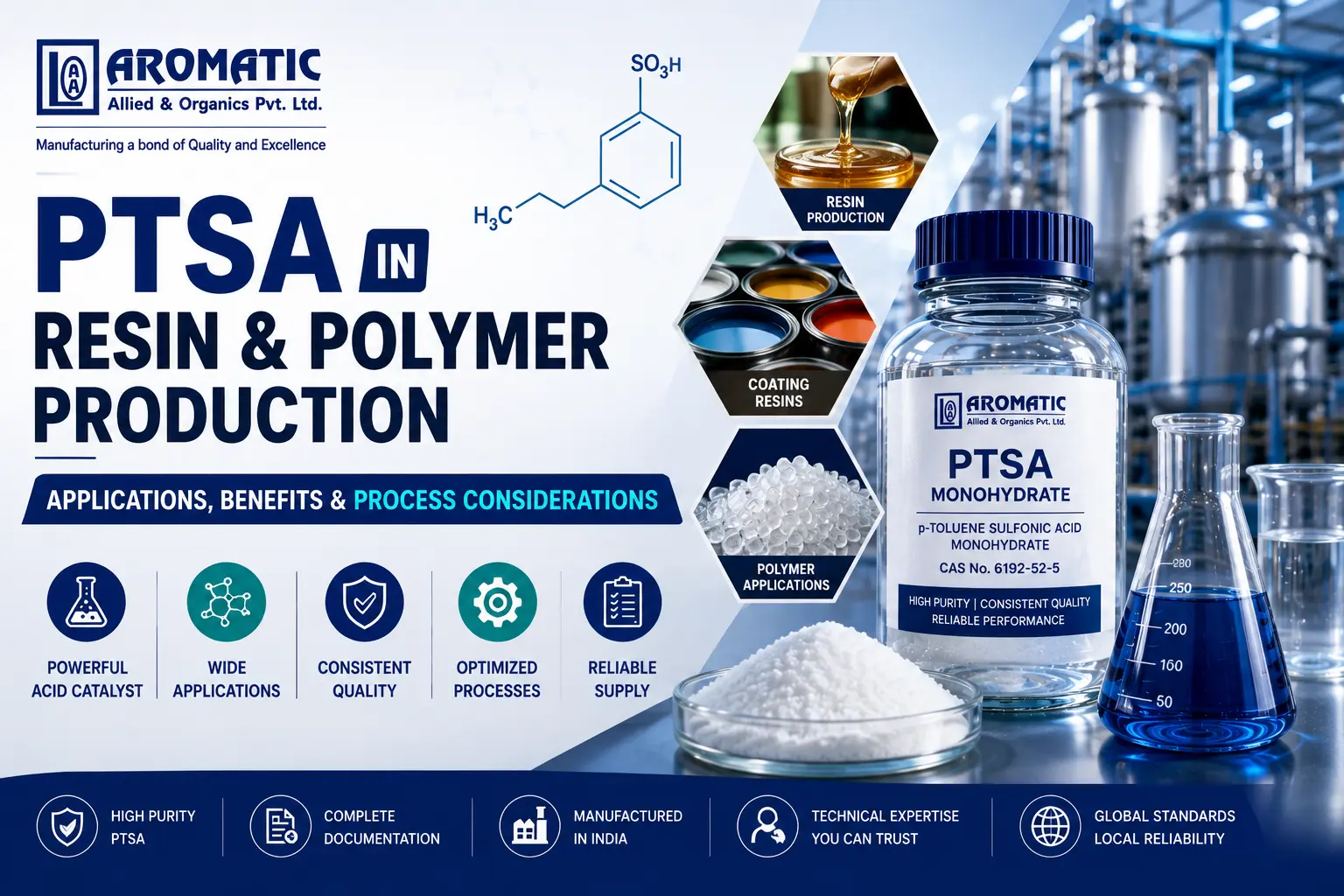
Resin and polymer manufacturing depends on carefully controlled chemical reactions. Catalyst selection can influence reaction rate, curing behaviour, process efficiency, and the characteristics of the resulting material. In suitable formulations and reaction systems, PTSA in resin and polymer production can provide the acid catalysis needed to support these processes.
p-Toluenesulfonic Acid (PTSA), also known as para-toluenesulfonic acid or p-TSA, is a strong organic acid used across organic synthesis and industrial chemistry. Its applications extend into resin manufacturing, polymer chemistry, coatings, pharmaceutical synthesis, and specialty chemical production. AAOL’s PTSA Monohydrate product is specifically positioned for polymer chemistry and resin manufacturing applications where controlled acid catalysis and consistent product quality are important.
However, PTSA is not a universal catalyst for every polymer or resin system. Its suitability depends on the chemistry involved, formulation, reaction conditions, catalyst concentration, and downstream processing requirements. Understanding these factors helps manufacturers determine where PTSA can add value and how to source it appropriately.
What Role Does PTSA Play in Resin and Polymer Production?
PTSA primarily functions as an acid catalyst in suitable resin and polymer-related chemical processes. By providing protonic acidity, it can promote reactions that require acid activation and help accelerate selected transformations.
Its role can vary depending on the manufacturing system. In some applications, PTSA is used to promote resin-forming or curing reactions; in others, it can participate in chemical transformations associated with polymer modification or specialty-material synthesis.
For example, published technical literature documents p-toluenesulfonic acid as an acid catalyst in coating and resin systems, including formulations involving polyester, phenolic, and amino resins. Patent literature also describes PTSA-containing catalyst systems for accelerating crosslinking and curing in coating compositions.
This means the value of PTSA is not simply its acidity. Manufacturers need to consider how that acidity interacts with the specific resin chemistry and process conditions.
Why Is PTSA Used as a Catalyst in Resin Manufacturing?
Strong Organic Acid Catalysis
PTSA is a strong organic acid capable of facilitating a range of acid-catalyzed reactions. Its catalytic activity makes it useful where proton-mediated reaction pathways are required.
In resin manufacturing, the catalyst can help accelerate reactions that might otherwise require longer processing times or different operating conditions. The appropriate catalyst loading and process parameters, however, need to be established for the specific formulation.
Convenient Solid-State Handling
PTSA Monohydrate is supplied as a crystalline solid, which can provide practical handling advantages compared with some strong liquid acids. AAOL’s product information describes PTSA Monohydrate as a white to off-white crystalline powder and identifies its use in polymer chemistry, resin manufacturing, and industrial catalysis.
This can be useful for manufacturers that need to measure and incorporate a catalyst accurately during formulation or production.
Compatibility With Organic Reaction Systems
Many resin and polymer processes involve organic raw materials and solvents. PTSA’s established use in organic synthesis makes it relevant to reaction systems where an organic acid catalyst is required.
Its documented use extends across esterification, condensation, acetalization, and other acid-catalyzed reactions, giving process chemists several potential application pathways depending on the chemistry being developed.
Read this: PTSA in organic synthesis.
Support for Controlled Reaction Processing
Catalyst selection can influence reaction kinetics and the conditions required to achieve the desired conversion. PTSA can therefore be evaluated during process development when manufacturers are optimizing reaction time, temperature, catalyst loading, and product characteristics.
The important point is that PTSA should be treated as one component of a controlled formulation and process, rather than assuming that increasing catalyst concentration will automatically improve production.
Key Applications of PTSA in Resin and Polymer Manufacturing
PTSA in Resin Production
One of the established industrial applications of PTSA is its use in resin-related chemistry.
Acid catalysts can promote reactions involved in the formation, modification, or curing of resin systems. PTSA has been documented in coating and resin formulations where acid-catalyzed crosslinking is required. Patent literature, for example, describes p-toluenesulfonic acid as a catalyst in polyester/amino resin coating systems and reports its use to accelerate curing.
For resin manufacturers, the objective is not simply to accelerate a reaction. The catalyst must work within the formulation while maintaining the desired balance of curing behaviour, stability, processing time, and final performance.
PTSA in Coating Resin Systems
Coating formulations often rely on controlled crosslinking to develop the required hardness, durability, chemical resistance, and other performance characteristics.
PTSA and related acid catalysts have been used in acid-catalyzed coating systems, including formulations involving amino and polyester resins. Technical patent literature shows PTSA being incorporated into coating compositions as a curing catalyst, demonstrating its relevance to industrial coating chemistry.
The exact catalyst system depends on the resin chemistry and curing mechanism. Therefore, manufacturers should evaluate PTSA as part of the complete formulation rather than as an isolated ingredient.
PTSA in Specialty Resin Manufacturing
Specialty resin systems can require carefully controlled reaction conditions and specific catalyst behaviour. PTSA may be considered where strong organic acid catalysis is compatible with the intended reaction pathway.
This can be particularly relevant to manufacturers producing specialty materials for coatings, adhesives, industrial formulations, and other applications where resin chemistry is tailored to specific performance requirements.
PTSA in Polymer Chemistry
PTSA also has applications beyond conventional resin curing.
Its acid-catalyzed chemistry can be relevant to selected polymer modification and polymer-related reactions. Scientific literature has demonstrated the use of PTSA in polymer-related processes, including catalytic cleavage of ester bonds in unsaturated polyester resin and polycarbonate depolymerization systems.
These examples also illustrate an important point: PTSA’s role in polymer chemistry is broader than simply accelerating polymer formation. Depending on the chemistry, it can participate in transformations involving existing polymer structures as well.
AAOL India has been a trusted platform for customers for years. If you are looking to purchase high-quality PTSA without compromising on quality, AAOL India is one of the leading PTSA manufacturers and suppliers in India, offering reliable products that meet industry standards.
How PTSA Works in Acid-Catalyzed Resin Reactions
At a basic level, PTSA provides the acidic environment required to activate suitable chemical groups within a reaction system.
A simplified process can be understood as:
PTSA addition → acid activation → reaction between functional groups → formation of desired product → completion of the reaction
The exact mechanism varies substantially between resin systems.
For example, in an acid-catalyzed condensation or curing reaction, protonation can increase the reactivity of a functional group, making subsequent chemical transformation easier. The catalyst can then participate in further catalytic cycles rather than being consumed in a simple one-to-one reaction.
This is why catalyst loading, temperature, reaction time, resin composition, and moisture conditions can all influence the overall process.
For manufacturers, understanding this interaction is more useful than treating PTSA simply as an additive.
Factors That Influence PTSA Performance in Resin Manufacturing
PTSA Concentration
Catalyst concentration needs to be established according to the specific resin chemistry and desired process outcome.
Too little catalyst may provide insufficient reaction acceleration, while excessive acidity can affect formulation stability, reaction behaviour, or downstream processing.
The appropriate concentration should therefore be determined through formulation development and process validation.
Reaction Temperature
Temperature directly affects reaction kinetics. Increasing temperature can accelerate certain acid-catalyzed reactions, but excessive heat may also contribute to unwanted side reactions, premature curing, or formulation instability.
For this reason, catalyst loading and temperature should be considered together.
Reaction Time
The required reaction time depends on the formulation, catalyst concentration, temperature, and desired degree of conversion.
A suitable PTSA system may help manufacturers achieve the required reaction within a practical processing window, but the optimal conditions must be established experimentally.
Resin Chemistry
Different resin systems contain different functional groups and follow different reaction mechanisms. A catalyst that performs well in one formulation may not provide the same results in another.
This is why application-specific testing is essential before moving a catalyst into commercial production.
Moisture and Product Form
Moisture can be an important consideration when working with PTSA Monohydrate or other hydrated chemical forms.
AAOL’s PTSA Monohydrate has a defined water-content specification and is recommended to be stored in a cool, dry environment while protected from excessive moisture exposure.
Manufacturers should therefore account for the product form and moisture contribution when developing or modifying a process.
Downstream Processing
Catalyst selection should also be evaluated in relation to what happens after the reaction.
Depending on the formulation, manufacturers may need to consider neutralisation, purification, residual acidity, catalyst compatibility, or other downstream requirements.
A catalyst that performs well during the reaction but creates unnecessary difficulties during finishing may not be the most appropriate overall choice.
PTSA Monohydrate for Resin and Polymer Applications
PTSA Monohydrate is one of the principal PTSA forms relevant to industrial users.
AAOL’s PTSA Monohydrate has:
- • CAS Number: 6192-52-5
- • Molecular Formula: C₇H₈O₃S·H₂O
- • Molecular Weight: 190.22
- • Assay: Minimum 98%
- • Appearance: White to off-white crystalline powder
AAOL identifies polymer chemistry and resin manufacturing among the product’s key applications alongside organic synthesis, pharmaceutical intermediates, fine chemical production, and industrial catalysis.
For resin and polymer manufacturers, the significance of these specifications goes beyond the product label. Consistent assay, controlled moisture characteristics, reliable batch quality, and appropriate documentation can all contribute to predictable process performance.
For complete product specifications and technical information, buyers should refer to the relevant PTSA Monohydrate product page and applicable technical documentation rather than relying on generalized application information.
Why PTSA Quality Matters in Resin and Polymer Production
Catalyst quality can directly affect manufacturing consistency.
When a resin manufacturer changes the quality or characteristics of a catalyst, the resulting process may behave differently. This is particularly relevant when production has already been optimized around specific catalyst specifications.
Before approving a PTSA supplier for resin manufacturing, procurement and technical teams should consider:
Assay and Purity
The assay should be appropriate for the intended application and aligned with the manufacturer’s internal specifications.
Batch Consistency
Consistent material characteristics help reduce unnecessary variation during repeated production runs.
Moisture Characteristics
Where PTSA Monohydrate is used, water content and storage conditions should be considered as part of process development.
Technical Documentation
Documentation such as SDS, TDS, COA, and relevant specifications can help procurement and quality teams evaluate the material.
Read this: Understanding COA, TDS and MSDS
Packaging Integrity
The packaging should protect the product against moisture and contamination during transportation and storage.
Manufacturing Capability
For recurring industrial requirements, buyers should establish whether the supplier has genuine manufacturing infrastructure and the capacity to maintain reliable supply.
AAOL’s product information identifies batch-to-batch reliability, technical documentation, quality assurance, and industrial-scale manufacturing capability as part of its PTSA Monohydrate offering.
Read more about PTSA quality parameters.
How to Choose PTSA for Resin and Polymer Production
Selecting PTSA for a resin or polymer process should involve both technical and procurement considerations.
Start With the Application
Identify exactly where PTSA will be used and what chemical transformation or curing mechanism is involved.
Define the Required Product Specifications
Establish the required assay, moisture characteristics, physical form, and other relevant parameters before evaluating suppliers.
Evaluate Manufacturing Consistency
A supplier’s ability to maintain consistent product quality is particularly important when PTSA becomes part of a repeatable commercial process.
Review Documentation
Ensure that the supplier can provide the documentation required by your quality, procurement, EHS, and production teams.
Consider Packaging and Storage
The packaging format should be suitable for your handling, storage, and production environment.
Evaluate Supply Capability
A supplier should be capable of supporting the required order volumes and recurring production schedules.
Consider Technical Support
For specialized applications, access to a technically knowledgeable supplier can make qualification and troubleshooting easier.
This is especially relevant when moving from laboratory trials to pilot or commercial-scale production.
PTSA Compared With Other Acid Catalysts in Resin Systems
PTSA should not automatically be considered the best catalyst for every resin formulation.
The choice between PTSA and other acid catalysts depends on factors such as:
- • Required acidity
- • Resin chemistry
- • Reaction mechanism
- • Catalyst concentration
- • Solubility
- • Temperature requirements
- • Cure profile
- • Formulation stability
- • Downstream processing
- • Handling requirements
The practical advantage of PTSA is that it combines strong organic acidity with established use in organic synthesis and industrial resin and coating systems.
Published technical literature also documents p-toluenesulfonic acid in acid-catalyzed coating formulations, while scientific studies demonstrate its catalytic behaviour in polymer-related transformations.
Therefore, catalyst selection should be based on process suitability rather than acidity alone.
Common Challenges When Using PTSA in Resin Manufacturing
Maintaining the Right Catalyst Loading
Catalyst concentration needs to be controlled carefully because the relationship between catalyst loading and reaction performance is formulation-specific.
Managing Reaction Temperature
Temperature affects reaction kinetics and can influence curing behaviour, reaction selectivity, and formulation stability.
Maintaining Batch-to-Batch Consistency
Changes in catalyst quality can introduce variation into an otherwise controlled process. Consistent sourcing is therefore important for commercial production.
Managing Moisture
PTSA Monohydrate introduces a defined amount of water associated with its hydrated form. Manufacturers should account for this when moisture balance is important to the formulation.
Handling Residual Acidity
Depending on the process, residual acid may need to be considered during neutralisation, purification, or final formulation.
Scaling From Laboratory to Commercial Production
A reaction that performs well at laboratory scale may behave differently when transferred to larger equipment. Mixing, heat transfer, catalyst distribution, and reaction control can all change with scale.
This makes process development and scale-up validation essential before establishing commercial production parameters.
PTSA Procurement Checklist for Resin Manufacturers
Evaluation Factor | Why It Matters |
Product form | Determines compatibility with the manufacturing process |
Assay and purity | Supports predictable catalytic performance |
Moisture characteristics | Important for formulations sensitive to water |
Batch consistency | Helps reduce process variation |
Technical documentation | Supports quality and regulatory evaluation |
Packaging | Protects the material during storage and transportation |
Manufacturing capacity | Supports recurring and bulk requirements |
Supply reliability | Reduces the risk of production interruptions |
Technical support | Helps address application-specific requirements |
For procurement teams, this approach is more useful than comparing PTSA suppliers solely on price.
Why Source PTSA From an Experienced Manufacturer?
For resin and polymer manufacturers, the supplier relationship can become an important part of process reliability.
AAOL has been manufacturing specialty chemicals since 1999, with established expertise in sulphonation chemistry and manufacturing infrastructure supporting an overall annual production capacity of approximately 4,000 MT. Its PTSA Monohydrate offering is positioned for industrial catalysis, polymer chemistry, resin manufacturing, pharmaceutical applications, and specialty chemical production.
AAOL’s PTSA Monohydrate is supported by quality-focused manufacturing, technical documentation, and application-oriented product information. The product is available for industrial requirements, with packaging and supply arrangements discussed according to customer requirements.
For businesses evaluating a long-term PTSA supplier in India, these manufacturing and quality considerations can be as important as the chemical itself.
PTSA in Resin and Polymer Production: Key Takeaways
PTSA can play a valuable role in selected resin and polymer manufacturing processes where strong organic acid catalysis is required.
Its applications can extend across:
- • Resin manufacturing
- • Coating resin systems
- • Specialty chemical formulations
- • Polymer-related reactions
- • Polymer modification
- • Selected curing and crosslinking systems
However, its suitability depends on the specific chemistry and process. Catalyst loading, temperature, reaction time, resin composition, moisture, and downstream processing should all be evaluated before establishing production conditions.
For manufacturers, consistent PTSA quality is equally important. Assay, moisture characteristics, batch consistency, documentation, packaging, and supply reliability should form part of the supplier qualification process.
AAOL’s PTSA Monohydrate is manufactured for industrial synthesis, polymer chemistry, resin manufacturing, pharmaceutical applications, and specialty chemical production, providing an option for manufacturers seeking a consistent PTSA supply partner.
Conclusion
PTSA in resin and polymer production is best understood as an application-specific use of strong organic acid catalysis rather than a universal solution for polymer manufacturing. In suitable systems, PTSA can support resin formation, curing, coating chemistry, and selected polymer-related transformations.
For commercial manufacturers, successful implementation depends on more than catalyst selection. Consistent product quality, controlled process conditions, appropriate storage, reliable documentation, and dependable supply all contribute to a stable manufacturing operation.
With its PTSA Monohydrate manufactured for resin manufacturing, polymer chemistry, industrial catalysis, pharmaceutical applications, and specialty chemical production, AAOL provides a relevant sourcing option for businesses evaluating PTSA for industrial applications.
Looking for PTSA for your resin or polymer manufacturing requirement? Request a quote from AAOL to discuss your product specifications, quantity, packaging, and application requirements.
FAQs About PTSA Applications in Pharmaceutical Manufacturing
What is PTSA used for in resin manufacturing?
PTSA is used as an acid catalyst in selected resin-forming, curing, and related chemical processes. Its suitability depends on the resin chemistry and reaction conditions.
Is PTSA used in polymer production?
Yes. PTSA has applications in polymer-related chemistry, including selected catalytic transformations and polymer modification processes. AAOL specifically identifies polymer chemistry among the applications of its PTSA Monohydrate.
Why is PTSA used as a catalyst in resin production?
PTSA provides strong organic acid catalysis and can accelerate suitable acid-catalyzed reactions. This can be useful in resin formation, curing, or other processes where controlled acid catalysis is required.
Can PTSA Monohydrate be used in resin manufacturing?
PTSA Monohydrate can be used in suitable resin manufacturing processes where its hydrated form and specifications are compatible with the formulation and process requirements. AAOL identifies resin manufacturing as one of its PTSA Monohydrate application areas.
What factors affect PTSA performance in resin production?
Important factors include catalyst concentration, reaction temperature, reaction time, resin chemistry, moisture conditions, mixing, and downstream processing requirements.
What quality parameters should resin manufacturers check when purchasing PTSA?
Manufacturers should evaluate assay, relevant impurity specifications, moisture characteristics, batch consistency, physical form, documentation, packaging integrity, and supplier manufacturing capability.
Is PTSA suitable for every polymer or resin system?
No. PTSA’s suitability depends on the specific chemistry and manufacturing process. Catalyst selection should be established through appropriate formulation development and process evaluation.
Where can manufacturers source PTSA in India?
Manufacturers can evaluate established specialty chemical producers based on product quality, manufacturing capability, documentation, packaging, supply reliability, and technical support. AAOL supplies PTSA Monohydrate for industrial and specialty chemical applications across India.


Comments are closed