



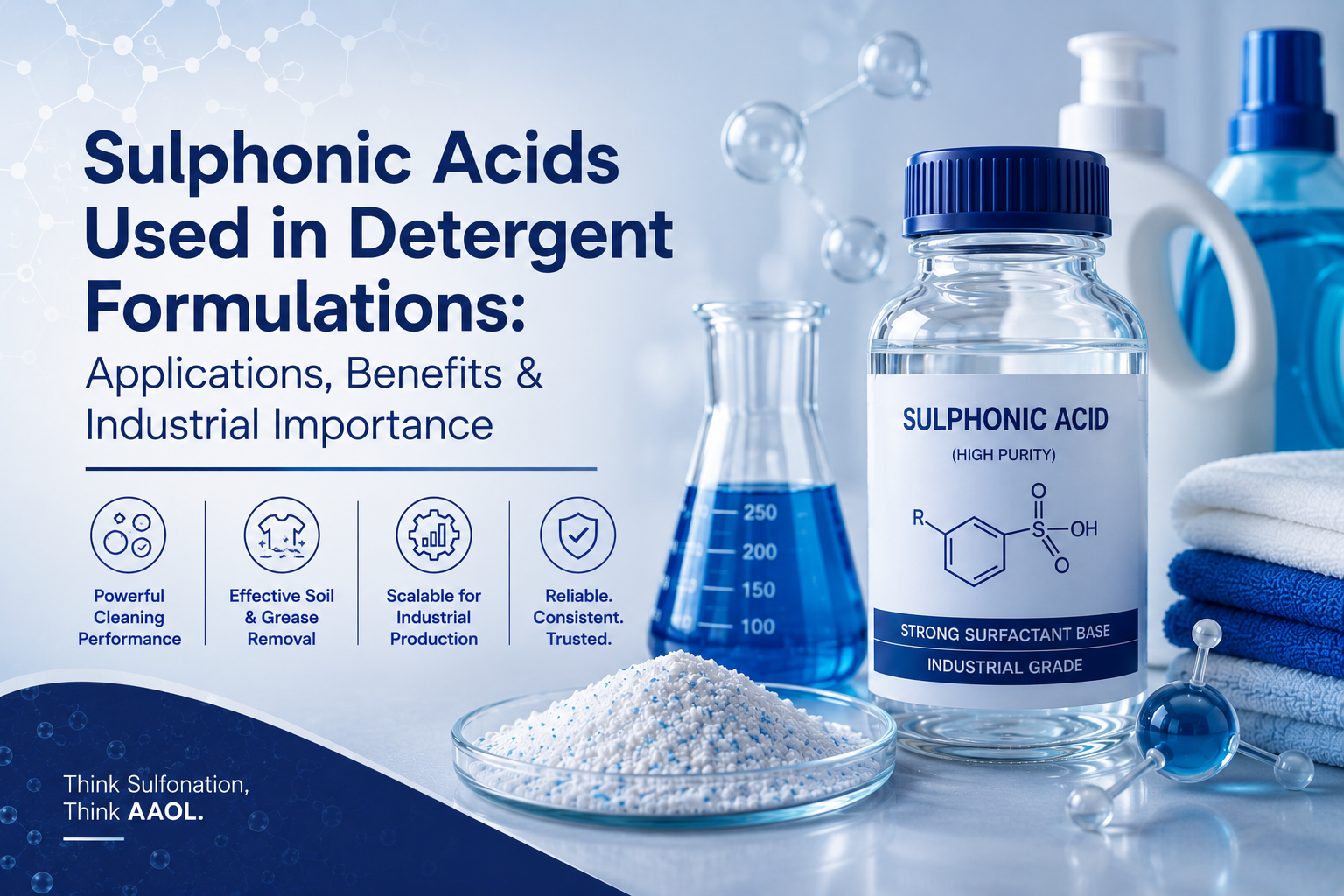
Consumers often judge a detergent by simple outcomes: how well it removes stains, how much foam it produces, or whether it leaves fabrics and surfaces feeling clean. Behind those results, however, lies a complex combination of chemistry, formulation science, and manufacturing expertise.
Among the most important ingredients supporting modern detergent technology are sulphonic acids and their derivatives. The widespread use of these compounds has transformed the detergent industry because they enable the production of highly effective surfactants capable of removing oils, dirt, and other contaminants from a wide variety of surfaces. Today, Sulphonic Acids Used in Detergent Formulations continue to serve as the foundation of many household, industrial, and institutional cleaning products.
Understanding the Role of Sulphonic Acids in Detergent Chemistry
Before exploring detergent applications, it is important to understand what makes sulphonic acids valuable from a formulation perspective.
Sulphonic acids belong to a class of organosulfur compounds containing the sulphonic acid functional group (-SO₃H). Their salts and derivatives, commonly known as sulfonates, are widely used in surfactants, detergents, dyes, pharmaceuticals, and numerous industrial applications.
In detergent manufacturing, the goal is not simply to add an acid to a formulation. Instead, sulphonic acid chemistry is used to create surfactant systems that help water interact more effectively with oils, grease, dirt, and particulate matter. This ability is one of the primary reasons sulphonic-acid-based surfactants have become central to modern cleaning technologies.
Also read: What Is Sulfonic Acid? Structure, Properties, Types & Industrial Applications
Why Sulphonic Acids Became the Backbone of Modern Detergents
Historically, soaps derived from fats and fatty acids dominated cleaning applications. Over time, detergent manufacturers increasingly adopted sulfonate-based surfactants because they offered performance advantages across a wider range of conditions.
Several factors contributed to this transition.
Superior Surfactant Performance
Surfactants work by reducing the surface tension between water and contaminants. Sulfonate-based surfactants are particularly effective because they contain both hydrophilic and hydrophobic components, allowing them to interact with water and oily substances simultaneously.
Effective Soil and Grease Removal
One of the primary reasons detergent manufacturers continue to rely on sulphonic acid chemistry is its ability to support the removal of stubborn oils, grease, and dirt from fabrics, utensils, industrial equipment, and hard surfaces.
Scalability for Industrial Production
Sulfonate-based surfactants can be produced at large industrial scales, making them suitable for both consumer and commercial detergent markets.
Sulfonic Acid Uses Across the Detergent Industry
When discussing sulfonic acid uses, detergent manufacturing is consistently one of the most significant industrial applications.
Modern detergent formulations incorporate sulfonate-based surfactants in a variety of products, including:
• Laundry detergents
• Dishwashing liquids
• Industrial cleaners
• Surface cleaning formulations
• Institutional cleaning products
• Personal care cleansing products
The versatility of sulfonate chemistry allows formulators to develop products tailored to different cleaning requirements while maintaining consistent performance standards.
Sulfonic Acid Uses in Detergents: How Surfactants Deliver Cleaning Performance
To understand sulfonic acid uses in detergents, it helps to examine how surfactants function during the cleaning process.
When a detergent is mixed with water, surfactant molecules position themselves between water and oily contaminants. Their molecular structure enables them to surround grease and dirt particles, allowing those contaminants to be suspended and removed during rinsing.
This mechanism explains why sulfonate-based surfactants remain common in products designed to handle:
• Kitchen grease
• Food residues
• Industrial oils
• Fabric stains
• General household dirt
Without effective surfactants, many modern cleaning products would struggle to deliver the performance consumers expect.
Recommended Blog: PTSA in Organic Synthesis: Why It Remains a Preferred Catalyst for Modern Chemical Manufacturing
Common Sulphonic Acid Derivatives Used in Detergent Manufacturing
Several sulfonated compounds are widely used throughout the detergent industry.
Linear Alkylbenzene Sulfonates (LAS)
Linear alkylbenzene sulfonates are among the most widely used anionic surfactants in household and industrial detergents. Their combination of cleaning efficiency, foaming characteristics, and formulation flexibility has made them a major component of modern detergent chemistry.
Alpha Olefin Sulfonates (AOS)
Alpha olefin sulfonates are another important class of anionic surfactants. These materials are used in detergents and cleaning products because of their detergency, foam stability, and grease-removal performance.
Aromatic Sulphonic Acid Derivatives
Aromatic sulfonic acids and their derivatives continue to play important roles in specialized detergent and surfactant applications, particularly where specific formulation characteristics are required.
Uses of Sulphonic Acid Beyond Detergent Manufacturing
Although detergents represent one of the largest commercial applications, the uses of sulphonic acid extend far beyond cleaning products.
Sulphonic acid derivatives are also utilized in:
Pharmaceutical Manufacturing
Sulphonic acids contribute to pharmaceutical chemistry through catalysts, intermediates, and sulfonate-containing compounds.
Dyes and Pigments
Sulfonation chemistry is widely used in dye production because sulphonic acid groups can improve water solubility and processing characteristics.
Water Treatment and Ion Exchange Systems
Certain sulphonic acid derivatives are used in ion-exchange resins and water treatment applications.
Industrial Catalysis
Strong sulphonic acids such as methanesulphonic acid and p-toluenesulphonic acid are frequently used as catalysts in organic synthesis.
Sulphonic Acid in Detergents: What Manufacturers Consider During Formulation
Selecting the right surfactant system involves balancing multiple performance requirements.
When evaluating sulphonic acid in detergents, formulators often consider:
Cleaning Efficiency
The ability to remove soils and contaminants effectively remains the primary objective.
Foam Characteristics
Different applications require different foaming profiles depending on product type and end-user expectations.
Product Stability
Formulations must remain stable throughout storage, transportation, and usage.
Cost-Performance Balance
Manufacturers continually seek solutions that deliver strong performance while maintaining commercial viability.
These considerations influence the selection of surfactants and other ingredients throughout the formulation process.
How AAOL India Supports Industries That Depend on Sulphonic Acid Chemistry
Manufacturers operating in detergents, specialty chemicals, pharmaceuticals, and industrial processing often require dependable access to high-quality sulphonic acid products and intermediates.
At AAOL India, we understand that consistent chemical quality can directly influence formulation performance, manufacturing efficiency, and long-term product reliability. As customer requirements evolve, the ability to source dependable raw materials becomes increasingly important for maintaining competitive product performance.
This is particularly relevant in industries where surfactant chemistry and sulphonation-derived products play a central role in manufacturing operations.
Future Outlook for Sulphonic Acid-Based Detergent Technologies
The detergent industry continues to evolve in response to changing consumer expectations, formulation innovations, and manufacturing advancements.
Despite these changes, sulphonic acid chemistry remains highly relevant because it provides a proven foundation for surfactant production and cleaning performance.
As manufacturers continue developing more sophisticated cleaning products, sulphonic acid derivatives are expected to remain integral to detergent formulations across household, commercial, and industrial markets.
Conclusion
The importance of Sulphonic Acids Used in Detergent Formulations extends far beyond their chemical classification. These compounds help enable the surfactant systems responsible for cleaning performance in countless household and industrial products.
From the many sulfonic acid uses found in modern manufacturing to the extensive uses of sulphonic acid across detergents, pharmaceuticals, dyes, and specialty chemicals, their industrial significance remains substantial. Understanding sulfonic acid uses in detergents and the role of sulphonic acid in detergents provides valuable insight into why these compounds continue to serve as essential building blocks of modern cleaning technology.
For manufacturers seeking reliable chemical solutions and technical expertise, AAOL India remains committed to supporting industries that depend on high-quality sulphonic acid chemistry.


Comments are closed