



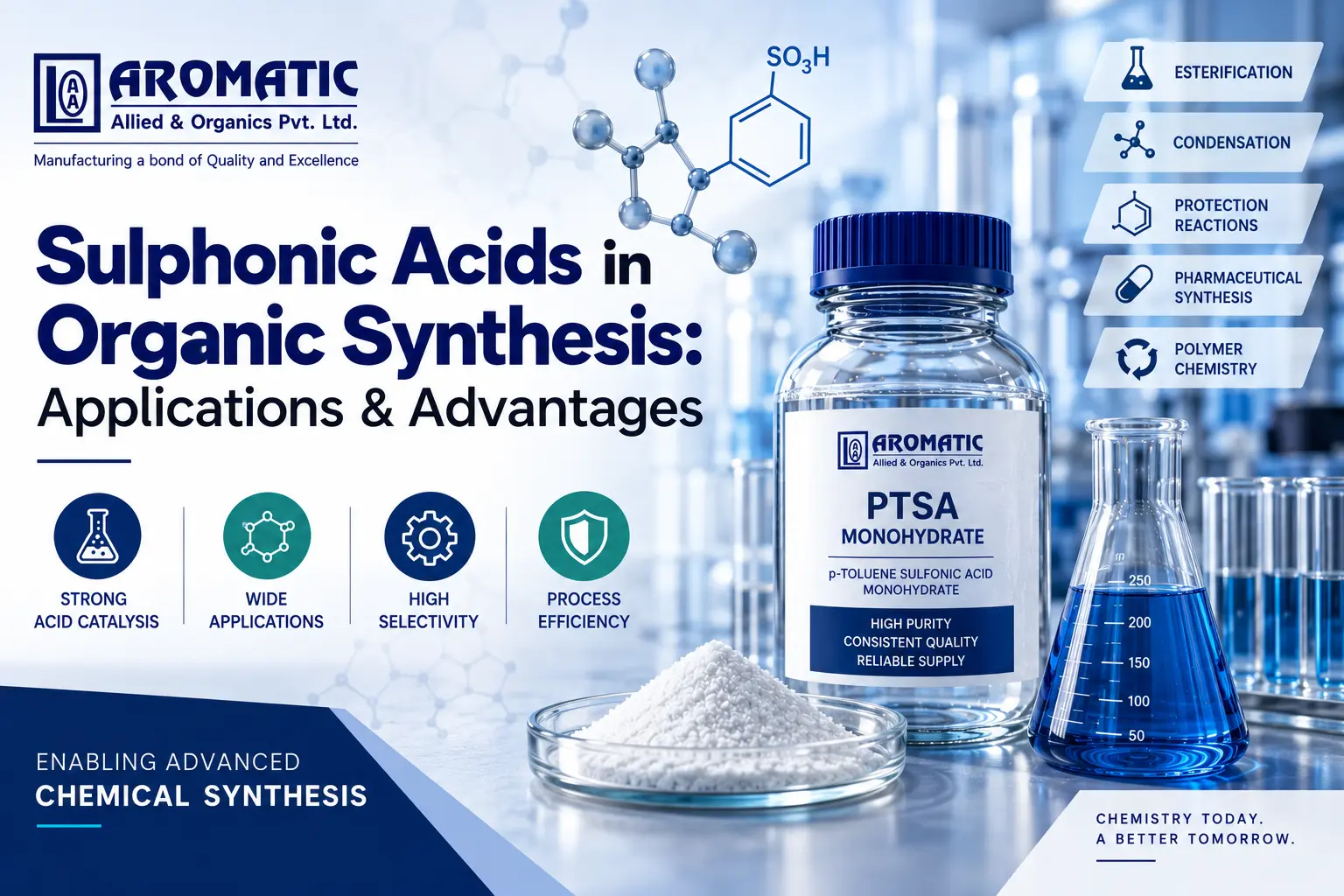
Sulphonic acids are an important class of strong organic acids used in a wide range of synthetic chemistry applications. Their combination of strong Brønsted acidity, structural diversity and compatibility with many organic reaction systems makes them useful as catalysts, intermediates and process reagents.
Among the best-known examples is p-toluenesulphonic acid (PTSA), which is widely used in acid-catalysed reactions such as esterification, condensation, acetalization and selected polymer and resin processes. Other sulphonic acids, including methanesulphonic acid and benzenesulphonic acid, are also used in chemical synthesis depending on the reaction conditions and process requirements.
In organic synthesis, sulphonic acids are especially valuable where a strong acid catalyst is required but the reaction system benefits from an organic acid rather than a conventional mineral acid.
However, the suitability of any sulphonic acid depends on factors such as:
• substrate sensitivity
• solvent system
• water content
• reaction temperature
• downstream purification
• corrosion compatibility
• required product purity
This makes sulphonic-acid selection an important part of both laboratory-scale chemistry and industrial process development.
What Are Sulphonic Acids?
Sulphonic acids are organic compounds containing the sulphonic acid functional group, –SO₃H, attached to an organic group.
Their general structure can be represented as:
R–SO₃H
where R may be an alkyl group, aromatic ring or another organic structure.
Sulphonic acids are generally strong acids because the sulphonate ion formed after proton loss is strongly stabilized by resonance across the oxygen atoms.
This high acidity is one of the main reasons sulphonic acids are useful in organic synthesis.
Common Sulphonic Acids Used in Organic Synthesis
Several sulphonic acids are commonly encountered in synthetic chemistry.
| Sulphonic Acid | Typical Role in Organic Synthesis |
|---|---|
| p-Toluenesulphonic Acid (PTSA) | Acid catalyst in esterification, condensation, acetalization and resin chemistry |
| Methanesulphonic Acid (MSA) | Strong acid catalyst and process acid |
| Benzenesulphonic Acid | Intermediate and acid reagent in aromatic chemistry |
| Camphorsulphonic Acid | Chiral acid and resolving agent in selected applications |
| Solid-supported sulphonic acids | Heterogeneous acid catalysts in selected processes |
The properties of each acid differ, so one sulphonic acid should not automatically be considered interchangeable with another.
Why Are Sulphonic Acids Used in Organic Synthesis?
Sulphonic acids are widely used because they can promote many reactions that require protonation, activation of functional groups or acid-catalyzed bond formation.
Their usefulness comes from several chemical and practical characteristics.
Strong Brønsted Acidity
Sulphonic acids are strong Brønsted acids, meaning they can donate protons effectively.
In organic reactions, protonation can activate functional groups such as:
• carbonyl groups
• alcohols
• acetals
• alkenes
• other acid-sensitive intermediates
For example, protonation of a carbonyl oxygen increases the electrophilicity of the carbonyl carbon, making it more susceptible to nucleophilic attack.
This is why sulphonic acids are frequently used in reactions such as esterification and acetal formation.
Compatibility with Organic Reaction Media
One practical advantage of organic sulphonic acids is their compatibility with many organic reaction systems.
PTSA, for example, is commonly used in organic solvents and can be easier to incorporate into certain reaction mixtures than some strongly aqueous mineral acids.
This can be particularly useful when the reaction:
• contains hydrophobic organic substrates
• requires low water content
• is sensitive to highly aqueous conditions
• needs a strong acid catalyst that disperses effectively in the reaction medium
However, solvent compatibility varies between individual sulphonic acids, so selection should always be reaction-specific.
Catalytic Use
In many synthetic reactions, sulphonic acids can be used in catalytic quantities rather than as stoichiometric reagents.
This is common in acid-catalyzed transformations such as:
• esterification
• transesterification
• acetalization
• condensation
• selected dehydration reactions
The acid activates the reacting functional group and is regenerated during the reaction cycle.
This makes sulphonic acids useful not only in laboratory chemistry but also in process development where catalyst loading, work-up and downstream purification are important considerations.
Structural Flexibility
Not all sulphonic acids behave identically.
Their organic structure can influence:
• solubility
• acidity
• steric behavior
• phase compatibility
• ease of recovery
• suitability for specific substrates
For example, PTSA is an aromatic sulphonic acid, while methanesulphonic acid is an alkanesulphonic acid.
This structural diversity allows chemists to select a sulphonic acid based on the needs of a particular synthetic process rather than relying on a single universal acid catalyst.
Why PTSA Is Especially Important in Organic Synthesis
p-Toluenesulphonic acid (PTSA) is one of the most widely recognized sulphonic acids in organic chemistry.
Its usefulness comes from the combination of strong acidity and practical compatibility with many organic reaction systems.
PTSA is commonly used in reactions including:
• esterification
• acetal and ketal formation
• condensation
• dehydration
• selected protection and deprotection reactions
• polymer and resin chemistry
Because PTSA can often function as an effective acid catalyst in organic media, it is widely used in both laboratory synthesis and industrial chemical processes.
For industrial applications, however, factors such as assay, water content, impurity profile, batch consistency and product form become increasingly important.
This is particularly relevant when using PTSA Monohydrate, where the presence of water may influence reactions that are sensitive to moisture or equilibrium conditions.
Major Applications of Sulphonic Acids in Organic Synthesis
Sulphonic acids are used across a broad range of acid-catalyzed organic reactions. Their role is usually to protonate a functional group, increase electrophilicity, facilitate bond formation, or promote the removal of water or another leaving group.
The exact behavior depends on the substrate, solvent, temperature, water content, and the specific sulphonic acid used.
Esterification Reactions
One of the most common uses of sulphonic acids in organic synthesis is esterification.
In a typical Fischer esterification, a carboxylic acid reacts with an alcohol to form an ester and water:
Carboxylic acid + Alcohol ⇌ Ester + Water
A sulphonic acid catalyst helps by protonating the carbonyl oxygen of the carboxylic acid. This increases the electrophilicity of the carbonyl carbon and makes it more susceptible to nucleophilic attack by the alcohol.
PTSA is frequently used for this purpose because it provides strong acid catalysis and can be compatible with many organic reaction media.
In equilibrium-limited esterification reactions, water removal may be important because accumulated water can shift the equilibrium back toward the starting materials.
Transesterification
Sulphonic acids can also catalyze transesterification, where one ester is converted into another through reaction with an alcohol.
In simplified form:
Ester + Alcohol ⇌ New Ester + New Alcohol
Acid catalysis activates the ester carbonyl and facilitates exchange of the alkoxy group.
The practical effectiveness of a sulphonic acid in transesterification depends on factors such as:
• substrate structure
• alcohol type
• temperature
• water content
• catalyst concentration
• desired conversion
This is relevant in both laboratory synthesis and selected industrial processes.
Acetal and Ketal Formation
Sulphonic acids are widely used in the formation of acetals and ketals from aldehydes or ketones.
These reactions are important because acetals and ketals are commonly used as protecting groups for carbonyl compounds.
The general sequence involves:
1. protonation of the carbonyl oxygen
2. nucleophilic attack by an alcohol or diol
3. formation of intermediate species
4. removal of water
5. formation of the acetal or ketal
Because these reactions are reversible, controlling water content is often important.
PTSA is commonly used as an acid catalyst in these transformations due to its strong acidity and suitability in many organic solvent systems.
Condensation Reactions
Sulphonic acids can catalyze a variety of condensation reactions by activating carbonyl compounds or facilitating dehydration.
In many condensation processes, the acid catalyst helps by:
• increasing carbonyl reactivity
• promoting nucleophilic attack
• stabilizing reaction intermediates
• assisting removal of water
The specific mechanism depends on the substrates involved.
This makes sulphonic acids useful in the synthesis of:
• fine chemicals
• intermediates
• resin precursors
• heterocyclic compounds
• specialty organic molecules
Dehydration Reactions
Strong organic acids can also be used in selected dehydration reactions.
In these reactions, protonation may help convert a poor leaving group into a better one and facilitate elimination of water.
Possible applications include:
• dehydration of alcohols
• cyclization reactions involving water loss
• formation of unsaturated compounds
• condensation-driven synthesis
However, dehydration reactions can be sensitive to temperature and acid strength, and excessive acidity may increase side reactions. Process optimization is therefore important.
Protection and Deprotection Reactions
Sulphonic acids are useful in several protection and deprotection strategies in organic chemistry.
For example, they may be used to:
• form acetals or ketals for carbonyl protection
• remove acid-sensitive protecting groups
• promote cleavage of certain protecting groups under controlled conditions
The advantage is that acid catalysis can often be tuned by changing:
• catalyst loading
• temperature
• solvent
• reaction time
However, strongly acid-sensitive molecules may require milder catalysts or alternative methods.
Selected Alkylation Reactions
Sulphonic acids may participate in selected acid-catalyzed alkylation reactions.
In these systems, protonation can generate a more reactive electrophilic species, allowing carbon-carbon or carbon-heteroatom bond formation.
This application is highly reaction-specific.
It would be inaccurate to say that sulphonic acids are universally preferred alkylation catalysts, because suitability depends heavily on:
• substrate stability
• carbocation formation
• competing side reactions
• reaction temperature
• solvent
• catalyst strength
For this reason, sulphonic acids should be evaluated against alternative Brønsted acids or Lewis acids for the specific chemistry involved.
Resin and Polymer Chemistry
Sulphonic acids, particularly PTSA, are also used in resin and polymer-related processes.
Their strong acidity can support reactions such as:
• condensation
• crosslinking
• curing
• polymer modification
• formation of resin intermediates
In certain thermosetting systems, acid catalysts help promote the reactions that convert lower-molecular-weight resin components into a crosslinked network.
For industrial users, catalyst selection can influence:
• curing rate
• processing temperature
• pot life
• final resin properties
• process consistency
This makes catalyst purity and batch-to-batch consistency important in commercial manufacturing.
Read more: PTSA in Resin and Polymer Production: Applications, Benefits and Process Considerations
Pharmaceutical and Fine-Chemical Synthesis
Sulphonic acids are used in selected pharmaceutical, intermediate, and fine-chemical synthesis routes.
Depending on the process, they may function as:
• acid catalysts
• reaction promoters
• intermediates
• salt-forming agents
• process reagents
PTSA is particularly common in organic synthesis because it can promote acid-catalyzed transformations without introducing a highly aqueous reaction environment.
That can be useful in multi-step synthesis where water content, selectivity, or downstream purification matters.
However, the use of a sulphonic acid in pharmaceutical manufacturing does not automatically mean the material is suitable for pharmaceutical use. Required grade, impurity profile, documentation, and regulatory specifications must be evaluated separately.
Read more: Industrial Uses of Sulphonic Acid: Powerful Applications Driving Modern Manufacturing
Also Read: Sulphonic Acids Used in Detergent Formulations: Applications, Benefits & Industrial Importance
Why These Applications Matter in Process Chemistry
The value of sulphonic acids is not simply that they are “strong acids.”
Their practical importance comes from how they can be matched to a particular reaction system.
A suitable sulphonic acid may help improve:
• reaction rate
• conversion
• selectivity
• compatibility with organic substrates
• catalyst handling
• downstream processing
But the outcome is always process-dependent.
For industrial synthesis, the best catalyst is not necessarily the strongest acid. It is the acid that delivers the required reaction performance while remaining compatible with the process, equipment, work-up, and product-quality requirements.
Advantages of Sulphonic Acids in Organic Synthesis
Sulphonic acids are useful in organic synthesis because they combine strong Brønsted acidity with practical compatibility across many reaction systems.
Their main advantage is not simply that they are “strong acids.” It is that, in the right reaction, they can offer a useful balance of reactivity, solubility, selectivity, handling, and process control.
1. Strong Acid Catalysis
Sulphonic acids are strong proton donors and can efficiently activate functional groups such as carbonyls, alcohols, acetals, and related intermediates.
This makes them useful in reactions where protonation is required to increase electrophilicity or improve leaving-group ability.
Typical applications include:
• esterification
• acetalization
• condensation
• dehydration
• selected protection and deprotection reactions
• resin and polymer chemistry
Because the acid is often regenerated during the catalytic cycle, sulphonic acids can frequently be used in catalytic rather than stoichiometric amounts.
2. Compatibility with Organic Reaction Media
One important advantage of organic sulphonic acids such as PTSA is their compatibility with many organic reaction systems.
This can be useful where highly aqueous mineral-acid conditions are undesirable.
In practice, this may help when:
• substrates are poorly soluble in water
• the reaction is sensitive to excess water
• the process is conducted in an organic solvent
• controlled acid catalysis is required
This does not mean sulphonic acids are always better than mineral acids, but they can be more suitable in certain organic-phase systems.
3. Practical Use of Solid Acids Such as PTSA
PTSA is commonly handled as a crystalline solid, often as PTSA Monohydrate.
For laboratory and manufacturing environments, a solid acid can offer practical advantages such as:
• easier weighing
• controlled dosing
• reduced handling of highly concentrated liquid mineral acids
• convenient storage under appropriate conditions
However, PTSA remains a corrosive acid and must still be handled with suitable PPE, storage, and equipment compatibility.
4. Reaction Selectivity in Suitable Systems
In some reactions, sulphonic acids can provide useful selectivity compared with alternative acidic systems.
This depends strongly on:
• substrate structure
• acid loading
• temperature
• solvent
• reaction time
• water content
Selectivity should therefore be demonstrated experimentally rather than assumed from acid strength alone.
For industrial processes, this is especially important because small differences in catalyst behaviour can affect:
• by-product formation
• purification load
• yield
• final product quality
5. Structural Diversity
The sulphonic-acid family includes compounds with different organic structures, which allows chemists to choose an acid suited to a particular process.
Examples include:
• aromatic sulphonic acids such as PTSA
• alkanesulphonic acids such as methanesulphonic acid
• chiral sulphonic acids
• polymer-supported sulphonic acids
• functionalized solid-acid catalysts
This diversity provides more options than treating “acid catalysis” as a single category.
6. Potential for Reusable or Heterogeneous Acid Catalysts
Some sulphonic-acid groups are incorporated into solid supports or polymeric materials to create heterogeneous acid catalysts.
In suitable systems, these catalysts can offer benefits such as:
• easier separation from the reaction mixture
• potential catalyst recovery
• reduced neutralization requirements
• simplified downstream purification
These advantages are system-specific and depend on catalyst stability, activity, and regeneration performance.
Sulphonic Acids vs Mineral Acids in Organic Synthesis
Sulphonic acids are often compared with mineral acids such as:
• sulphuric acid
• hydrochloric acid
• phosphoric acid
The correct choice depends on the chemistry and process conditions.
| Factor | Sulphonic Acids | Mineral Acids |
|---|---|---|
| Acid strength | Generally strong | Varies by acid |
| Compatibility with organic media | Often good for selected organic systems | Can be limited depending on solvent and water content |
| Physical form | May be solid or liquid | Commonly liquid or aqueous |
| Water introduced into process | Can be lower in some systems | Often significant when aqueous acids are used |
| Corrosion | Can still be corrosive | Often strongly corrosive |
| Catalyst recovery | Possible in selected systems | Process-dependent |
| Selectivity | Reaction-specific | Reaction-specific |
| Industrial suitability | Depends on reaction and process design | Depends on reaction and process design |
The key point is that sulphonic acids should not be described as universally superior to mineral acids.
For some reactions, sulphuric acid may be more economical or more effective.
For others, an organic sulphonic acid such as PTSA may offer better compatibility with the reaction medium or simpler process handling.
The decision should be based on experimental performance and process requirements.
Limitations and Process Considerations
A technically credible discussion of sulphonic acids should also cover where problems can occur.
Corrosion and Equipment Compatibility
Sulphonic acids are strong acids and can be corrosive.
Industrial use therefore requires evaluation of:
• reactor materials
• seals and gaskets
• transfer lines
• storage containers
• pumps and valves
Material selection should be based on the specific acid, concentration, temperature, and process conditions.
Water Sensitivity
Water can significantly influence many acid-catalyzed reactions.
This is particularly important in equilibrium-controlled reactions such as:
• esterification
• acetalization
• ketal formation
For PTSA Monohydrate, the water of crystallization should be considered where moisture content affects conversion or selectivity.
In water-sensitive systems, the distinction between monohydrate and lower-water forms may be important.
Acid-Sensitive Substrates
Strong acid conditions can promote unwanted reactions such as:
• decomposition
• rearrangement
• polymerization
• elimination
• hydrolysis
If the substrate is acid-sensitive, catalyst loading and temperature may need to be reduced, or a milder catalyst may be preferable.
Work-Up and Neutralization
After the reaction, residual acid may need to be:
• neutralized
• extracted
• washed
• removed by filtration
• recovered
This can affect:
• salt formation
• wastewater load
• purification complexity
• product yield
• operating cost
The most effective catalyst during the reaction is not always the easiest catalyst to remove afterward.
Catalyst Removal and Product Purity
For high-purity applications, residual acid or acid-derived impurities may need tight control.
This is particularly important in:
• pharmaceutical intermediates
• fine chemicals
• electronic chemicals
• specialty resins
Catalyst choice should therefore account for downstream purification from the beginning of process development.
How to Select the Right Sulphonic Acid for an Organic Synthesis Process
Choosing a sulphonic acid should be based on the complete process rather than acid strength alone.
Acid Strength
The selected acid must provide enough proton activity to promote the desired reaction without causing excessive side reactions.
Solubility
The catalyst should have suitable compatibility with the reaction medium.
Poor solubility can reduce catalytic efficiency or create mixing problems.
Water Content
Water may affect:
• reaction equilibrium
• conversion
• selectivity
• hydrolysis
• crystallization
This is especially relevant for PTSA Monohydrate.
Reaction Temperature
Some reactions require elevated temperatures, while others are highly temperature-sensitive.
The acid should remain stable and effective under the intended operating conditions.
Purity and Impurity Profile
At laboratory scale, reagent-grade material may be sufficient.
At industrial scale, buyers should consider:
• assay
• water content
• inorganic impurities
• colour
• batch consistency
• application-specific contaminants
Downstream Processing
The catalyst should not be selected only for reaction rate.
It should also be evaluated for:
• neutralization
• removal
• recovery
• purification
• wastewater impact
• final product specifications
Scale of Manufacturing
A catalyst that performs well in a 100 mL flask may behave differently in a multi-tonne reactor.
Industrial scale introduces additional factors such as:
• heat transfer
• mixing
• dosing rate
• reaction exotherm
• storage
• handling
• supply consistency
That is why process chemistry decisions should be validated at the appropriate scale before full commercial adoption.
Laboratory vs Industrial Use of Sulphonic Acids
Sulphonic acids are used in both laboratory-scale synthesis and industrial manufacturing, but the criteria for selecting and handling them can differ significantly.
At laboratory scale, chemists often prioritize reaction performance, convenience, and ease of purification. At industrial scale, those factors still matter, but they must be balanced against process safety, raw-material consistency, equipment compatibility, supply reliability, and downstream processing.
Sulphonic Acids in Laboratory Synthesis
In laboratory organic synthesis, sulphonic acids are commonly selected because they are effective, familiar acid catalysts that can be used across a wide range of reactions.
Typical considerations include:
• reaction yield
• reaction time
• catalyst loading
• solvent compatibility
• ease of addition
• ease of quenching
• work-up simplicity
PTSA is particularly common in laboratory chemistry because it is a strong organic acid and can be convenient to handle in solid form.
For small-scale synthesis, researchers can often screen several acids quickly to determine which provides the best balance of conversion and selectivity.
Sulphonic Acids in Industrial Manufacturing
At industrial scale, catalyst selection becomes more complex.
The reaction may involve:
• large batch sizes
• repeated production cycles
• tight product specifications
• raw-material qualification
• process-safety requirements
• corrosion management
• waste treatment
• long-term supply planning
For these reasons, industrial users need to look beyond whether a sulphonic acid simply “works” in a reaction.
They also need to evaluate:
• assay consistency
• water content
• impurity profile
• batch-to-batch reproducibility
• packaging
• storage stability
• transport requirements
• documentation
• supplier reliability
A catalyst that gives good laboratory results but introduces variability at production scale may not be the best commercial choice.
Common Sulphonic Acids Used in Organic Synthesis
Different sulphonic acids can serve different roles in synthetic chemistry.
| Sulphonic Acid | Typical Role | Common Applications |
|---|---|---|
| p-Toluenesulphonic Acid (PTSA) | Strong organic acid catalyst | Esterification, acetalization, condensation, resin chemistry |
| Methanesulphonic Acid (MSA) | Strong process acid and catalyst | Esterification, selected alkylation and industrial synthesis |
| Benzenesulphonic Acid | Aromatic sulphonic acid and intermediate | Organic synthesis and derivative formation |
| Camphorsulphonic Acid (CSA) | Chiral Brønsted acid | Chiral synthesis, salt formation, resolution |
| Polymer-supported sulphonic acids | Heterogeneous acid catalyst | Reusable catalytic systems in selected processes |
This comparison is useful because the choice of acid should depend on the actual process rather than on familiarity with a single catalyst.
Role of PTSA in Organic Synthesis
Among the sulphonic acids used in synthesis, p-toluenesulphonic acid (PTSA) is one of the most widely recognized.
PTSA is a strong aromatic sulphonic acid commonly used as an acid catalyst in organic reactions.
Its applications include:
• esterification
• transesterification
• acetal and ketal formation
• condensation reactions
• dehydration
• protection and deprotection
• selected resin and polymer processes
The reason PTSA is so widely used is not simply its acidity.
It can be a practical choice where a strong acid catalyst is required in an organic reaction medium and where process conditions are compatible with PTSA.
You may read: PTSA in Organic Synthesis as well.
Why PTSA Is Widely Used
PTSA offers several practical characteristics that make it attractive in synthesis:
• strong Brønsted acidity
• compatibility with many organic solvents
• availability in solid form
• relatively straightforward dosing
• established use across many synthetic transformations
These characteristics make it common in both research laboratories and commercial process chemistry.
PTSA Monohydrate and Water Content
PTSA is often supplied as PTSA Monohydrate.
This form contains one molecule of water associated with each PTSA molecule.
For many reactions, this is not a problem.
However, in water-sensitive or equilibrium-controlled reactions, the water content should be considered carefully.
Examples include:
• esterification
• acetalization
• ketal formation
• moisture-sensitive intermediate synthesis
In these processes, even small amounts of water can influence conversion, equilibrium, or product distribution.
For that reason, the form and water content of PTSA should be considered during process development rather than treated as an unimportant specification.
Conclusion
Sulphonic acids play an important role in organic synthesis because they combine strong acidity with a wide range of practical applications.
They are used in reactions such as:
• esterification
• transesterification
• acetalization
• condensation
• dehydration
• protection and deprotection
• polymer and resin chemistry
• pharmaceutical and fine-chemical synthesis
Among them, PTSA is one of the most widely used sulphonic acid catalysts because of its strong Brønsted acidity and compatibility with many organic reaction systems.
However, the choice of sulphonic acid should always depend on the specific process.
Factors such as water content, solvent compatibility, reaction temperature, impurity profile, equipment materials, and downstream purification can be just as important as acid strength.
For industrial applications, consistent product quality and process suitability are especially important when selecting a sulphonic acid for repeated commercial use.
FAQs
What are sulphonic acids used for in organic synthesis?
Sulphonic acids are used mainly as strong acid catalysts, process reagents, intermediates, and functional-group precursors.
Common applications include esterification, condensation, acetalization, dehydration, resin chemistry, and selected pharmaceutical or fine-chemical synthesis.
Why is PTSA used in organic synthesis?
PTSA is used because it is a strong organic acid that can catalyze many acid-driven reactions while remaining compatible with many organic reaction systems.
It is widely used in esterification, acetalization, condensation, dehydration, and resin-related chemistry.
Are sulphonic acids stronger than carboxylic acids?
Yes.
Sulphonic acids are generally much stronger acids than common carboxylic acids because the sulphonate conjugate base is strongly stabilized.
This makes sulphonic acids more effective proton donors in many acid-catalyzed reactions.
Can sulphonic acids be used as catalysts?
Yes.
Many sulphonic acids are used catalytically in organic synthesis.
They can activate carbonyl compounds, alcohols, and other functional groups by protonation and are regenerated during the catalytic cycle.
What is the difference between sulphonic acid and sulphuric acid?
Sulphonic acids are organic compounds containing an –SO₃H group attached to an organic structure.
Sulphuric acid is an inorganic mineral acid with the formula H₂SO₄.
Both can act as strong acids, but their physical properties, solubility, process behavior, and suitability for specific reactions can differ significantly.
Which sulphonic acid is commonly used in esterification?
PTSA and methanesulphonic acid are both used in esterification chemistry, depending on the substrates, solvent, temperature, and process conditions.
There is no single sulphonic acid that is always best for every esterification process.
Are sulphonic acids used in pharmaceutical synthesis?
Yes, sulphonic acids are used in selected pharmaceutical and intermediate synthesis routes as catalysts, process reagents, intermediates, or salt-forming agents.
The exact grade and quality requirements depend on the intended process and regulatory specifications.
What should be considered when selecting a sulphonic acid catalyst?
Key factors include:
- acid strength
- solubility
- water content
- reaction temperature
- substrate stability
- impurity profile
- catalyst removal
- downstream purification
- equipment compatibility
- industrial scale
The catalyst should be selected for the complete process rather than on acidity alone.


Comments are closed