



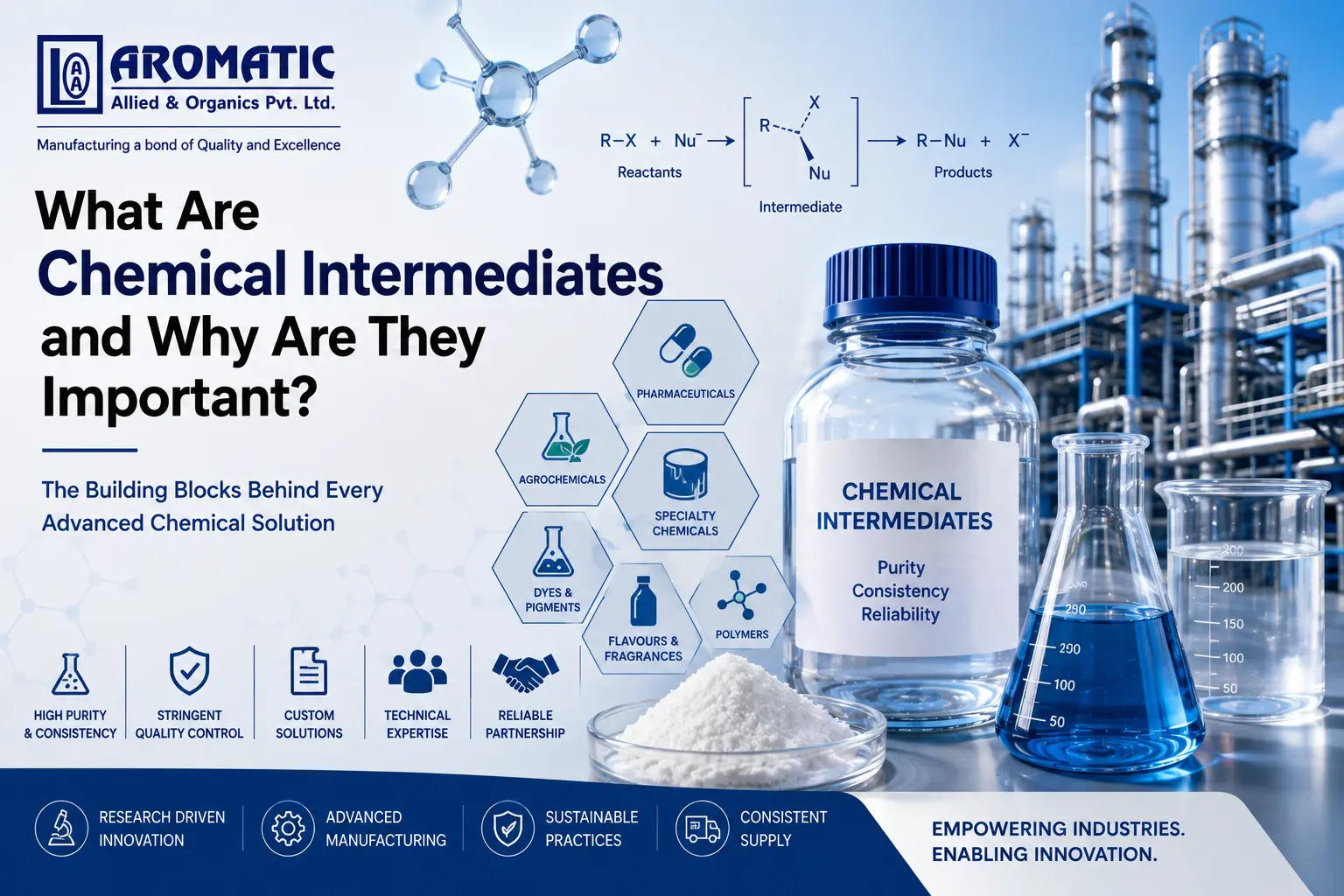
Every medicine, crop protection product, speciality chemical, or industrial formulation begins long before the final product reaches the market. Behind every successful manufacturing process lies a sequence of carefully controlled chemical reactions, each producing compounds that move one step closer to the desired outcome.
These compounds are known as chemical intermediates.
Although they rarely receive the same attention as finished products or Active Pharmaceutical Ingredients (APIs), chemical intermediates are among the most important components of modern manufacturing. They connect individual reaction steps, enable the synthesis of increasingly complex molecules, and help manufacturers produce high-quality products efficiently and consistently.
The importance of chemical intermediates extends across numerous industries, including pharmaceuticals, agrochemicals, dyes, polymers, personal care products, and specialty chemicals. Without them, many of today’s manufacturing processes would become significantly more complex, less efficient, and economically impractical.
Understanding what are chemical intermediates and why are they important is therefore essential not only for chemists and researchers but also for procurement professionals, manufacturers, and industrial buyers responsible for selecting reliable raw materials and supply partners.
In this guide, we’ll explore how chemical intermediates are formed, their role in organic chemistry and industrial manufacturing, why they are indispensable in pharmaceutical production, and what buyers should consider when sourcing them.
Understanding Chemical Intermediates
Before examining their industrial applications, it is helpful to understand what chemists mean by the term “chemical intermediate.”
A chemical intermediate is a substance that is formed during one stage of a chemical reaction and is subsequently consumed in the next stage to produce another compound. Unlike final products, intermediates are not usually intended for direct commercial use. Instead, they serve as transitional compounds that help convert starting materials into more complex molecules through a sequence of controlled reactions.
In industrial manufacturing, intermediates are intentionally produced because they simplify multi-step synthesis pathways, improve reaction control, and make it possible to manufacture sophisticated products at commercial scale.
It is important to distinguish between two closely related concepts:
- Reaction intermediates, which exist only temporarily during the reaction mechanism and are generally not isolated.
- Manufacturing or chemical intermediates, which are deliberately produced, isolated, stored, transported, and used as raw materials in subsequent manufacturing steps.
Although both are called intermediates, they serve different purposes and should not be confused.
This distinction becomes especially important when discussing pharmaceutical manufacturing and specialty chemicals, where isolated intermediates are frequently traded as commercial products.
What Are Intermediates in Chemistry?
One of the most common questions asked by students and industry professionals alike is:
What are intermediates in chemistry?
In chemistry, an intermediate is any compound that forms between the reactants and the final products during a reaction sequence.
Some intermediates exist only for fractions of a second before being transformed into another compound, while others can be isolated, purified, and used as starting materials for subsequent reactions.
For example, many pharmaceutical manufacturing processes involve multiple reaction stages.
Rather than converting raw materials directly into an Active Pharmaceutical Ingredient (API) in a single step, manufacturers produce several intermediate compounds. Each intermediate undergoes additional chemical transformations until the desired final product is obtained.
This stepwise approach offers several practical advantages.
It allows chemists to:
- Monitor individual reaction stages more effectively.
- Improve overall process control.
- Optimise reaction conditions.
- Remove impurities between synthesis steps.
- Scale production more efficiently.
As pharmaceutical molecules become increasingly complex, the importance of carefully designed intermediate stages continues to grow.
You may also read: What is Active Pharmaceutical Ingredient?
What Is an Intermediate in Organic Chemistry?
Understanding what is an intermediate in organic chemistry requires looking at how organic molecules are constructed.
Organic synthesis rarely involves a single chemical reaction. Instead, complex molecules are typically assembled through a series of carefully planned transformations, with each stage producing a compound that becomes the starting material for the next reaction.
These compounds are known as organic intermediates.
Organic intermediates allow chemists to introduce new functional groups, modify molecular structures, protect reactive sites, or improve reaction selectivity before proceeding to subsequent synthesis steps.
For example, during the synthesis of pharmaceutical compounds, process chemists often create several intermediate molecules before the final Active Pharmaceutical Ingredient is produced.
Each intermediate serves a specific purpose within the overall synthetic pathway.
Rather than viewing intermediates as unfinished products, it is more accurate to think of them as carefully engineered milestones that make complex chemical manufacturing possible.
This staged approach enables manufacturers to optimise yield, improve reproducibility, and maintain greater control over product quality throughout the synthesis process.
How Chemical Intermediates Are Formed During Chemical Reactions
Chemical intermediates are created when reactants undergo a sequence of transformations rather than a single direct conversion.
In many industrial synthesis routes, the starting materials react under controlled conditions to produce an intermediate compound. This intermediate then participates in one or more additional reactions before the final product is obtained.
Because each stage can be independently monitored and optimised, manufacturers gain greater flexibility in controlling the overall process.
Several factors influence intermediate formation, including:
Reaction Conditions
Temperature, pressure, solvent selection, catalyst choice, and reaction time all affect how efficiently intermediates are formed and converted into subsequent products.
Catalyst Selection
Catalysts often play a critical role in directing reaction pathways and improving reaction efficiency.
For example, organic acid catalysts such as p-Toluenesulfonic Acid (PTSA) are widely used in various organic synthesis processes because they facilitate important acid-catalysed transformations without becoming part of the final product.
Process Optimisation
Industrial chemists continually optimise reaction conditions to maximise yield while minimising impurities and unwanted side reactions.
Well-designed intermediate stages make this optimisation process more manageable.
Purification Between Stages
Many manufacturing processes include purification after intermediate formation.
Removing impurities before the next reaction step improves overall product quality and helps prevent impurity accumulation throughout the synthesis pathway.
This staged manufacturing strategy has become one of the defining characteristics of modern pharmaceutical and speciality chemical production.
Why Modern Chemical Manufacturing Depends on Intermediates
Few commercial chemicals are produced through a single reaction.
Instead, manufacturers rely on carefully designed synthesis pathways that divide complex chemistry into manageable stages.
Chemical intermediates make this possible.
By isolating and controlling intermediate compounds, manufacturers can:
- Improve reaction efficiency.
- Increase product consistency.
- Simplify quality control.
- Enhance manufacturing scalability.
- Reduce process variability.
- Optimise production economics.
These advantages explain why chemical intermediates have become essential not only in pharmaceutical manufacturing but also in agrochemicals, specialty chemicals, dyes, polymers, electronics, and numerous other industrial sectors.
For companies supplying these materials, maintaining consistent quality, robust documentation, and dependable manufacturing processes is just as important as producing the intermediate itself. This is why experienced manufacturers such as AAOL India focus on delivering chemical intermediates that support reliable downstream manufacturing while meeting the quality expectations of industrial customers.
Reaction Intermediate Explained with Real Examples
One of the most searched questions in chemistry is: what is reaction intermediate explain with an example?
The answer depends on whether we’re discussing a reaction mechanism or an industrial manufacturing process.
A reaction intermediate is a short-lived chemical species that forms during one step of a reaction mechanism before being converted into another compound. Unlike commercial chemical intermediates, reaction intermediates are usually unstable and exist only temporarily. Because of their high reactivity, they are often difficult—or impossible—to isolate under normal reaction conditions.
Reaction intermediates are fundamental to understanding how chemical reactions occur. They help chemists explain why reactions follow specific pathways, why some products are formed preferentially, and how catalysts influence reaction rates and selectivity.
Intermediate Compound Example
A simple intermediate compound example can be found in the nitration of benzene.
During the reaction, a positively charged intermediate known as the arenium ion (also called the sigma complex) is formed after the electrophile attacks the aromatic ring. This intermediate exists only briefly before losing a proton and restoring aromaticity to produce nitrobenzene.
Similarly, in many organic reactions, carbocations, free radicals, carbanions, and reaction complexes function as intermediates that enable the reaction to proceed toward the final product.
Although these species are rarely isolated, understanding them is essential for designing more efficient synthetic pathways.
Reaction Intermediates vs Chemical Intermediates
Because the terminology is similar, these concepts are frequently confused.
Reaction Intermediate | Chemical (Manufacturing) Intermediate |
Exists temporarily during a reaction mechanism | Produced intentionally during manufacturing |
Usually unstable | Stable enough to isolate and transport |
Rarely sold commercially | Frequently traded as industrial chemicals |
Helps explain reaction mechanisms | Used as raw materials for further synthesis |
Understanding this distinction is particularly important in pharmaceutical manufacturing, where isolated chemical intermediates are routinely purchased and used in commercial production.
Why Chemical Intermediates Are Critical in Pharmaceutical Manufacturing
Few industries rely on chemical intermediates as extensively as pharmaceuticals.
Developing an Active Pharmaceutical Ingredient (API) rarely involves a single chemical transformation. Instead, manufacturers build complex molecules through carefully controlled, multi-step synthesis pathways in which intermediate compounds are created, purified, tested, and converted into progressively more advanced structures.
These intermediate stages allow manufacturers to maintain greater control over the manufacturing process while ensuring that impurities are managed before they affect subsequent reaction steps.
Without chemical intermediates, producing many modern medicines at commercial scale would be significantly more challenging.
Building Complex Pharmaceutical Molecules
Many pharmaceutical compounds contain intricate molecular structures that cannot be synthesised efficiently in a single reaction.
Instead, chemists divide the process into manageable stages.
Each stage produces an intermediate that becomes the starting material for the next transformation.
This approach allows manufacturers to optimise individual reactions before progressing to the next stage, ultimately improving process reliability and product quality.
Supporting Process Development
During pharmaceutical research and development, process chemists continually evaluate alternative synthesis routes.
Intermediate compounds provide flexibility during this optimisation process because individual reaction stages can be modified without redesigning the entire manufacturing pathway.
As a result, manufacturers can improve:
- Reaction yield
- Process efficiency
- Product purity
- Manufacturing scalability
- Overall production economics
Improving Quality Control
Each intermediate stage provides an opportunity to evaluate product quality before moving forward.
Rather than waiting until the final API has been synthesised, manufacturers can identify impurities or process deviations much earlier.
This staged quality approach supports better manufacturing consistency while reducing the likelihood of costly downstream failures.
Also read: What is Quality Control in the Pharmaceutical Industry
Supporting Regulatory Expectations
Although regulatory requirements differ depending on the product and market, pharmaceutical manufacturers generally maintain extensive documentation throughout the production process.
Maintaining traceability for intermediate compounds helps support quality assurance, manufacturing investigations, and supplier qualification activities.
Applications of Chemical Intermediates Across Different Industries
Although pharmaceuticals represent one of the largest markets for chemical intermediates, their industrial importance extends far beyond medicine.
Today, intermediate compounds support manufacturing across numerous sectors.
Pharmaceutical Industry
Perhaps the most recognised application involves pharmaceutical intermediate production.
These compounds help manufacturers synthesise Active Pharmaceutical Ingredients while improving process control and manufacturing efficiency.
Agrochemical Industry
Crop protection products frequently require multiple synthesis stages before the final active ingredient is produced.
Chemical intermediates help manufacturers construct increasingly complex molecules used in herbicides, fungicides, and insecticides.
Specialty Chemicals
Many speciality chemicals are themselves produced from intermediate compounds before being supplied to downstream industries.
These intermediates allow manufacturers to develop highly specialised products for specific industrial applications.
Dyes and Pigments
Colour chemistry often involves sequential reactions in which intermediate compounds contribute to the development of dyes and pigments with desired performance characteristics.
Polymer and Material Science
Many advanced polymers, resins, coatings, and performance materials depend on intermediate compounds during manufacturing.
These intermediates enable manufacturers to produce materials with carefully controlled physical and chemical properties.
Personal Care and Cosmetics
Certain ingredients used in cosmetics and personal care products are manufactured through intermediate stages before becoming finished formulation ingredients.
Although the final consumer rarely encounters these compounds, they remain essential to the production process.
What Is an Intermediate in the Chemical Industry?
Outside academic chemistry, the term what is intermediate in chemical industry has a much more practical meaning.
An industrial chemical intermediate is a commercially manufactured substance produced specifically for further chemical processing.
Unlike finished products intended for end users, intermediate chemicals are supplied to manufacturers who use them as raw materials during subsequent production stages.
Examples include intermediates used for manufacturing:
- Active Pharmaceutical Ingredients (APIs)
- Agrochemicals
- Flavour and fragrance ingredients
- Performance chemicals
- Industrial additives
- Specialty polymers
This explains why the global chemical supply chain includes dedicated manufacturers specialising in intermediate production rather than finished products alone.
How Manufacturers Select Chemical Intermediates
Selecting the right intermediate is not simply about chemical composition.
Manufacturers evaluate multiple technical, commercial, and operational considerations before introducing an intermediate into production.
Product Specifications
The intermediate must satisfy the required purity and quality specifications for its intended synthesis pathway.
Process Compatibility
The material should perform consistently under the reaction conditions used within the manufacturing process.
Batch Consistency
Reliable manufacturing depends on receiving intermediate compounds with consistent characteristics across production batches.
Technical Documentation
Quality Assurance teams commonly review documents such as:
- Certificate of Analysis (COA)
- Technical Data Sheet (TDS)
- Safety Data Sheet (SDS)
before approving materials for manufacturing.
Also Read: Understanding COA, TDS, and MSDS: What’s the Difference and Why Every Chemical Buyer Needs All Three
Supply Reliability
Interruptions in intermediate supply can delay production schedules, particularly when the material forms part of a multi-stage synthesis process.
For this reason, procurement teams often evaluate supplier reliability alongside product quality.
Why Process Chemists Value High-Quality Intermediates
To a process chemist, a chemical intermediate is more than just another raw material.
It represents the starting point for the next critical stage of synthesis.
Variations in purity, impurity profile, moisture content, or physical characteristics can influence reaction performance, purification efficiency, and ultimately the quality of the finished product.
This is why organisations involved in pharmaceutical and specialty chemical manufacturing increasingly prioritise consistent, well-characterised intermediates supplied by experienced manufacturers.
For companies such as AAOL India, maintaining consistent quality standards, robust documentation, and dependable supply helps support manufacturers that rely on intermediate compounds throughout their production processes.
What Buyers Should Evaluate Before Purchasing Chemical Intermediates
Selecting the right chemical intermediate involves much more than reviewing a product name or comparing quotations. Because intermediates often influence multiple downstream reactions, procurement decisions can have a direct impact on manufacturing efficiency, product quality, and overall production costs.
Experienced buyers typically evaluate both the product and the supplier before approving a new source.
Product Quality and Purity
Every manufacturing process begins with raw materials that meet clearly defined quality specifications.
Before purchasing an intermediate, buyers should verify that the product specifications align with their manufacturing requirements. Depending on the application, quality parameters may include purity, appearance, moisture content, assay, impurity profile, or other analytical characteristics relevant to the synthesis process.
Consistent quality reduces unnecessary process variability and supports more predictable manufacturing outcomes.
Batch-to-Batch Consistency
A high-quality intermediate should perform consistently every time it enters production.
Variations between batches may affect reaction performance, purification efficiency, product yield, and overall process reproducibility.
Reliable manufacturers maintain robust quality systems to help minimise such variations across commercial production batches.
Technical Documentation
Documentation is an essential part of supplier qualification.
Before introducing a new intermediate into production, buyers commonly request:
- Certificate of Analysis (COA)
- Technical Data Sheet (TDS)
- Safety Data Sheet (SDS)
Together, these documents help quality assurance, procurement, production, and EHS teams evaluate whether the material is suitable for use.
A batch-specific COA confirms analytical results for the supplied material, while the TDS explains typical product characteristics and the SDS provides guidance on safe handling, storage, and emergency response.
Supply Reliability
Interruptions in intermediate supply can affect multiple stages of manufacturing.
For this reason, buyers often assess:
- Manufacturing capacity
- Inventory management
- Lead times
- Packaging options
- Export capabilities
- Supply continuity
A dependable supplier helps manufacturers reduce operational risks while maintaining production schedules.
Technical Expertise
In many cases, selecting an intermediate requires technical discussions regarding reaction chemistry, product suitability, documentation, or application-specific requirements.
Suppliers with strong technical knowledge are often better positioned to support customers during product qualification and long-term manufacturing programmes.
Why the Right Chemical Intermediate Supplier Matters
The quality of an intermediate is only one part of the purchasing decision.
The supplier behind that product often determines how efficiently manufacturers can qualify materials, resolve technical questions, and maintain uninterrupted production.
An experienced supplier contributes value through:
Consistent Manufacturing
Reliable production processes support consistent product quality across multiple batches.
Comprehensive Documentation
Professional documentation simplifies incoming quality inspection, supplier qualification, and regulatory compliance activities.
Responsive Technical Support
Questions relating to product selection, specifications, storage conditions, or documentation are often resolved more efficiently when supported by experienced technical teams.
Long-Term Supply Stability
Manufacturers typically prefer stable supplier relationships because changing suppliers frequently can require additional testing, documentation reviews, and internal qualification procedures.
Choosing a supplier that understands your manufacturing objectives helps reduce procurement complexity over time.
How AAOL India Supports Manufacturers with High-Quality Chemical Intermediates
At AAOL India, we recognise that chemical intermediates form the foundation of numerous industrial manufacturing processes. Whether they are used in pharmaceutical synthesis, specialty chemicals, agrochemicals, or research applications, customers expect products that deliver consistent quality and dependable performance.
Our focus extends beyond supplying chemicals.
We support customers through:
Consistent Product Quality
Quality management practices help ensure that chemical intermediates meet established product specifications and support reliable downstream manufacturing.
Technical Documentation
AAOL India provides essential documentation, including:
- Certificate of Analysis (COA)
- Technical Data Sheet (TDS)
- Safety Data Sheet (SDS)
These documents assist customers during supplier qualification, incoming inspection, and quality assurance activities.
Broad Product Portfolio
Our portfolio includes speciality chemicals and intermediates serving pharmaceutical manufacturers, specialty chemical companies, agrochemical producers, research laboratories, and industrial customers.
This enables organisations to source multiple products through a single trusted supplier.
Customer-Focused Technical Support
From product enquiries to documentation requests, our team works closely with customers to help simplify procurement and support long-term manufacturing requirements.
As industries continue to demand higher quality standards and more resilient supply chains, AAOL India remains committed to providing dependable chemical intermediates backed by technical expertise and responsive customer service.
Conclusion
Understanding what are chemical intermediates and why are they important provides valuable insight into the science behind modern manufacturing.
Although intermediate compounds rarely appear in the finished product, they play a vital role in connecting individual reaction steps, enabling complex synthesis pathways, and supporting consistent production across pharmaceutical, agrochemical, specialty chemical, and industrial manufacturing sectors.
From explaining what are intermediate compounds and what is an intermediate in organic chemistry to understanding their commercial role in today’s chemical industry, one fact remains clear: high-quality intermediates are essential for achieving efficient, scalable, and reliable manufacturing processes.
For organisations sourcing chemical intermediates, selecting the right supplier is just as important as selecting the right product. Consistent quality, robust documentation, technical expertise, and dependable supply all contribute to stronger manufacturing performance and long-term business success.
If your organisation is looking for reliable chemical intermediates for pharmaceutical, specialty chemical, or industrial applications, AAOL India offers a comprehensive portfolio supported by quality-focused manufacturing, technical documentation, and customer-centric service.
Request a Quote to discuss your sourcing requirements with our technical team.
FAQs
What are intermediate chemicals?
Intermediate chemicals are compounds produced during one stage of manufacturing and used as raw materials in subsequent chemical reactions to produce more complex products. They are essential building blocks in industries such as pharmaceuticals, agrochemicals, specialty chemicals, and polymers.
What is the difference between a reaction intermediate and a chemical intermediate?
A reaction intermediate is a temporary species formed during the mechanism of a chemical reaction and is usually not isolated. A chemical intermediate, by contrast, is intentionally manufactured, isolated, and used as a commercial raw material for further synthesis.
Why are chemical intermediates important in pharmaceutical manufacturing?
Chemical intermediates enable manufacturers to build complex pharmaceutical molecules through controlled, multi-step synthesis. They improve process control, facilitate purification between reaction stages, and support consistent product quality.
Are chemical intermediates used only in the pharmaceutical industry?
No. In addition to pharmaceuticals, chemical intermediates are widely used in agrochemicals, specialty chemicals, dyes, pigments, polymers, electronics, personal care products, and many other industrial sectors.
What should buyers look for when sourcing chemical intermediates?
Buyers should evaluate product quality, batch consistency, technical documentation, manufacturing capability, supply reliability, and the supplier’s technical expertise before making a purchasing decision.


Comments are closed