


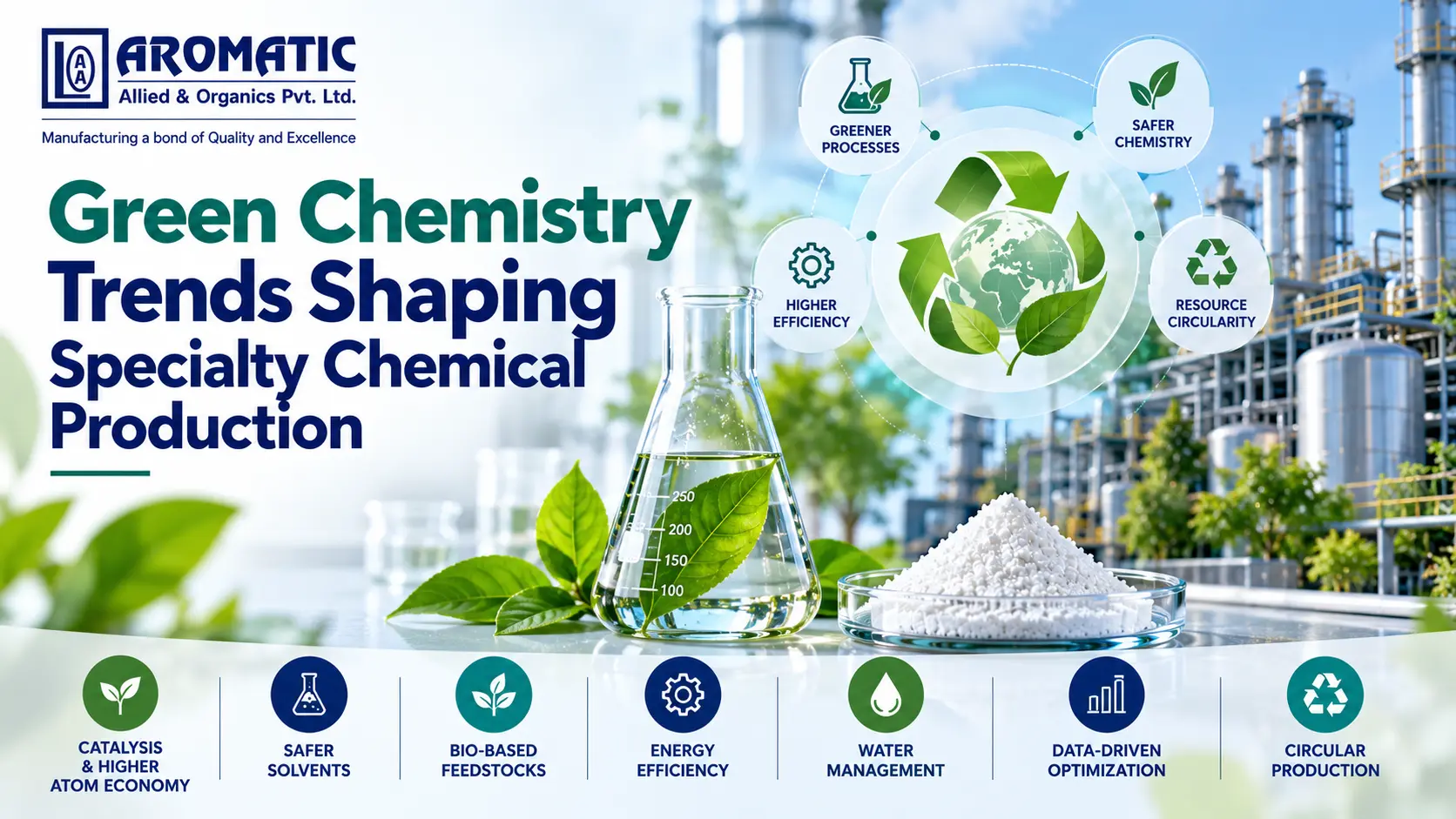
Green chemistry is increasingly influencing how specialty chemicals are designed, manufactured and evaluated. The shift is not simply about replacing one raw material with another or adding an environmental claim to an existing product. It is about reducing waste at source, improving material efficiency, selecting safer inputs where feasible, lowering energy demand, improving process control and considering safety and sustainability earlier in product and process development.
This matters particularly in specialty chemical manufacturing, where complex synthesis routes, lower production volumes and demanding purity specifications can create significant material and process intensity.
The Government of India defines green chemistry around designing chemical products and processes that reduce or eliminate hazardous substances, while its 12 principles emphasize waste prevention, atom economy, safer solvents, energy efficiency, renewable feedstocks, catalysis and real-time process monitoring.
The trends shaping the sector today are therefore less about a single “green” technology and more about changing how chemical processes are conceived, optimized and measured.
What Does Green Chemistry Mean in Speciality Chemical Manufacturing?
Green chemistry focuses on preventing environmental and safety problems at the design stage rather than dealing with them only after waste or emissions have already been generated.
For speciality chemical producers, this can influence decisions such as:
- ● which synthetic route to choose
- ● whether a catalytic pathway can replace a stoichiometric one
- ● how many reaction and purification steps are needed
- ● which solvents are used
- ● how much energy is required
- ● whether raw materials can be sourced from renewable or waste-derived streams
- ● how by-products and wastewater are managed
- ● how process performance is monitored
The core idea is straightforward:
A process should be evaluated not only by whether it produces the required molecule, but by how efficiently and safely it does so.
That does not mean every process can immediately become low-waste, low-energy or renewable-feedstock based. Specialty chemical production often involves strict quality requirements, legacy process constraints and complex reaction chemistry.
Green chemistry therefore works best as a framework for continuous process improvement and better design decisions, not as a marketing label.
AAOL India is also one of India’s leading PTSA manufacturers in India.
1. Greater Use of Catalysis
One of the clearest green chemistry trends is the preference for catalytic processes where they can replace stoichiometric reagents.
The ninth principle of green chemistry specifically recommends using catalysts rather than stoichiometric reagents where possible because catalysts can often perform repeated reaction cycles while being used in much smaller quantities.
In specialty chemical manufacturing, catalytic systems can potentially improve:
- ● reaction selectivity
- ● raw-material utilization
- ● by-product control
- ● process efficiency
- ● downstream purification
However, catalytic chemistry is not automatically greener.
A catalyst may still require:
- ● hazardous solvents
- ● high temperatures
- ● difficult recovery
- ● energy-intensive purification
- ● scarce or problematic materials
The more useful question is not:
“Is this reaction catalytic?”
but:
“Does the catalytic route improve the overall process when material use, waste, energy and safety are considered together?”
This distinction is important for acid-catalyzed chemistry, hydrogenation, oxidation, polymer chemistry and many other specialty chemical processes.
2. Safer Solvents and Lower Solvent Intensity
Solvents can account for a substantial share of the material used in chemical manufacturing.
Green chemistry therefore places strong emphasis on reducing unnecessary solvent use and selecting safer alternatives where technically feasible.
Possible strategies include:
- ● reducing solvent volumes
- ● using higher reaction concentrations
- ● eliminating unnecessary solvent exchanges
- ● selecting lower-hazard solvents
- ● recovering and reusing solvents
- ● using solvent-free conditions where practical
- ● using aqueous systems when appropriate
The Government of India’s green chemistry framework specifically includes safer solvents and reaction conditions as one of the 12 principles.
But the term “green solvent” should be used carefully.
A solvent is not automatically sustainable because it is:
- ● bio-based
- ● water-based
- ● less volatile
- ● marketed as environmentally friendly
A proper assessment also considers:
- ● toxicity
- ● energy required for recovery
- ● process performance
- ● emissions
- ● degradation
- ● recyclability
- ● lifecycle impact
In some cases, a solvent that performs efficiently and can be recovered may offer a better overall process than one that appears safer initially but creates a larger energy or purification burden.
Read more: How to Choose The Right Chemical Supplier in India.
3. Bio-Based and Renewable Feedstocks
Another major trend is growing interest in replacing fossil-derived raw materials with feedstocks from renewable sources.
Examples can include materials derived from:
- ● biomass
- ● agricultural residues
- ● plant oils
- ● fermentation
- ● waste streams
- ● renewable carbon sources
The potential benefits are significant, especially where renewable feedstocks can reduce dependence on finite resources or create new routes from waste-derived materials.
However, renewable does not automatically mean sustainable.
Manufacturers must still evaluate:
- ● feedstock consistency
- ● land and water requirements
- ● seasonality
- ● transportation
- ● purification
- ● cost
- ● availability at scale
- ● final process performance
Current industry analysis also identifies bio-based materials and feedstocks as a major direction for the chemical sector, while noting practical challenges around scalability and performance.
For specialty chemicals, the most realistic opportunity may often be selective replacement of suitable raw materials, rather than complete conversion of an entire portfolio to renewable chemistry.
4. Safe-and-Sustainable-by-Design Chemistry
A major shift in chemical development is the move toward Safe and Sustainable by Design (SSbD) thinking.
Instead of designing a chemical first and assessing its impact later, SSbD aims to bring safety and sustainability considerations into the early stages of innovation.
The European Commission revised its SSbD framework in 2026, encouraging lifecycle-based decision-making that considers safety, environmental impact and sustainability from sourcing through production, use and end-of-life.
For specialty chemical producers, this changes the development question from:
“Can we manufacture this product?”
to:
“Can we manufacture the required function with fewer hazards and lower lifecycle impact?”
This may involve evaluating:
- ● alternative raw materials
- ● alternative synthesis routes
- ● safer substitutes
- ● product persistence
- ● recyclability
- ● process hazards
- ● energy intensity
- ● end-of-life considerations
SSbD is not a claim that a product is automatically sustainable.
It is a structured way to identify trade-offs earlier in development.
5. Higher Atom Economy and Fewer Synthetic Steps
Yield alone does not tell the full story of process efficiency.
A reaction may have a high percentage yield but still produce significant waste if much of the starting material does not become part of the final product.
This is why atom economy is an important green chemistry concept.
The objective is to design synthetic routes where a larger proportion of the atoms in the starting materials are incorporated into the desired product.
Manufacturers are also increasingly interested in:
- ● reducing protection and deprotection steps
- ● avoiding unnecessary derivatization
- ● combining sequential operations
- ● one-pot synthesis
- ● telescoped processes
- ● higher-selectivity reactions
Every eliminated step can potentially reduce:
- ● solvent use
- ● washing
- ● isolation
- ● drying
- ● energy demand
- ● processing time
- ● waste generation
But fewer steps are only beneficial if product quality, safety and process control remain acceptable.
6. Energy-Efficient Process Design
Energy efficiency is another core principle of green chemistry.
This can involve:
- ● reducing unnecessary heating or cooling
- ● shortening reaction cycles
- ● lowering distillation demand
- ● improving heat integration
- ● increasing process concentration
- ● optimizing drying and separation
- ● using process intensification where appropriate
The Government of India’s green chemistry principles recommend increasing energy efficiency and operating at ambient temperature and pressure where practical.
The important qualification is where practical.
Lower-temperature processing is not always the greener option.
For example, a reaction run briefly at a higher temperature may consume less total energy than a much longer low-temperature process.
Therefore, energy performance should be measured across the full process rather than inferred from one operating condition.
7. Real-Time Process Monitoring
Green chemistry increasingly overlaps with process analytical technology and digital process control.
The 12th-principle framework includes real-time analysis to prevent pollution by identifying problems before they create off-specification batches or unnecessary waste.
Real-time or near-real-time monitoring can support:
- ● reaction endpoint control
- ● temperature management
- ● dosing accuracy
- ● impurity monitoring
- ● reduced over-processing
- ● fewer rejected batches
- ● improved batch consistency
For specialty chemicals, this can be especially valuable where:
- ● reactions are sensitive to operating conditions
- ● impurity limits are tight
- ● raw-material variability matters
- ● overreaction creates difficult by-products
The environmental benefit comes indirectly through better control.
A process that avoids rework, batch failure and excess processing can use fewer materials and less energy.
8. AI and Data-Driven Process Optimization
Artificial intelligence and advanced data analytics are increasingly being used in chemical R&D and manufacturing.
Applications may include:
- ● reaction-condition screening
- ● synthetic route evaluation
- ● catalyst selection
- ● predictive modelling
- ● impurity prediction
- ● process optimization
- ● predictive maintenance
Elsevier identifies AI-enabled R&D as one of the important trends currently shaping the chemical industry, particularly for evaluating synthetic routes and predicting properties.
However:
AI itself is not green chemistry.
It is an enabling technology.
AI contributes to greener manufacturing only when it helps reduce:
- ● failed experiments
- ● material consumption
- ● unnecessary processing
- ● energy demand
- ● waste
- ● unsafe process conditions
This distinction matters because digitalization and sustainability are often grouped together even when no environmental benefit has actually been demonstrated.
9. Circularity and Resource Reuse
Circularity is becoming increasingly important in specialty chemical manufacturing.
Rather than viewing materials only as inputs that eventually become waste, manufacturers are increasingly evaluating whether streams can be:
- ● recovered
- ● recycled
- ● reused
- ● repurposed
- ● treated for internal reuse
Relevant examples include:
- ● solvent recovery
- ● reuse of process water
- ● recycle of suitable reaction streams
- ● recovery of valuable by-products
- ● reduced packaging waste
Circularity is also becoming part of broader chemical design frameworks, including Safe and Sustainable by Design approaches that consider impacts throughout the lifecycle.
But recycling a stream is not automatically environmentally preferable.
The recovery process itself may require:
- ● heat
- ● electricity
- ● purification
- ● additional chemicals
The correct decision depends on the complete material and energy balance.
10. Zero Liquid Discharge and Water Management
Water management is particularly important in chemical manufacturing because many processes generate aqueous effluent containing:
- ● salts
- ● residual raw materials
- ● acids(like industrial sulphonic acids etc.) or bases
- ● organic contaminants
- ● process by-products
Zero Liquid Discharge (ZLD) systems are designed so that liquid wastewater is treated and recovered rather than routinely discharged from the facility.
ZLD is not the same as green chemistry.
Green chemistry primarily focuses on preventing waste at the source, while ZLD is largely an environmental management and wastewater-treatment strategy.
That distinction is important.
A process that generates large quantities of wastewater and then treats it through ZLD is not necessarily greener than a process that prevents the wastewater from being generated in the first place.
However, ZLD can still form an important part of responsible industrial water management.
AAOL’s current position
AAOL’s verified sustainability-related manufacturing practice includes Zero Liquid Discharge.
The correct way to describe this is:
AAOL operates with a Zero Liquid Discharge approach as part of its manufacturing infrastructure, supporting controlled wastewater management in specialty chemical production.
I would not use ZLD to claim that every AAOL process is “green” or environmentally superior.
Instead, it should be presented as one verified example of how environmental considerations are applied at the manufacturing-infrastructure level.
11. Measuring Green Chemistry Instead of Just Claiming It
One of the most important trends is the move from broad sustainability language toward measurable process performance.
Useful green chemistry metrics include:
Atom Economy
Measures how much of the starting materials theoretically becomes part of the final product.
Higher atom economy generally means fewer atoms are discarded as by-products.
Process Mass Intensity (PMI)
PMI measures the total mass of materials entering a process relative to the mass of product produced.
The ACS Green Chemistry Institute uses PMI as an important method for benchmarking material efficiency and quantifying improvements in manufacturing processes.
Simplified:
PMI = Total mass of process inputs ÷ Mass of product
Lower PMI generally indicates lower material intensity, although environmental impact still depends on what those materials are.
E-Factor
The E-Factor measures:
Mass of waste generated ÷ Mass of product
It is widely used as an indicator of waste intensity in chemical manufacturing.
Why Multiple Metrics Matter
No single metric proves that a process is sustainable.
A process might have:
- ● excellent atom economy
- ● but use a hazardous solvent
or:
- ● low waste
- ● but high energy demand
or:
- ● renewable feedstocks
- ● but poor lifecycle performance
Green chemistry therefore increasingly requires a multi-metric approach rather than one headline number.
Read this: What Is the Sulphonation Process?
What These Trends Mean for Specialty Chemical Manufacturers
The direction of travel is clear.
Specialty chemical manufacturers are increasingly expected to improve not only product performance but also the way products are made.
That creates pressure and opportunity in several areas:
- ● process redesign
- ● catalyst development
- ● safer solvent selection
- ● resource efficiency
- ● impurity control
- ● lifecycle thinking
- ● regulatory readiness
- ● customer sustainability requirements
- ● supply-chain transparency
The commercial advantage does not come simply from calling a process “green.”
It comes from showing that process improvements can deliver measurable benefits such as:
- ● reduced material use
- ● reduced waste
- ● lower energy demand
- ● improved safety
- ● more consistent manufacturing
- ● reduced treatment burden
Challenges in Adopting Green Chemistry
Green chemistry is not always easy to implement at industrial scale.
Capital Investment
New technologies may require:
- ● new reactors
- ● recovery systems
- ● analytical equipment
- ● wastewater-treatment upgrades
- ● process-control infrastructure
Process Revalidation
Changing:
- ● solvent
- ● catalyst
- ● raw material
- ● temperature
- ● synthesis route
may require extensive testing before commercial adoption.
Product Quality
A greener route is not commercially useful if it cannot consistently meet:
- ● purity specifications
- ● colour requirements
- ● impurity limits
- ● customer performance requirements
Raw-Material Availability
Renewable or safer alternatives may not always be available at:
- ● consistent quality
- ● sufficient scale
- ● acceptable cost
Scale-Up Risk
A reaction that appears efficient in the laboratory may behave differently in production because of:
- ● mixing
- ● heat transfer
- ● mass transfer
- ● reaction kinetics
This is why green chemistry development should follow:
Test → Measure → Validate → Scale
rather than assuming that a laboratory improvement will automatically translate into an industrial one.
Green Chemistry and Specialty Chemical Production in India
India’s specialty chemical sector is increasingly exposed to both domestic and international expectations around environmental performance, safer chemistry and manufacturing efficiency.
The Government of India formally promotes green chemistry concepts such as:
- ● waste prevention
- ● safer synthesis
- ● energy efficiency
- ● catalysis
- ● renewable feedstocks
- ● real-time process analysis
At the same time, Indian specialty chemical companies are investing in areas such as sustainability, bio-based chemistry, digitalization and process optimization as they compete in global supply chains.
For manufacturers, the opportunity is not simply to adopt more environmental language.
It is to demonstrate improvements through:
- ● verified process data
- ● better documentation
- ● measurable resource efficiency
- ● stronger environmental controls
- ● safer process design
Conclusion
Green chemistry is increasingly reshaping specialty chemical production by changing how manufacturers think about process efficiency, safety, resource use and environmental impact.
The most important trends include catalytic chemistry, safer and lower-intensity solvent use, renewable feedstocks, safe and Sustainable by Design approaches, improved atom economy, fewer synthetic steps, lower-energy processing, real-time monitoring, AI-enabled optimisation, resource recovery, and measurable green metrics.
The direction is moving away from vague sustainability claims and toward measurable process improvement.
For speciality chemical manufacturers, the strongest green chemistry strategy is therefore not to claim that every process is sustainable.
It is to identify where material use, waste, energy, safety and environmental control can be improved, measure the results and scale only what is proven to work.
AAOL’s verified Zero Liquid Discharge approach can be positioned as one part of this broader responsibility toward controlled wastewater management, while future green chemistry claims should continue to be supported by process-level evidence.
FAQs
What is green chemistry in specialty chemical manufacturing?
Green chemistry is the design of chemical products and processes to reduce waste, hazardous substances, energy use and environmental impact while maintaining the required chemical function and manufacturing performance.
What are the main green chemistry trends in specialty chemical production?
Major trends include greater use of catalysis, safer solvents, renewable feedstocks, higher atom economy, energy-efficient processing, real-time monitoring, Safe and Sustainable by Design chemistry, circular resource use and measurable green metrics.
How does catalysis support green chemistry?
Catalysts can reduce the amount of reagents required and may improve selectivity or reduce by-product formation in suitable reactions. The overall benefit depends on the full process.
Is AI part of green chemistry?
AI is not itself a green chemistry principle. It can support greener chemistry by helping optimize synthetic routes, reaction conditions, resource use and process control.
What is Process Mass Intensity?
Process Mass Intensity measures the total mass of materials used in a process divided by the mass of product produced. It is commonly used to compare material efficiency.
Is Zero Liquid Discharge a green chemistry process?
Not exactly. ZLD is primarily a wastewater-management strategy, while green chemistry focuses on preventing hazardous substances and waste at source. ZLD can complement green chemistry as part of broader environmental management.
What is Safe and Sustainable by Design?
Safe and Sustainable by Design is a lifecycle-based framework that encourages safety and sustainability considerations to be included early in chemical and material development. The European Commission revised its SSbD framework in 2026.


Comments are closed