


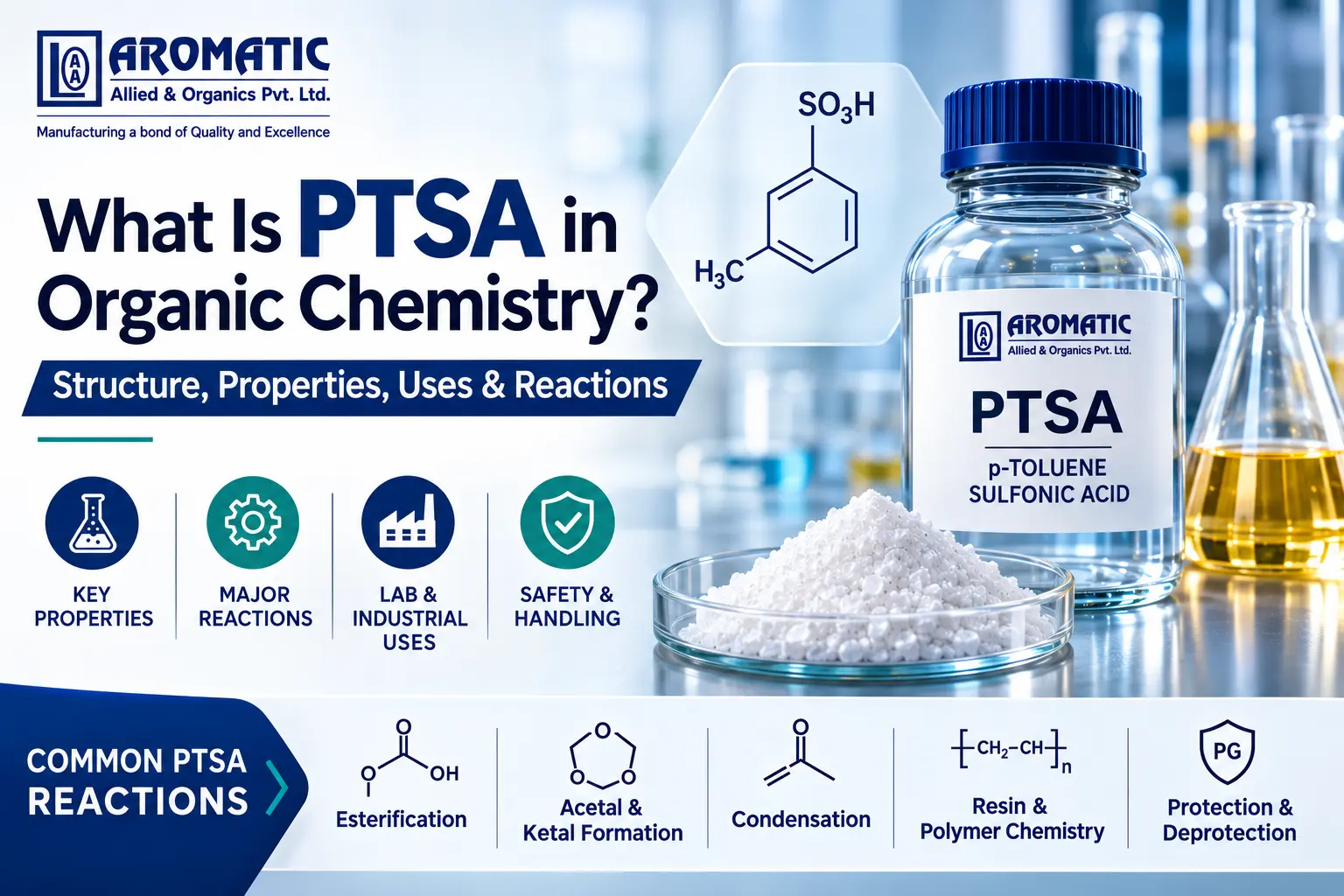
PTSA, short for p-toluenesulfonic acid, is a strong organic acid widely used as an acid catalyst in organic chemistry. Chemists may also write it as p-TsOH, TsOH, para-toluenesulfonic acid, or 4-methylbenzenesulfonic acid.
Its usefulness comes from a practical combination of strong Brønsted acidity and compatibility with many organic reaction systems. PTSA can protonate functional groups and help reactions such as esterification, acetal formation, deprotection, condensation and other acid-catalyzed transformations proceed under suitable conditions.
PTSA is also encountered in more than one physical form, particularly anhydrous PTSA and PTSA Monohydrate. Understanding that distinction is important because their molecular weights and contribution of water to a reaction are different.
This guide explains what PTSA is, how its structure relates to its acidity, why organic chemists use it and how to distinguish it from similarly named compounds such as PTSC and p-toluenesulfonamide.
What Does PTSA Stand For in Organic Chemistry?
In organic chemistry, PTSA normally refers to p-toluenesulfonic acid.
Other commonly used names and abbreviations include:
- ● p-Toluenesulfonic acid
- ● Para-toluenesulfonic acid
- ● p-TsOH
- ● TsOH
- ● 4-Methylbenzenesulfonic acid
- ● Tosic acid
PubChem identifies the compound as 4-methylbenzenesulfonic acid, with the molecular formula C₇H₈O₃S and a molecular weight of 172.20 g/mol for the anhydrous compound.
The abbreviation requires some care, however. In commercial literature, PTSA is occasionally used for para-toluenesulfonamide, which is an entirely different chemical. The surrounding chemical name, CAS number and molecular formula should therefore always be checked rather than relying on the acronym alone.
What Is the Chemical Structure of PTSA?
PTSA is an aromatic sulfonic acid.
Its structure contains three important parts:
- 1. A benzene ring
- 2. A methyl group (–CH₃)
- 3. A sulfonic acid group (–SO₃H)
The methyl group and sulfonic acid group occupy opposite, or para, positions on the aromatic ring.
A simplified representation is:
CH₃–C₆H₄–SO₃H
The presence of the sulfonic acid group is responsible for PTSA’s strong acidity and much of its usefulness as an organic acid catalyst.
PubChem classifies p-toluenesulfonic acid as an arenesulfonic acid and identifies the anhydrous compound as CAS 104-15-4.
Key Properties of PTSA
PTSA can be encountered in anhydrous and hydrated forms. That distinction matters when interpreting molecular weight, CAS number and catalyst quantity.
Property | Anhydrous PTSA | PTSA Monohydrate |
Chemical name | p-Toluenesulfonic acid | p-Toluenesulfonic acid monohydrate |
Common abbreviations | PTSA, p-TsOH, TsOH | PTSA Monohydrate |
Formula | C₇H₈O₃S | C₇H₈O₃S·H₂O |
Molecular weight | 172.20 g/mol | approximately 190.22 g/mol |
CAS number | 104-15-4 | 6192-52-5 |
Hydration state | Anhydrous | One molecule of water associated with each PTSA formula unit |
Common Organic Chemistry similarly distinguishes CAS 104-15-4 for anhydrous p-TsOH and CAS 6192-52-5 for the monohydrate.
AAOL commercially supplies PTSA Monohydrate, not anhydrous PTSA. For the commercial product form, specifications and technical documentation, see AAOL’s PTSA Monohydrate specifications. The current product page identifies CAS 6192-52-5 and a minimum assay of 98%.
Why Is PTSA a Strong Acid?
PTSA behaves as a Brønsted acid, meaning it can donate a proton (H⁺) during a chemical reaction.
When PTSA loses that proton, it forms the p-toluenesulfonate, or tosylate, conjugate base.
The negative charge in the sulfonate group can be distributed across its oxygen atoms through resonance. This stabilization of the conjugate base makes proton donation favourable and contributes to PTSA’s strong acidic behaviour.
This is important in organic chemistry because protonation can change the reactivity of functional groups.
For example, protonation may:
- ● increase the electrophilicity of a carbonyl compound,
- ● convert a poor leaving group into a better one,
- ● assist dehydration,
- ● promote formation of reactive intermediates,
- ● or facilitate reversible protection and deprotection reactions.
PTSA therefore functions as more than simply an acidic substance. Its acidity can be used deliberately to alter reaction pathways.
Why Is PTSA Used in Organic Chemistry?
The main reason PTSA is used is straightforward: many organic transformations require acid catalysis.
PTSA is one of the established organic acids available for providing that catalytic environment.
Its practical characteristics include strong Brønsted acidity, availability as a solid monohydrate and usefulness in many polar organic reaction environments. Common Organic Chemistry describes p-TsOH as a commonly used strong organic acid catalyst.
A 2024 review in Organic & Biomolecular Chemistry also documents the broad use of p-toluenesulfonic acid across modern organic transformations.
That does not mean PTSA is automatically the best acid for every reaction.
Catalyst selection should still consider:
- ● substrate stability,
- ● solvent,
- ● required acidity,
- ● water sensitivity,
- ● catalyst loading,
- ● reaction temperature,
- ● side reactions,
- ● purification,
- ● and scale.
For a wider discussion of its role across different reaction families, see PTSA in organic synthesis.
Common PTSA Reactions in Organic Chemistry
PTSA is used across several types of acid-catalyzed chemistry. The exact conditions and catalyst loading vary substantially between reactions, so the examples below describe reaction roles rather than universal procedures.
Esterification Reactions
Esterification is one of the best-known applications of PTSA.
In Fischer esterification, a carboxylic acid reacts with an alcohol to form an ester and water:
Carboxylic acid + Alcohol ⇌ Ester + Water
PTSA provides acid catalysis by protonating the carbonyl functionality and helping the reaction progress through the required proton-transfer and elimination steps.
Because Fischer esterification is reversible, PTSA accelerates the reaction but does not by itself determine the equilibrium conversion.
AAOL’s technical data also identifies PTSA Monohydrate as an organic catalyst used in esterification industries.
For the full reaction mechanism, equilibrium behaviour and water considerations, read PTSA in esterification reactions rather than duplicating those details here.
Acetal and Ketal Formation
Aldehydes and ketones can react with alcohols under acid catalysis to form acetals or ketals.
PTSA can provide the acidic conditions required to activate the carbonyl group and facilitate formation of these protected derivatives.
Acetal and ketal formation is frequently useful in synthetic chemistry because carbonyl groups may need to be protected while another part of the molecule undergoes a reaction.
The suitability of PTSA depends on whether the other functional groups in the molecule tolerate acidic conditions.
Protection and Deprotection Reactions
PTSA is also used in selected protecting-group chemistry.
For example, Common Organic Chemistry identifies p-TsOH as a catalyst for tetrahydropyranyl (THP) protection and deprotection.
Protecting groups temporarily mask a reactive functional group so that another transformation can be performed elsewhere in the molecule.
Because deprotection often requires controlled cleavage of an acid-sensitive bond, PTSA can be useful where an appropriately strong acid catalyst is required.
Condensation Reactions
PTSA can promote selected condensation reactions by activating carbonyl compounds or supporting formation of reactive intermediates.
Modern research continues to investigate PTSA in multicomponent and one-pot transformations, demonstrating that its role extends beyond traditional esterification and protection chemistry. The appropriate conclusion, however, is not that PTSA improves every condensation reaction; performance remains substrate- and condition-dependent.
Resin and Polymer Chemistry
PTSA also has applications in selected resin and polymer processes where acid catalysis is required.
Depending on the formulation, it may be evaluated in resin formation, curing, crosslinking or other acid-catalyzed processes.
These applications need to be considered separately from small-molecule organic synthesis because variables such as moisture, catalyst concentration, cure behaviour and formulation composition can become particularly important.
For the detailed application discussion, see PTSA in resin and polymer production.
Other Acid-Catalyzed Transformations
PTSA also appears in selected:
- ● dehydration reactions,
- ● hydrolysis reactions,
- ● cyclizations,
- ● rearrangements,
- ● multicomponent reactions,
- ● and other proton-catalyzed transformations.
A broad literature review of PTSA-promoted chemistry shows that researchers continue to study the reagent across diverse synthetic methodologies.
The reaction class alone, however, is not enough to choose PTSA. The substrate and complete process must still be evaluated.
PTSA Monohydrate vs Anhydrous PTSA
The difference between anhydrous PTSA and PTSA Monohydrate is easy to overlook but chemically important.
Anhydrous PTSA contains no stoichiometric water of crystallization.
PTSA Monohydrate contains one water molecule associated with each molecule of PTSA in the formula unit.
That changes the molecular weight:
- ● Anhydrous PTSA: 172.20 g/mol
- ● PTSA Monohydrate: approximately 190.22 g/mol
Consequently, equal masses of the two forms do not contain equal numbers of moles of PTSA formula units.
The hydrated form also introduces water associated with the crystal structure. In reactions where water balance matters—such as some equilibrium-controlled or moisture-sensitive transformations—that contribution should be considered.
This does not mean anhydrous PTSA is universally better.
Whether hydrate water matters depends on the reaction itself, its scale, water-removal strategy, reactant concentrations and required product specification.
AAOL’s commercial offering discussed in this article is PTSA Monohydrate. Anhydrous PTSA is included only to explain the chemistry and terminology.
Is PTSA the Same as Tosyl Chloride or Para-Toluenesulfonamide?
No.
These compounds contain related aromatic sulfonyl structures, which is one reason their names are sometimes confused, but they are chemically different substances.
Compound | Common name / abbreviation | CAS number | Main functional group |
p-Toluenesulfonic acid | PTSA, p-TsOH, TsOH | 104-15-4 | Sulfonic acid |
PTSA Monohydrate | PTSA Monohydrate | 6192-52-5 | Hydrated sulfonic acid |
p-Toluenesulfonyl chloride | PTSC, TsCl, Tosyl chloride | 98-59-9 | Sulfonyl chloride |
p-Toluenesulfonamide | p-Toluenesulfonamide | 70-55-3 | Sulfonamide |
PTSA vs PTSC
PTSA contains a sulfonic acid group (–SO₃H).
PTSC, or p-toluenesulfonyl chloride, contains a sulfonyl chloride group (–SO₂Cl).
PTSC is commonly known as tosyl chloride and serves different synthetic purposes from PTSA.
PTSA vs Para-Toluenesulfonamide
Para-toluenesulfonamide contains a sulfonamide group (–SO₂NH₂) rather than a sulfonic acid group.
Some commercial sources abbreviate para-toluenesulfonamide as “PTSA,” so CAS number and chemical name should always be checked when purchasing, researching or interpreting technical documents.
For organic chemistry discussions, PTSA or p-TsOH ordinarily refers to p-toluenesulfonic acid.
PTSA in Modern Organic Synthesis
PTSA is an established reagent, but its chemistry is not limited to older textbook reactions.
Contemporary research continues to investigate PTSA in areas such as:
- ● one-pot synthesis,
- ● multicomponent reactions,
- ● heterocycle formation,
- ● acid-catalyzed cascade processes,
- ● and alternative reaction media.
A 2024 review of PTSA-promoted transformations documents its continuing use for constructing increasingly complex organic molecules.
PTSA has also been investigated as an acidic component of deep eutectic solvent systems, where the acid can form part of a broader solvent/catalytic environment.
These developments demonstrate continuing research interest, but they should not be interpreted to mean that every PTSA-based process is automatically greener, safer or more efficient. Those outcomes need to be demonstrated for the specific system.
PTSA in Laboratory Chemistry vs Industrial Chemistry
The fundamental chemistry of PTSA does not change when a reaction moves from a flask to a manufacturing reactor, but the decision-making does.
Laboratory Use
At laboratory scale, a chemist may focus primarily on:
- ● reaction conversion,
- ● catalyst loading,
- ● reaction time,
- ● solvent compatibility,
- ● product isolation,
- ● and functional-group tolerance.
A successful small-scale experiment may demonstrate that PTSA can catalyze the desired transformation.
Industrial Use
At manufacturing scale, considerably more must be evaluated.
Process teams may need to consider:
- ● assay,
- ● moisture characteristics,
- ● impurity limits,
- ● raw-material consistency,
- ● batch-to-batch variation,
- ● equipment compatibility,
- ● catalyst dosing,
- ● thermal behaviour,
- ● work-up,
- ● waste generation,
- ● documentation,
- ● packaging,
- ● and supply reliability.
This distinction is important.
A reagent that works chemically is not automatically the best manufacturing choice. The entire process—from raw-material charging through isolation and purification—must be considered.
AAOL identifies organic synthesis, esterification, polymer chemistry, resin manufacturing and industrial catalysis among its application areas.
PTSA Monohydrate for Industrial Applications
AAOL’s commercial PTSA Monohydrate is supplied as AROCAT-pTSA, CAS 6192-52-5.
The current technical specification identifies it as a crystalline PTSA Monohydrate product with a minimum assay of 98%, while the product’s SDS classifies it as corrosive.
For applications requiring the solid hydrated form, buyers can review the complete PTSA Monohydrate product specifications.
AAOL also manufactures a liquid form. Its PTSA Solution for industrial applications is positioned for uses including resin systems, foundry applications, dye chemistry and selected esterification processes.
Both products belong within AAOL’s wider sulphonic-acid chemistry portfolio.
PTSA Safety and Handling
PTSA is a strong corrosive acid and should be handled accordingly.
AAOL’s PTSA Monohydrate SDS classifies the material for skin corrosion, serious eye damage and corrosivity to metals. Appropriate protective equipment, suitable ventilation and procedures based on the current SDS should therefore be used when handling the material.
At manufacturing scale, safety assessment should also consider:
- ● concentration,
- ● reaction temperature,
- ● solvent system,
- ● materials of construction,
- ● mixing,
- ● heat generation,
- ● and the chemistry of other materials present.
A generalized blog article should never replace the current SDS or a facility-specific chemical risk assessment.
Conclusion
PTSA is p-toluenesulfonic acid, a strong organic sulfonic acid commonly used as a Brønsted acid catalyst in organic chemistry.
Its role is fundamentally about proton transfer. By protonating suitable functional groups, PTSA can facilitate esterification, acetal formation, protection and deprotection, condensation and a range of other acid-catalyzed transformations.
Understanding the terminology is just as important as understanding the chemistry. PTSA may refer to anhydrous p-toluenesulfonic acid or, depending on context, a hydrated commercial form such as PTSA Monohydrate. It should not be confused with PTSC/tosyl chloride or p-toluenesulfonamide.
For laboratory work, reaction compatibility and catalyst loading may dominate the decision. At industrial scale, assay, moisture, impurities, safety, work-up, documentation and supply consistency also become important.
AAOL commercially manufactures PTSA Monohydrate for organic synthesis and industrial catalytic applications. For application-specific chemistry, readers can continue to AAOL’s detailed resources on PTSA in organic synthesis and PTSA Monohydrate specifications.
FAQs
What does PTSA stand for in organic chemistry?
PTSA usually stands for p-toluenesulfonic acid, also written as p-TsOH or TsOH. Its IUPAC name is 4-methylbenzenesulfonic acid.
Is PTSA the same as p-TsOH?
Yes. PTSA, p-TsOH and TsOH are commonly used abbreviations for p-toluenesulfonic acid.
Is PTSA a strong acid?
Yes. PTSA is considered a strong organic Brønsted acid and is widely used to catalyze reactions that require proton activation.
Why is PTSA used as a catalyst?
PTSA can donate protons and activate functional groups involved in acid-catalyzed reactions. Because the acid is regenerated during the catalytic cycle, relatively small quantities may be sufficient in suitable processes.
What reactions use PTSA?
PTSA can be used in suitable esterification, acetalization, protection/deprotection, condensation, dehydration and other acid-catalyzed reactions. The required conditions vary with the substrates and process.
What is the difference between PTSA and PTSA Monohydrate?
PTSA Monohydrate contains one molecule of water per PTSA formula unit, whereas anhydrous PTSA does not. The forms therefore have different molecular weights and may contribute differently to the water balance of a reaction.
Is PTSA the same as tosyl chloride?
No. PTSA is p-toluenesulfonic acid, while tosyl chloride is p-toluenesulfonyl chloride, commonly abbreviated as TsCl or PTSC. They have different functional groups and different uses in organic chemistry.
Is PTSA corrosive?
Yes. PTSA is a corrosive acid and should be handled according to the applicable SDS, with appropriate protective equipment and process controls.


Comments are closed