



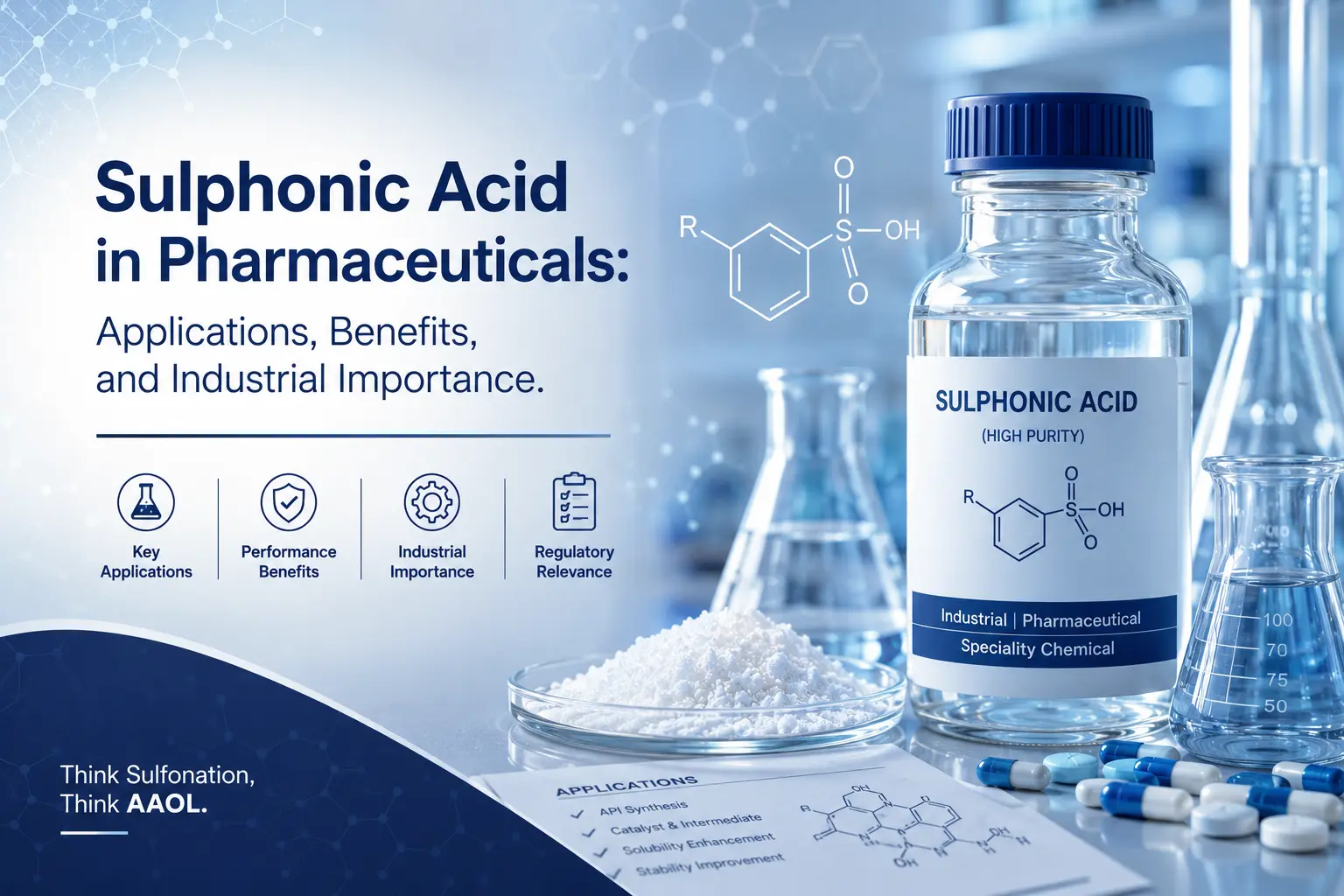
Walk into any pharmaceutical manufacturing facility, and you’ll find countless reactions taking place behind the scenes—many of them dependent on carefully selected catalysts and specialty chemicals. While active pharmaceutical ingredients (APIs) often receive most of the attention, the chemicals that enable efficient synthesis are equally important.
Among these, Sulphonic Acid in Pharmaceuticals has emerged as a critical area of industrial chemistry. Sulphonic acid derivatives such as p-Toluene Sulphonic Acid (PTSA), Xylene Sulfonic Acid (XSA), and Phenol Sulphonic Acid are widely used in chemical synthesis, pharmaceutical intermediates, and process optimization. Their strong acidic properties, stability, and versatility make them valuable tools for pharmaceutical manufacturers striving for consistency, efficiency, and scalability
As pharmaceutical production continues to grow in India and globally, the demand for high-quality sulphonic acid derivatives remains closely tied to innovation in drug development and chemical manufacturing.
Why Sulphonic Acid in Pharmaceuticals Matters in Modern Pharmaceutical Manufacturing
Pharmaceutical synthesis is rarely a single-step process. Most drug molecules require multiple transformations before reaching their final form. Each step must be carefully controlled to ensure product quality, purity, and yield.
This is where sulphonic acid derivatives play an important role.
Strong organic acids are frequently utilized to facilitate chemical transformations, accelerate reaction rates, and improve process efficiency. Compared to some conventional inorganic acids, certain sulphonic acid derivatives offer advantages in handling, storage, and compatibility with organic reaction systems.
For pharmaceutical manufacturers, this translates into:
• Improved reaction control
• Consistent process performance
• Better scalability
• Enhanced production efficiency
• Reliable synthesis of pharmaceutical intermediates
These advantages explain why sulphonic acid chemistry continues to be relevant in both research laboratories and commercial-scale pharmaceutical facilities.
Understanding the Different Types of Sulphonic Acids Used Across Industries
Not all sulphonic acids serve the same purpose. Different derivatives are selected based on reaction requirements, manufacturing conditions, and end-use applications.
p-Toluene Sulphonic Acid (PTSA)
Among industrial sulphonic acids, p-Toluene Sulphonic Acid (PTSA) is often considered one of the most versatile and widely used.
PTSA is a strong organic acid commonly used as a catalyst in organic synthesis. It is frequently employed in reactions such as:
• Esterification
• Transesterification
• Acetalization
• Ketalization
• Condensation reactions
Its effectiveness, combined with ease of handling, has made it a preferred catalyst across pharmaceutical and specialty chemical manufacturing.
Xylene Sulfonic Acid (XSA)
Xylene Sulfonic Acid belongs to the aromatic sulphonic acid family and is used across a range of industrial chemical processes.
Its acidic characteristics and compatibility with industrial formulations make it relevant for manufacturers involved in specialty chemicals, intermediates, and process chemistry.
Phenol Sulphonic Acid
Phenol Sulphonic Acid combines aromatic functionality with sulphonic acid chemistry, making it valuable in multiple industrial applications.
It is commonly utilized in chemical processing environments where sulfonated aromatic compounds play a role in downstream manufacturing operations.
Applications of Sulphonic Acid in Pharmaceuticals
The importance of Sulphonic Acid in Pharmaceuticals extends far beyond a single reaction type.
Modern pharmaceutical manufacturing relies on sulphonic acid derivatives for several critical functions.
Catalysis in Organic Synthesis
Many pharmaceutical molecules require acid-catalyzed transformations during synthesis.
Sulphonic acid derivatives help facilitate these reactions by providing strong acidic environments that support efficient chemical conversion.
This catalytic role contributes to:
• Reduced reaction times
• Improved conversion rates
• Greater process consistency
• Enhanced manufacturing efficiency
Production of Pharmaceutical Intermediates
Pharmaceutical intermediates serve as the building blocks of drug manufacturing.
Sulphonic acid chemistry often supports the synthesis pathways required to produce these intermediates, enabling manufacturers to develop complex molecules through controlled chemical transformations.
Process Optimisation and Scale-Up
Laboratory chemistry and commercial manufacturing are very different environments.
A reaction that performs well on a small scale must also deliver consistent results in large production batches.
Sulphonic acid derivatives can help support process optimization efforts by contributing to stable reaction conditions and reproducible outcomes.
Advanced Specialty Chemical Manufacturing
Many pharmaceutical manufacturers also produce or source specialty chemical intermediates.
Sulphonic acids are frequently incorporated into broader manufacturing ecosystems that support:
• Contract manufacturing
• Custom synthesis
• API development
• Specialty chemical production
Why PTSA Continues to Be a Preferred Choice for Pharmaceutical Processes
Ask process chemists about reliable organic acid catalysts, and PTSA often enters the conversation.
Its popularity is not accidental.
Strong Acidity with Practical Handling Advantages
One reason PTSA remains widely used is its combination of strong acidity and practical handling characteristics.
Unlike certain liquid acids, PTSA is available in solid form, simplifying storage, transportation, and dosing procedures.
Compatibility with Organic Systems
Pharmaceutical synthesis frequently takes place in organic solvent environments.
PTSA’s compatibility with many organic systems makes it particularly useful for a wide range of industrial applications.
Proven Industrial Utility
Decades of use across pharmaceutical, specialty chemical, and industrial manufacturing sectors have established PTSA as a dependable catalyst for numerous synthesis pathways.
What Pharmaceutical Procurement Teams Look for When Sourcing Sulphonic Acids
For procurement managers and sourcing specialists, purchasing decisions involve much more than price.
The quality of specialty chemicals can directly influence production outcomes.
When evaluating suppliers, pharmaceutical companies typically focus on:
Product Consistency
Consistency is critical when chemicals are used repeatedly across manufacturing campaigns.
Variations in quality can affect process performance and increase operational risk.
Documentation and Traceability
Technical documentation supports quality assurance efforts and helps manufacturers maintain compliance with internal standards.
Reliable Supply Chain Management
Production schedules depend on dependable material availability.
A supplier’s ability to deliver consistently often becomes a major factor in long-term purchasing decisions.
Technical Support
Experienced suppliers can help customers identify suitable grades, understand application requirements, and optimize procurement strategies.
The Growing Importance of Sulphonic Acid Derivatives in India’s Pharmaceutical Sector
India has become one of the world’s most significant pharmaceutical manufacturing hubs.
As production capacity expands and manufacturers pursue increasingly complex synthesis pathways, demand for specialty chemicals continues to grow.
Sulphonic acid derivatives support many of the chemical processes required to manufacture pharmaceutical intermediates and specialty compounds. Their relevance extends beyond pharmaceuticals into agrochemicals, specialty chemicals, and industrial processing sectors.
This growth has increased the importance of working with suppliers capable of maintaining quality, consistency, and dependable supply across changing market conditions.
How AAOL India Supports Specialty Chemical Requirements
For manufacturers sourcing sulphonic acid derivatives, supplier expertise can be as important as product quality.
AAOL India serves industries that require dependable specialty chemical solutions, including pharmaceutical manufacturing, specialty chemicals, and industrial processing. Organizations often look for suppliers that understand technical requirements, maintain quality standards, and support long-term procurement needs.
As market expectations evolve, partnerships with experienced companies such as AAOL India can help manufacturers strengthen supply chain resilience while maintaining consistent access to essential chemical products.
Choosing the Right Sulphonic Acid Supplier for Long-Term Success
Selecting a supplier should be viewed as a strategic business decision rather than a transactional purchase.
A reliable Sulphonic Acid supplier should offer:
• Consistent product quality
• Technical expertise
• Reliable logistics
• Responsive customer support
• Strong industry experience
• Long-term supply capability
Manufacturers that establish strong supplier relationships are often better positioned to manage production demands and maintain operational continuity.
This is particularly important in industries where quality and consistency directly influence manufacturing outcomes.
Future Outlook: Where Sulphonic Acid Chemistry Is Heading
The pharmaceutical industry continues to evolve through advances in process chemistry, manufacturing efficiency, and drug development.
As manufacturers seek improved production methods and scalable synthesis solutions, sulphonic acid derivatives are expected to remain important contributors to industrial chemistry.
Products such as PTSA, XSA, and Phenol Sulphonic Acid will likely continue supporting pharmaceutical intermediates, specialty chemical manufacturing, and advanced synthesis applications for years to come.
Companies that invest in quality sourcing and technical expertise will be better equipped to capitalize on these opportunities.
Conclusion
The role of Sulphonic Acid in Pharmaceuticals extends far beyond basic chemical processing. Sulphonic acid derivatives such as p-Toluene Sulphonic Acid (PTSA), Xylene Sulfonic Acid (XSA), and Phenol Sulphonic Acid contribute to pharmaceutical synthesis, intermediate production, process optimization, and industrial manufacturing efficiency.
As India’s pharmaceutical and specialty chemical sectors continue to expand, demand for reliable, high-quality sulphonic acid products is expected to remain strong. Whether manufacturers are focused on pharmaceutical intermediates, custom synthesis, or large-scale production, selecting the right Sulphonic Acid supplier can have a meaningful impact on operational performance.
For organizations seeking dependable sourcing, technical expertise, and consistent quality, partnering with an experienced Sulphonic Acid manufacturerer in india such as AAOL India can help support long-term manufacturing goals and supply chain reliability.


Comments are closed