



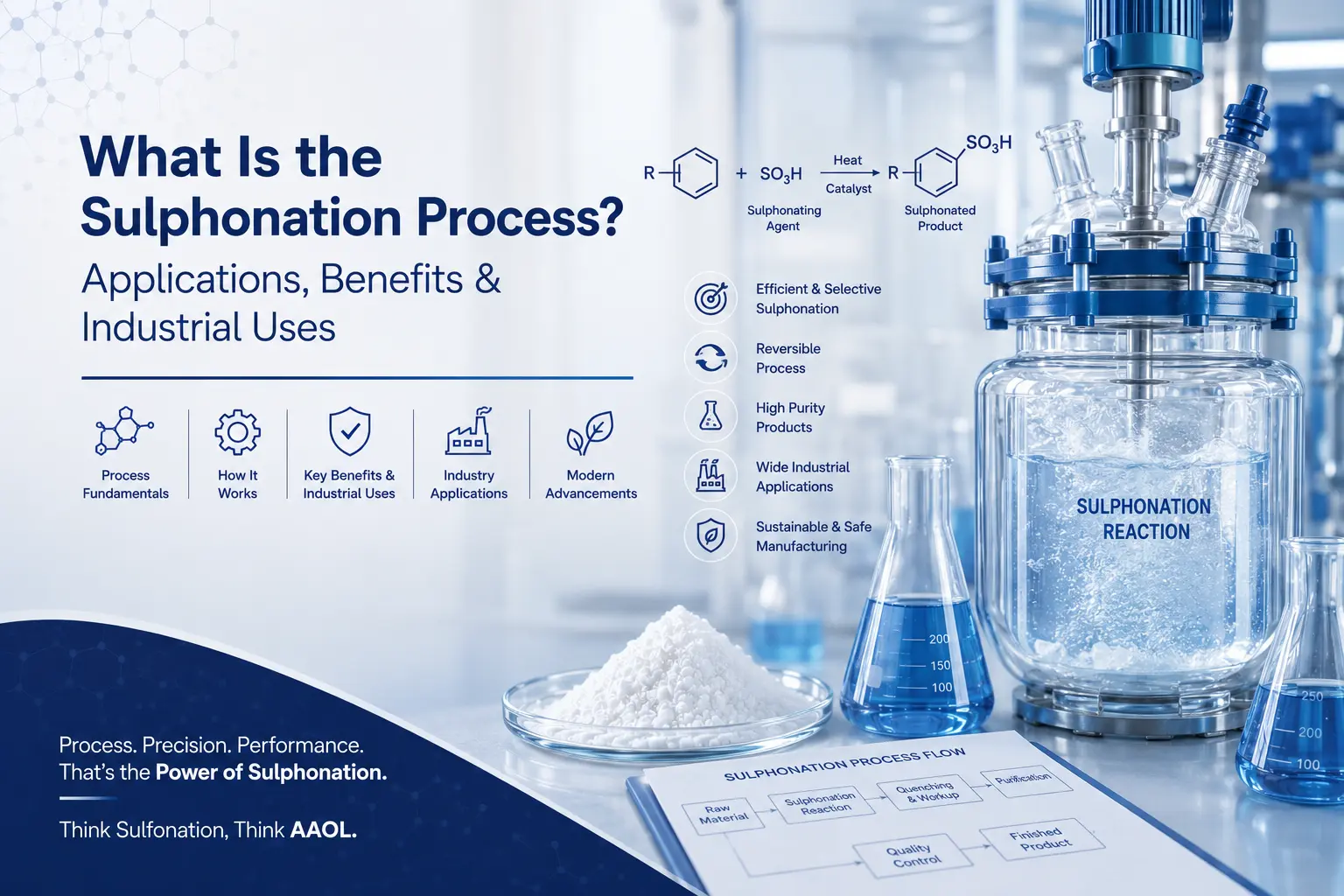
What Is the Sulphonation Process?
Behind many everyday products—from household detergents and personal care formulations to pharmaceutical intermediates and specialty chemicals—lies a chemical reaction that rarely receives public attention but plays a vital role in industrial manufacturing: the Sulphonation Process.
For chemical manufacturers, sulphonation is far more than a textbook reaction. It is a foundational industrial process that helps transform relatively simple organic compounds into highly functional molecules with improved solubility, surface activity, and chemical performance. The reaction has become essential across multiple sectors because it enables the production of compounds that modern industries depend on every day.
Whether the end product is a detergent surfactant, a pharmaceutical intermediate, a dye molecule, or a specialty chemical, the sulphonation process continues to be one of the most commercially significant chemical transformations used worldwide.
Understanding the Fundamentals of the Sulphonation Process
At its core, sulphonation is the chemical process of introducing a sulphonic acid group (-SO₃H) into an organic molecule.
In industrial chemistry, this transformation is typically achieved using sulphonating agents such as sulphur trioxide (SO₃), oleum, or sulphuric acid under controlled reaction conditions.
The addition of a sulphonic acid group can significantly alter the physical and chemical properties of a molecule. Depending on the application, sulphonation may improve:
• Water solubility
• Surface-active properties
• Chemical reactivity
• Compatibility with formulations
• Functional performance in industrial applications
This ability to modify molecular properties is one reason sulphonation remains a cornerstone of modern chemical manufacturing.
Why Is the Sulphonation Process So Important in Industrial Chemistry?
Very few chemical reactions have found widespread use across as many industries as sulphonation.
The reason is simple: manufacturers often need to convert hydrophobic organic compounds into materials that can interact effectively with water or other formulation systems.
Sulphonation provides a practical route to achieving this transformation.
As a result, sulphonated compounds are widely used in:
• Detergents and surfactants
• Pharmaceutical intermediates
• Dyes and pigments
• Agrochemicals
• Water treatment chemicals
• Industrial cleaners
• Specialty chemical formulations
For manufacturers, the process creates opportunities to develop products with enhanced performance characteristics while maintaining scalability for large-volume production.
How Does the Sulphonation Process Work?
Although industrial sulphonation systems can become highly sophisticated, the fundamental principle remains straightforward.
The reaction typically involves an organic substrate reacting with a sulphonating agent that introduces the sulphonic acid functional group.
For aromatic compounds such as benzene derivatives, sulphonation generally occurs through an electrophilic aromatic substitution mechanism.
In industrial facilities, several variables must be carefully controlled to ensure consistent results:
Temperature Control
Sulphonation reactions are often highly exothermic, meaning they release heat during the reaction.
Maintaining appropriate temperatures is critical for product quality and process safety.
Reaction Time
The duration of the reaction influences conversion efficiency and final product characteristics.
Sulphonating Agent Selection
Different applications may require different sulphonating systems depending on product specifications and process objectives.
Product Purity Requirements
Industries such as pharmaceuticals and specialty chemicals frequently demand tighter control over reaction conditions to achieve required purity standards.
Why Sulphonation Is Reversible
One of the most frequently asked questions in industrial and academic chemistry is: why sulphonation is reversible?
Unlike some chemical transformations that proceed almost entirely in one direction, aromatic sulphonation can be reversed under specific conditions through a process known as desulphonation.
When aromatic sulphonic acids are heated in the presence of dilute acid and water, the sulphonic acid group can be removed from the aromatic ring, effectively reversing the original sulphonation reaction.
This reversibility is particularly important in synthetic chemistry because it allows chemists to use sulphonation strategically as a temporary modification step during multi-stage synthesis pathways.
The reversible nature of the reaction has contributed significantly to its value in both research laboratories and industrial manufacturing environments.
Sulphonation Process in Detergent Manufacturing
Few industries demonstrate the commercial significance of sulphonation more clearly than the detergent sector.
The sulphonation process in detergent production is fundamental to the manufacture of many anionic surfactants used in household and industrial cleaning products.
One well-known example is the production of Linear Alkyl Benzene Sulphonic Acid (LABSA), a key raw material used in detergent formulations worldwide.
During manufacturing, organic feedstocks are sulphonated to produce surfactant molecules capable of reducing surface tension and helping remove dirt, oils, and contaminants from surfaces.
For detergent manufacturers, sulphonation directly influences:
• Cleaning performance
• Foaming characteristics
• Product stability
• Formulation efficiency
• Cost-effectiveness
Because detergents represent one of the largest end-use markets for sulphonated products, advancements in sulphonation technology continue to receive significant attention from manufacturers worldwide.
Applications of Sulphonation Across Major Industries
The versatility of sulphonation extends well beyond detergents.
Pharmaceutical Manufacturing
In pharmaceutical chemistry, sulphonation can contribute to the synthesis of intermediates and specialty compounds used in drug development and manufacturing.
Many pharmaceutical processes rely on carefully controlled functional group transformations, making sulphonation an important tool in synthetic chemistry.
Specialty Chemical Production
Specialty chemical manufacturers frequently use sulphonation to modify molecular properties and improve performance characteristics.
This flexibility allows producers to create customized products for highly specific industrial applications.
Dye and Pigment Manufacturing
Sulphonated compounds are widely used in dye chemistry because the sulphonic acid group can improve water solubility and processing characteristics.
Agrochemical Production
Certain agrochemical manufacturing pathways utilize sulphonation chemistry during intermediate production and formulation development.
Water Treatment and Industrial Processing
Sulphonated compounds are also found in products used for industrial cleaning, water treatment, and process optimization applications.
Industrial Challenges Associated with Sulphonation
Despite its importance, sulphonation is not always a straightforward process.
Manufacturers must carefully manage several operational challenges.
Heat Management
Sulphonation reactions can generate significant heat, requiring effective process control and equipment design.
Corrosion Considerations
Certain sulphonating systems may require corrosion-resistant materials and specialized equipment.
Product Consistency
Maintaining consistent reaction conditions is essential for achieving reliable product quality.
Environmental and Safety Requirements
Modern manufacturing facilities must balance production efficiency with environmental compliance and workplace safety standards.
Successfully managing these factors often separates high-performing operations from average ones.
How Modern Sulphonation Technology Has Evolved
Over the decades, sulphonation technology has undergone significant improvements.
Modern production systems are designed to achieve:
• Better reaction control
• Improved energy efficiency
• Higher product consistency
• Reduced waste generation
• Enhanced operational safety
These advancements have helped manufacturers meet growing demand while maintaining increasingly stringent quality requirements.
The result is a more efficient and sustainable approach to producing sulphonated products for global markets.
How AAOL India Supports Industries That Depend on Sulphonation Chemistry
As industries continue to rely on sulphonated products, sourcing high-quality chemical raw materials becomes increasingly important.
At AAOL India, we understand that manufacturers are not simply purchasing chemicals—they are investing in process reliability, product consistency, and long-term operational performance.
Organizations operating in pharmaceuticals, detergents, specialty chemicals, and industrial processing often require suppliers capable of supporting evolving manufacturing requirements while maintaining dependable supply chains.
This is where technical expertise, product quality, and industry experience become valuable differentiators.
To know more about sulphonic acid, you may read Sulphonic Acid in Pharmaceuticals: Applications, Benefits & Industrial Importance.
What Manufacturers Should Consider When Selecting Sulphonation-Related Raw Materials
Chemical procurement decisions have become increasingly strategic.
Before selecting raw materials associated with sulphonation chemistry, manufacturers often evaluate:
Quality Consistency
Consistent material specifications support predictable manufacturing outcomes.
Supply Reliability
Reliable sourcing helps reduce operational disruptions.
Technical Documentation
Comprehensive technical information supports quality assurance and regulatory requirements.
Industry Expertise
Suppliers with strong technical understanding can help customers navigate complex manufacturing challenges more effectively.
The Future of Sulphonation in Industrial Manufacturing
As industries continue to pursue higher-performance materials and more efficient production methods, sulphonation chemistry is expected to remain highly relevant.
The reaction’s ability to modify molecular properties, improve product functionality, and support large-scale manufacturing ensures its continued importance across numerous sectors.
From detergents and pharmaceuticals to specialty chemicals and industrial formulations, sulphonation remains one of the most versatile and commercially valuable transformations available to chemical manufacturers.
Conclusion
The Sulphonation Process remains one of the most important reactions in industrial chemistry because it enables the production of essential materials used across detergents, pharmaceuticals, dyes, agrochemicals, and specialty chemicals.
Understanding how sulphonation works, why sulphonation is reversible, and the role of the sulphonation process in detergent manufacturing provides valuable insight into why this chemistry continues to be widely used around the world.
As manufacturing requirements evolve, organisations that prioritise quality raw materials, technical expertise, and reliable supply partnerships will be better positioned to maximize the benefits of sulphonation chemistry. For industries seeking dependable chemical solutions, AAOL India remains committed to supporting manufacturers with products and expertise that contribute to long-term operational success.


Comments are closed