



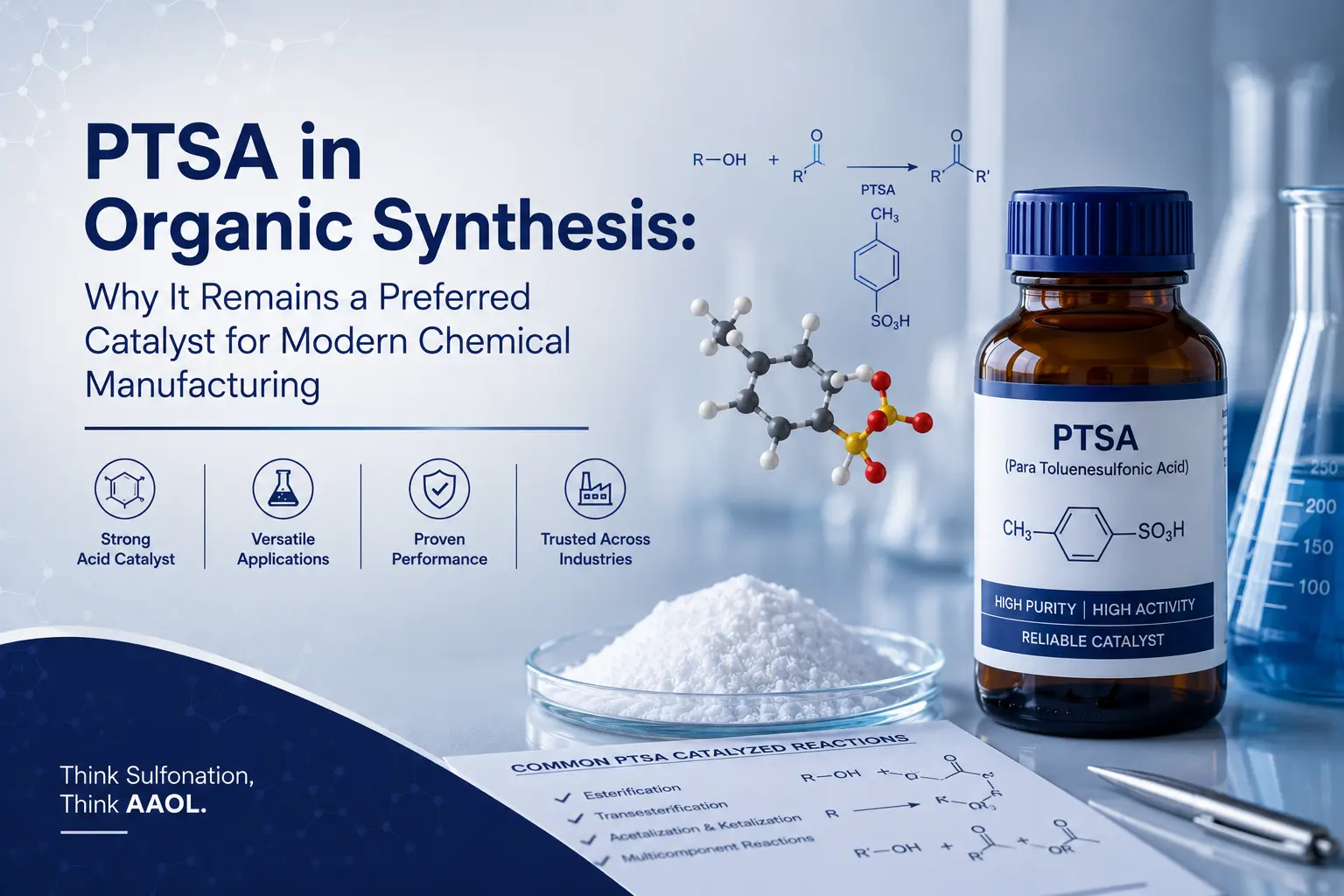
In industrial chemistry, some materials earn their reputation through decades of consistent performance rather than industry hype. p-Toluenesulfonic Acid, commonly known as PTSA, is one of them.
Whether a pharmaceutical manufacturer is scaling an intermediate, a specialty chemical producer is optimizing reaction efficiency, or a contract synthesis company is improving process economics, PTSA frequently appears as the catalyst of choice. Its widespread adoption is not accidental. The combination of strong acidity, solid-state handling, compatibility with organic reaction systems, and versatility across multiple reaction types has made PTSA one of the most widely used organic acid catalysts in modern synthesis.
Today, PTSA in Organic Synthesis continues to play an important role across pharmaceuticals, agrochemicals, speciality chemicals, resins, coatings, and advanced manufacturing processes where reliable catalytic performance is essential.
Understanding PTSA: More Than Just Another Acid Catalyst
p-Toluenesulfonic Acid (TsOH or PTSA) belongs to the family of aromatic sulfonic acids. Chemically, it is an arenesulfonic acid derived from toluene and is typically supplied as a white crystalline solid. It is highly soluble in water and many polar organic solvents, making it suitable for a broad range of reaction environments.
What distinguishes PTSA from many traditional acids is its unique balance of strength and practicality.
While strong mineral acids such as sulfuric acid and nitric acid have long been used in synthesis, PTSA offers strong acidity in a convenient solid form. Because it is non-oxidizing and can be weighed, transported, and stored more easily than many liquid acids, it has become a preferred option in both laboratory and industrial settings.
For process chemists, these characteristics often translate into improved operational convenience without sacrificing catalytic effectiveness.
Why PTSA Has Become a Preferred Catalyst in Organic Synthesis
Choosing a catalyst is rarely about acidity alone.
Manufacturers evaluate catalysts based on process efficiency, scalability, safety considerations, product quality, and overall economics.
PTSA continues to gain preference because it addresses several of these requirements simultaneously.
Strong Organic Acidity
PTSA is recognised as a strong organic acid and is significantly stronger than benzoic acid. Its acidic strength enables it to promote a variety of organic transformations that require proton-mediated reaction pathways.
Solid-State Handling Advantages
One of PTSA’s most practical advantages is that it exists as a solid. Unlike many strong liquid acids, PTSA can be weighed accurately and handled with greater convenience during production and laboratory operations.
Compatibility with Organic Reaction Systems
Many synthetic transformations take place in organic solvent environments. PTSA’s solubility profile makes it particularly useful for reactions where catalyst compatibility directly influences reaction performance.
Broad Reaction Applicability
Recent reviews of PTSA chemistry highlight its continued use across numerous reaction classes and modern synthetic methodologies, demonstrating its versatility beyond traditional acid-catalyzed transformations.
Moreover, You can also read PTSA Quality Parameters Buyers Should Know Before Purchasing.
Key PTSA-Catalyzed Reactions in Organic Synthesis
One reason PTSA remains commercially relevant is the diversity of reactions it can facilitate.
Esterification Reactions
Esterification is among the most common applications of PTSA in industrial chemistry.
In these reactions, PTSA promotes the formation of esters from carboxylic acids and alcohols. Esterification remains important across pharmaceutical manufacturing, flavors and fragrances, polymers, and specialty chemicals.
Transesterification Reactions
PTSA is also utilized in transesterification processes, where one ester is transformed into another through exchange of alkoxy groups.
These reactions are frequently encountered in specialty chemical production and industrial synthesis pathways.
Acetalization and Ketalization
Acetal and ketal formation remain important protective-group strategies in organic chemistry.
PTSA has been widely used to catalyze these transformations because it effectively promotes the reaction while maintaining compatibility with many organic systems.
Multicomponent and Advanced Organic Transformations
Recent scientific literature demonstrates that PTSA continues to be explored for newer catalytic applications, including multicomponent reactions and sustainable synthetic methodologies. This ongoing research reflects its enduring relevance within contemporary organic chemistry.
PTSA Use in Organic Chemistry for Pharmaceutical Manufacturing
When discussing ptsa use in organic chemistry, pharmaceutical manufacturing deserves special attention.
The pharmaceutical industry depends heavily on controlled synthesis pathways where reaction efficiency, reproducibility, and product quality are critical.
PTSA has been widely employed in the synthesis of pharmaceutical intermediates and organic transformations required during drug development and manufacturing. Its role as a catalyst helps facilitate reaction pathways while supporting process consistency.
For pharmaceutical manufacturers, the selection of an acid catalyst often influences:
• Process robustness
• Product yield
• Manufacturing efficiency
• Scale-up feasibility
• Production economics
These considerations explain why PTSA remains relevant across both research-scale and commercial-scale operations.
Beyond Pharmaceuticals: Industrial Applications of PTSA
Although pharmaceutical synthesis receives significant attention, PTSA’s industrial footprint extends much further.
Industrial sources document PTSA usage across:
Specialty Chemicals
PTSA is used as a catalyst and intermediate in numerous specialty chemical production processes.
Agrochemical Manufacturing
Catalytic organic transformations required in agrochemical synthesis may involve PTSA-based reaction systems.
Polymer and Resin Chemistry
PTSA has documented applications in polymer-related chemistry and resin curing systems.
Coatings and Industrial Formulations
Various industrial formulations utilize PTSA due to its catalytic characteristics and compatibility with specialized manufacturing processes.
What Procurement Teams Should Evaluate When Sourcing PTSA
From a purchasing perspective, selecting PTSA involves more than comparing prices.
Experienced procurement professionals often focus on several key factors.
Product Quality and Consistency
Consistent material quality supports predictable manufacturing performance and helps reduce process variability.
Purity Requirements
Different industries may require different purity specifications depending on their application and process requirements.
Supply Reliability
For pharmaceutical and specialty chemical manufacturers, uninterrupted material availability can be just as important as product specifications.
Technical Support and Documentation
Comprehensive technical documentation and responsive support can significantly improve procurement and production efficiency.
How AAOL India Supports PTSA Requirements Across Industries
For organizations sourcing PTSA, supplier capability often becomes a strategic consideration.
AAOL India serves manufacturers operating in pharmaceuticals, specialty chemicals, industrial processing, and related sectors where dependable chemical supply is essential. Beyond supplying materials, experienced chemical partners can help customers navigate specification requirements, quality expectations, and long-term sourcing strategies.
As production demands increase and manufacturing processes become more sophisticated, working with knowledgeable suppliers becomes increasingly valuable.
The Future of PTSA in Organic Synthesis
The chemistry industry continues to evolve toward greater efficiency, sustainability, and process optimization.
Interestingly, PTSA remains relevant within this changing landscape because it combines established industrial performance with ongoing research interest. Recent scientific reviews continue to document new PTSA-catalyzed transformations and applications, suggesting that its role in organic chemistry remains far from static.
As pharmaceutical and specialty chemical manufacturers pursue more efficient production methods, catalysts that offer proven reliability and broad applicability are likely to remain in demand.
Conclusion
The importance of PTSA in Organic Synthesis extends well beyond its role as a strong organic acid. Its combination of catalytic effectiveness, solid-state handling advantages, compatibility with organic systems, and broad industrial utility has helped establish PTSA as one of the most widely used catalysts in modern chemical manufacturing.
From esterification and acetalization to pharmaceutical intermediates and specialty chemical production, the continued relevance of ptsa use in organic chemistry reflects its practical value across multiple industries. For manufacturers seeking dependable performance and consistent quality, selecting the right PTSA supplier is an important part of building efficient and scalable production processes.
As industries continue to innovate, PTSA is likely to remain a trusted catalyst for pharmaceutical manufacturers, specialty chemical producers, and organizations looking to optimize organic synthesis at scale.


Comments are closed